


Rhetoric Versus Citizens’ Interests
Rhetoric Versus Citizens’ Interests
By Erkin Feyyaz Eşli
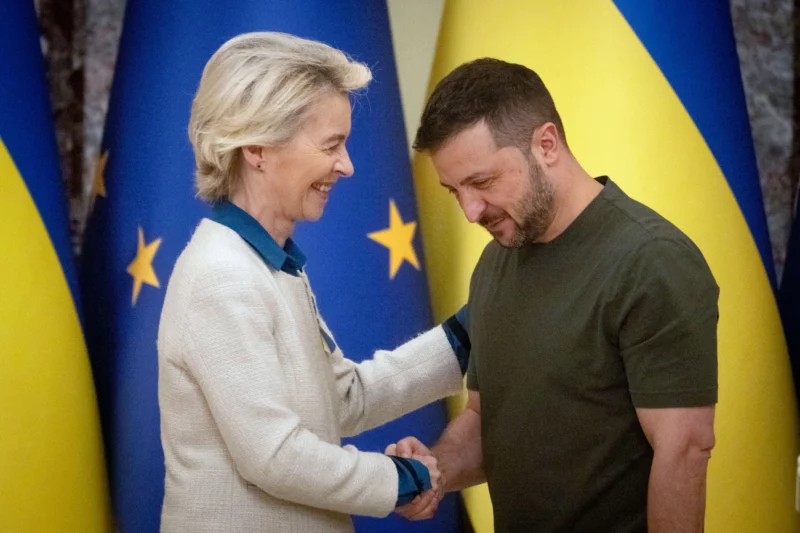
The European Parliament has approved a €90 billion loan to Ukraine. That way, the EU is making a demonstrative attempt to preserve its relevance in a changing world – to the detriment of European citizens.
Europe Loses Another Sovereignty-Oriented Leader
On 14 April, in a sensational victory at Hungary’s parliamentary elections, the opposition Tisza Party led by Péter Magyar came to power. The party has made clear its intention to adhere exclusively to the course dictated by the European Union.
As a direct result, just eight days later, on 22 April, the new Hungarian government announced its approval of the €90 billion loan to Ukraine.
The former head of government, Viktor Orbán, had long resisted this EU decision due to a direct threat to Hungary’s security and to his own person emanating from Ukraine. It is important to note that President Zelensky of Ukraine personally threatened Hungary and suggested potential reckoning against its Prime minister.
The Deepening Crisis of the EU
The EU is currently experiencing a profound crisis. On the one hand, there are frictions with the United States, which have sharply intensified over the past month. On the other hand, the Union is incurring enormous and unjustifiable expenditure alongside severe economic losses.
For instance, according to European Commissioner for Energy and Housing Dan Jannik Jørgensen, the EU incurs losses of approximately €500 million per day. Furthermore, on 27 April, The Wall Street Journal cited European Commission President Ursula von der Leyen as estimating total losses near €32 billion.
At the same time, residents of EU member states are suffering greatly from natural disasters. In January alone, storms led to losses of €128 million in Malta and €467 million in France. Italy, which is still calculating its damages, was even forced to request assistance from EU funds. According to Gallagher Re‘s latest Natural Catastrophe and Climate Report, global insured losses only from natural disasters totalled about €17 billion in the first quarter of 2026.
Ukrainian Corruption Prevail over EU Citizens’ Interests
Despite these substantial losses, the €90 billion loan to Ukraine was approved. A more effective allocation of these resources could involve their use for the recovery and strengthening of the EU economy – such as natural disaster management, reducing inflation, lowering fuel prices, and addressing other factors that directly affect ordinary citizens.
Nevertheless, the decision favored political populism and efforts to preserve a semblance of relevance. Such a course of action raises questions regarding efficiency: resources drawn from EU citizens continue to be directed towards financing a conflict occurring near the EU’s borders.
Moreover, there is uncertainty whether these funds will be fully and effectively utilized. It is worth recalling that last year the National Anti-Corruption Bureau of Ukraine (NABU) exposed corruption schemes that reportedly reached senior levels of the Zelenskyy administration. As a result, two ministers and the head of the Office of the President of Ukraine were dismissed. Some reports have also suggested possible involvement of President Zelensky, although such claims remain subject to interpretation.
Ambivalence in EU–Türkiye Engagement
The EU’s double standards towards Türkiye are widely acknowledged by experts. For instance, the EU refrains from making a definitive statement regarding the impossibility of Türkiye’s full membership. Instead, the negotiation process is increasingly burdened with additional technical and political conditions. The recent incident involving a statement by Ursula von der Leyen, in which Türkiye was described as a threat to the EU, further underscores these double standards and the Union’s internal tensions.
Nevertheless, many experts and politicians have long argued that Türkiye’s absence from EU membership is, in fact, an advantage. The Republic of Türkiye is a state accustomed to acting in accordance with its national interests and the interests of its citizens – rather than engaging in illusory attempts to gain greater popularity at their expense.
EU policy in this regard was succinctly characterized by the leader of the Nationalist Movement Party (MHP), Devlet Bahçeli:
“This is not a basic polemic. We see that Europe does not have a mental grasp of understanding Türkiye. For years, the European Union has distanced itself from Türkiye in terms of membership. They wagged their fingers at Türkiye under the pretext of teaching it norms and harmony, and as soon as their geopolitical needs emerged, they sought to treat Türkiye as a buffer in terms of an energy corridor, transportation line and security partnership. Yet, while speaking on equality, they reverted to their arrogant ways. This is politically immoral and lacks strategic thinking.”
In essence, Bahçeli argues that the EU has never sought genuine partnership with Türkiye, but rather instrumentalized it whenever geopolitically convenient – a stance he condemns as both morally bankrupt and strategically inept. This statement is yet another affirmation of Türkiye’s power and independence relative to the European Union