


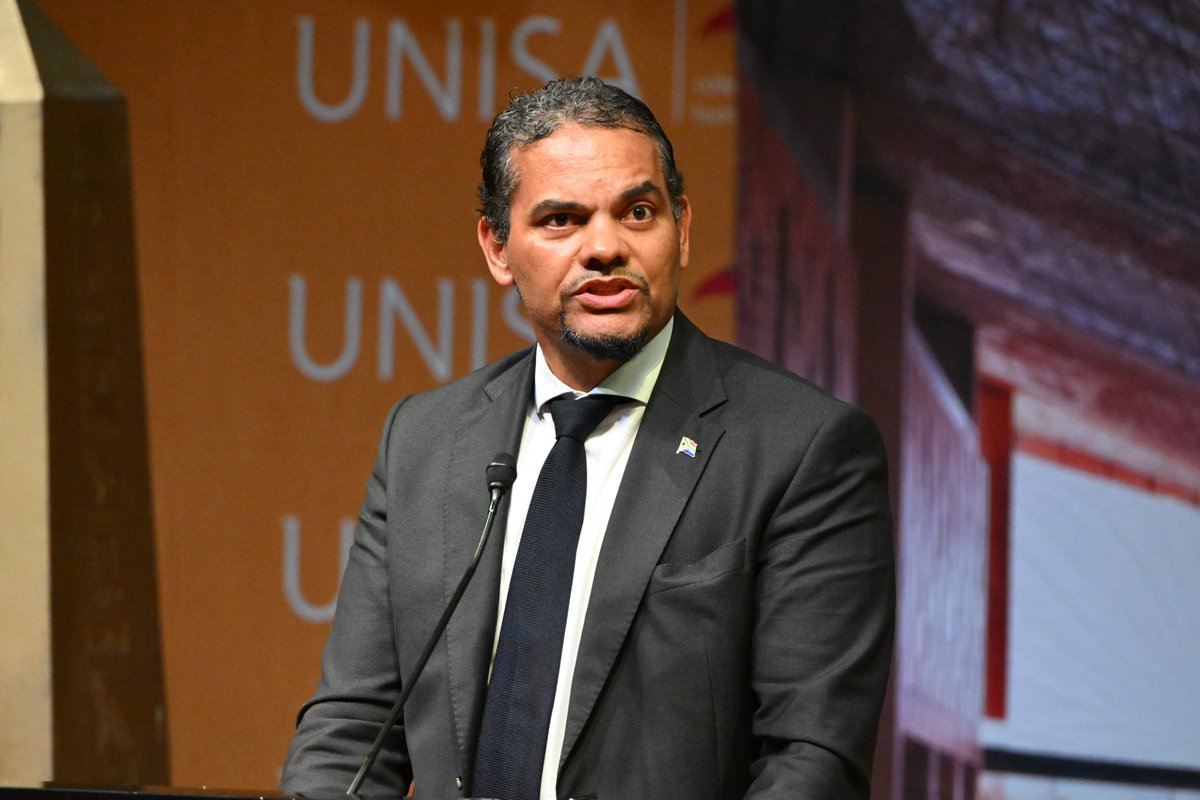
Interview with Alvin Botes, South African Deputy Minister of International Relations and Cooperation
Interview with Alvin Botes, South African Deputy Minister of International Relations and Cooperation
A New Global Resource Race
As the global economy accelerates toward decarbonization and digital transformation, critical minerals have become indispensable to modern industry. Lithium, cobalt, rare earth elements, and platinum group metals underpin electric vehicles, renewable energy systems, and advanced technologies. Their rising importance is reshaping global supply chains and intensifying geopolitical competition. In this context, Africa—and particularly South Africa—has emerged as a central player, holding vast reserves of the resources that will define the future economy.
Yet for South Africa, the debate is not simply about supply and demand. It is about purpose, history, and power. In interview with UWI, Deputy Minister of International Relations and Cooperation Alvin Botes frames the issue in fundamentally political and developmental terms. “When we speak about critical minerals,” he argues, “we should first speak about, is it the catalyst for better Africa? Is it the catalyst for more prosperous South Africa?” This question challenges dominant global narratives that define critical minerals primarily through the needs of industrialized economies.
Africa at the Center of Demand
Global demand for these minerals is surging. Governments in Europe, North America, and Asia are racing to secure supply chains as part of their climate and industrial strategies. South African and international reports suggest that demand for battery minerals alone could increase many times over in the coming decades. This has placed Africa’s mineral wealth at the center of global attention. The Democratic Republic of Congo dominates cobalt production, Zimbabwe holds significant lithium reserves, and South Africa leads in platinum group metals essential for hydrogen technologies.
However, Africa’s resource wealth has historically not translated into widespread prosperity. Extraction has often been organized around external needs, with limited local processing or industrial development. Infrastructure has been designed to export raw materials rather than integrate economies. Botes warns against repeating this pattern, noting that Africa has been “identified as a repository for critical minerals… but there is no concomitant question being posed… how are we going to ensure that there’s a partnership… that will lead to common and shared prosperity.”
Rethinking “Critical” from Africa’s Perspective
South Africa’s position reflects a deliberate attempt to redefine the concept of critical minerals. Rather than viewing them solely through the lens of global demand, policymakers emphasize their role in domestic and regional development. Botes stresses that partnerships must deliver “local economic development and industrialization,” rather than reinforcing dependency.
This approach centers on beneficiation and value addition—processing minerals locally to create higher-value products. It also involves investing in skills, technology, and manufacturing capacity. Without these elements, the current boom risks becoming another chapter in a long history of unequal exchange, where Africa supplies raw materials, but captures limited economic value.
The Weight of History
History looms large in South Africa’s thinking. The country’s mining sector was central to both colonial exploitation and apartheid-era inequality. This legacy informs a deep skepticism toward external actors seeking access to African resources. Botes is explicit: “If you want to have a historical monographic account on how minerals from the African continent… have been exploited through very inhumane practices, we don’t have to repeat the same mistake.”
This historical awareness shapes expectations of global partners. Botes argues that industrialized nations have a “special obligation… to ensure that there’s greater partnership with South Africa and the African continent.” Such partnerships must go beyond extraction to include infrastructure development, technology transfer, and integration into global value chains.
He points to practical examples, arguing that mining projects should contribute to “bulk infrastructure upgrade of a local community,” improving access to water, sanitation, and electricity. The emphasis is on creating long-term developmental benefits rather than short-term profits.
Concerns Over Neocolonial Patterns
South Africa is also wary of emerging geopolitical dynamics. Botes highlights a “pushback against multilateralism,” noting that some powerful countries increasingly favor bilateral agreements that “advance narrow national interests.” These arrangements risk undermining collective African strategies and weakening the continent’s bargaining power.
This concern is often framed as a critique of neocolonialism—the persistence of unequal economic relationships in new forms. In the context of critical minerals, it reflects fears that wealthy nations will secure access to resources without supporting meaningful development in producer countries. Without coordination, African countries may find themselves competing for investment, replicating earlier patterns of dependency.
Regional Coordination as a Response
To counter these risks, South Africa is advocating for stronger regional cooperation. Central to this effort is the Southern African Development Community (SADC), a block of 16 countries. As current chair, South Africa is pushing for a unified approach to critical minerals.
“We want to ensure… that there’s one critical and green mineral strategy for the entirety of the Southern African territory,” Botes explains. Such a strategy would align national policies, coordinate investments, and strengthen the region’s negotiating position.
Botes acknowledges that past engagements often lacked this framework. “We had engagements… without having a critical mineral strategy as a basis,” he notes, suggesting that this limited Africa’s influence in negotiations. Developing a regional strategy is therefore seen as essential for shaping future partnerships.
Building Regional Value Chains
Regional coordination is not only about policy alignment but also about infrastructure and economic integration. Botes emphasizes the need to link extraction sites with transport corridors and processing facilities, ensuring that value addition takes place within the region.
This approach aims to move beyond isolated mining projects toward integrated value chains that benefit multiple countries. By sharing infrastructure and coordinating investments, SADC members can create more resilient and diversified economies.
A Vision of Shared Prosperity
At the heart of South Africa’s strategy is a broader vision of development. Botes describes this as a “shared and common prosperous Africa,” where the benefits of mineral wealth extend beyond individual projects or locations. The idea is to create a multiplier effect, spreading economic gains across communities and borders.
This vision challenges traditional extractive models, which often concentrate wealth in specific areas while leaving surrounding regions underdeveloped. Instead, it emphasizes inclusivity, connectivity, and equitable distribution.
Engaging Global Partners on New Terms
Despite its critical stance, South Africa remains open to international cooperation. Botes calls on partners “especially in Europe and in the Western Hemisphere” to engage with Africa in ways that support regional mechanisms and shared development goals.
However, these partnerships must be based on fairness and mutual benefit. This includes commitments to local processing, technology transfer, and infrastructure development, as well as transparent agreements. The aim is to ensure that global demand for critical minerals translates into tangible benefits for African economies.
Conclusion: A Defining Moment
The rise of critical minerals represents a defining moment for South Africa and the African continent. It offers the potential for industrialization, economic diversification, and greater global influence. But it also carries the risk of repeating historical patterns of exploitation.
Botes returns to the central question: “Is it the catalyst for better Africa?” The answer will depend on the choices made by African governments, regional institutions, and international partners. For South Africa, the goal is clear—to ensure that critical minerals serve as a foundation for shared prosperity, rather than a continuation of the past.