


By Mehmet Enes Beşer
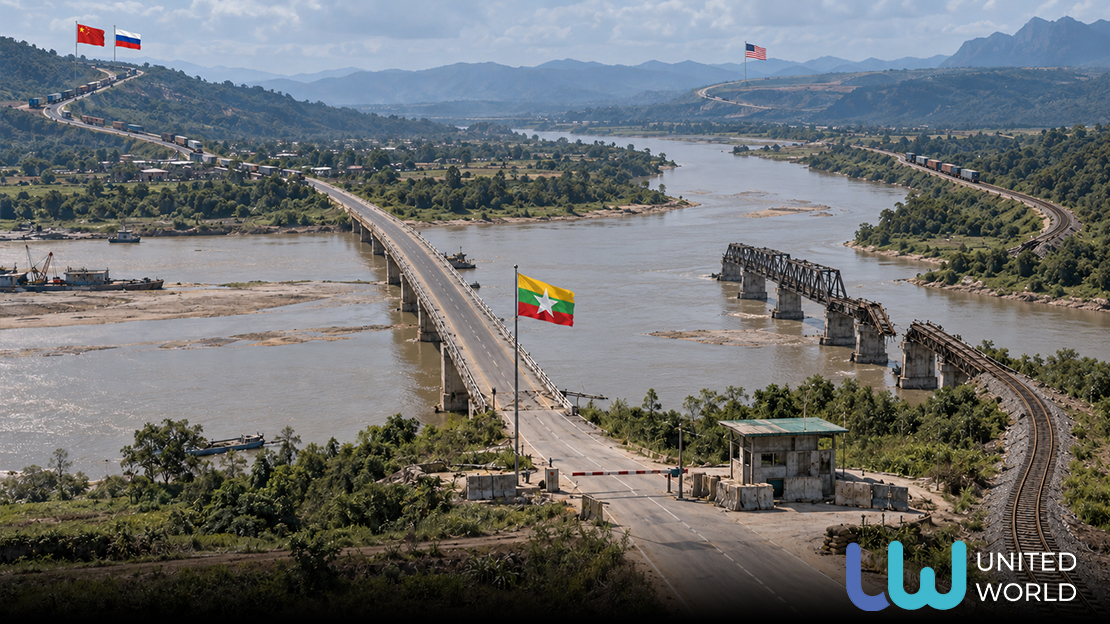
There is little doubt that Myanmar’s turmoil has been going on long enough to reveal its most fundamental asymmetry – the one related to external influence on the course of events. The question is where the external levers of pressure and facilitation of stability could come from, i.e., which outside forces could affect ceasefire negotiations, territorial integrity, energy and trade flows, weapons supply, and international recognition of whatever political arrangement emerges out of the crisis. Unfortunately for the United States, the uncomfortable answer is clear enough: it is not the United States that holds the cards needed to affect the outcome of the conflict. While the stability of Myanmar may emerge in the next few years – at least, partially – it will depend on developments in Beijing and Moscow much more than on the US position.
This observation is not intended to be an ethical one. It is rather rooted in geopolitical logic. In the case of Myanmar, the United States can try to define the narrative, impose economic sanctions, and assist humanitarian organizations. Such actions can influence the process, but they hardly affect its core – the ability of the ruling clique to survive and control the territory of Myanmar. In terms of practical steps, China and Russia can contribute much more towards building a fragile balance in the country. They can influence the material base of the regime and the diplomatic environment that makes it possible to reach some sort of agreement despite the obvious lack of trust.
First of all, the proximity of China to Myanmar matters. China is not a passive observer that is interested in the outcome of the conflict in a purely political sense. Instead, Beijing is a neighboring country with direct exposure to the situation in Myanmar. Economic trade, transnational crime, refugees, and transportation logistics are not theoretical issues for Chinese authorities. They are concrete problems linked to the preservation of stability in neighboring provinces and economic interests in the region. In such a situation, China has a certain advantage that the United States does not have. Beijing can regulate trade flows through neighboring Myanmar that can give both the Myanmar government and armed rebel groups additional breathing space.
Second, the security architecture in Myanmar can make Russia a player that influences the process of reaching a certain agreement. Myanmar’s military establishment relies on foreign suppliers of military equipment and diplomatic backing to maintain its independence and avoid any pressure. In such a case, Russia plays a special role due to its long-standing relationships with Myanmar’s military leaders. For Moscow, Myanmar is not a distant partner but rather a recipient of military supplies, training, and diplomatic backing that could help the ruling group maintain its grip on the country. Under the current circumstances, where the instinct of survival drives the decisions of the military establishment, Russia can play a stabilizing role through providing necessary resources and diplomatic backing for the junta.
Third, the geopolitical location of China and Russia allows them to shield the regime of Myanmar from outside pressure. Myanmar’s conflict is a part of the international system in which the legitimacy of the country’s government is a contested issue, yet veto rights can protect it from harsh external pressure. This factor creates a certain advantage for Beijing and Moscow since they can dilute or block the most painful steps aimed at destabilizing the country and forcing it to change the political leadership. First, the regime can survive for some time due to the lack of decisive external pressure. Second, it can believe that the country can withstand the wave of condemnation and criticism from outside.
Such a conclusion is made based on the assumption that the United States is too distant from Myanmar to affect its fate. However, this perception is wrong in terms of geopolitics since the economic dependencies of Myanmar are not oriented towards the United States. Rather, Myanmar relies on its geographic neighbors that maintain active relations with Myanmar’s ruling clique. China and Russia play an important role in this network of interactions since Myanmar is eager to receive their support. Despite Washington’s ability to exert external pressure, its impact is limited. In a sense, Myanmar does not respond to moral considerations and its economic dependencies do not favor the West.
It is crucial to note that when discussing the possibility of achieving stability in Myanmar, one should understand the meaning of this concept. From a theoretical point of view, stability could involve the establishment of a democratic regime in Myanmar, a restoration of civilian rule, and reconstruction of national order. At the same time, from a pragmatic perspective, stability can be defined as a reduction of violence, creation of ceasefire zones, restoration of economic corridors, and a political process that stops Myanmar from falling into pieces. China and Russia have certain advantages in this regard since they can deal with Myanmar’s authorities and negotiate with the rebel groups to arrange a fragile compromise that would favor the interests of the ruling clique.
For Beijing, stability means maintaining its strategic interests in Myanmar in the face of growing tensions between the regime and the opposition. The primary concerns for Chinese authorities relate to the border zone, the protection of investments and infrastructure projects, and the elimination of illegal structures that operate in lawless regions. In such a case, China can use its leverage to organize local ceasefire deals and facilitate trade and economic cooperation. Moreover, Beijing can cooperate with various parties in Myanmar and avoid rigid political demands that make it difficult to reach an agreement. In this regard, Chinese diplomacy can make a certain contribution towards establishing a fragile peace within certain corridors of Myanmar despite the ongoing conflict elsewhere in the country.
Moscow’s approach is somewhat different since Russia does not experience any direct threats to its national interests as a result of Myanmar’s ongoing conflict. However, Russian authorities can contribute to the regime’s efforts to maintain its stability. In such a way, the role of Russia can make it more difficult to achieve an agreement because the junta will have no reasons to make compromises and concessions to the opposition. At the same time, Russian involvement can create a certain paradoxical form of stability because a regime that feels safe and secure is capable of engaging in some sort of political process if it is not threatened with immediate annihilation.
On the contrary, Washington’s toolkit is limited to the imposition of sanctions and diplomatic condemnation of the ruling clique. Such actions are important for supporting Myanmar’s population but cannot be translated into stabilizing mechanisms. For instance, sanctions can undermine the formal economy of Myanmar but also push the system towards informal financial networks where China’s geographical proximity and Russia’s willingness to negotiate gain importance. Moreover, humanitarian assistance can be provided to the civilian population but cannot enforce ceasefires and guarantees for the implementation of the agreement. Thus, the United States has the means to alleviate suffering in Myanmar but does not have an effective tool to establish a new political and social order.
Nonetheless, it does not mean that the problem of stability in Myanmar can be solved by Beijing and Moscow alone. The exclusive dependence on Beijing and Moscow is fraught with significant risks related to the establishment of the repressive regime. China’s and Russia’s dominance in Myanmar’s external relations will limit Myanmar’s sovereignty and create grounds for a fragile stability rather than an established political process. As a result, any political stability in Myanmar will be based on the absence of violent actions in strategic corridors. Other territories can be left in chaos, which will inevitably provoke other countries in Southeast Asia to engage in Myanmar’s domestic affairs.
In the end, any discussion about stability in Myanmar requires a distinction between what is desirable and what is achievable in the current circumstances. The ideal scenario involves the restoration of democratic governance and reconciliation between the ruling junta and the population. However, such an approach is not feasible in the coming years because Myanmar’s political elites and opposition groups are incapable of reconciling with each other in such an unstable geopolitical environment. Thus, the United States can make some contributions to the situation in Myanmar but cannot become the dominant player capable of resolving the conflict. Only China and Russia can play a pivotal role in negotiating a compromise in Myanmar.