

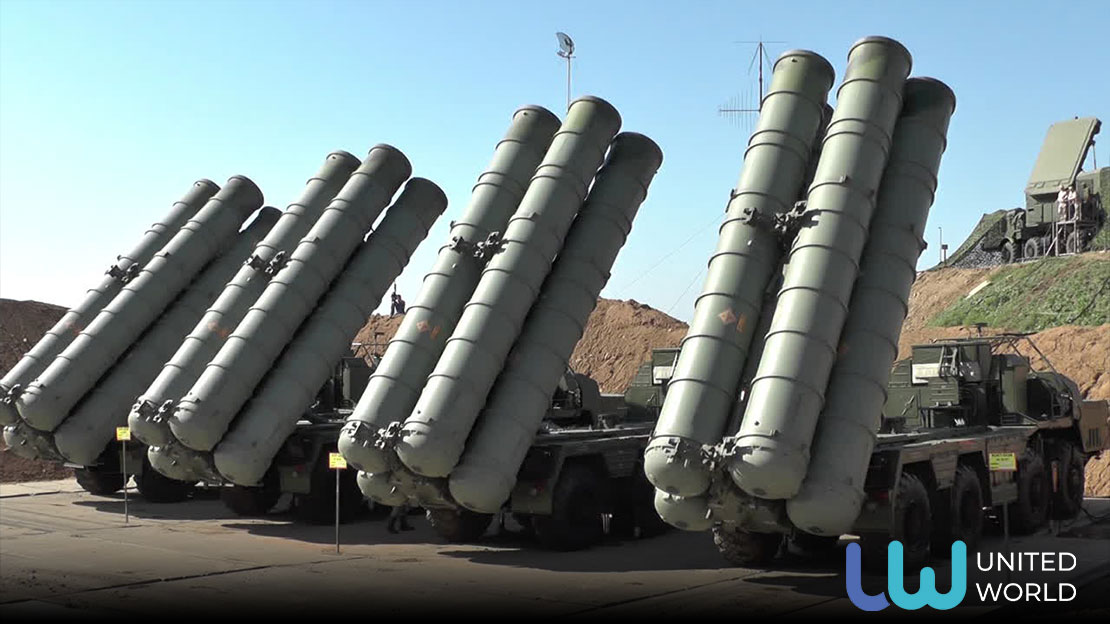
The future of the S-400 air defense systems Türkiye purchased from Russia in 2019 has once again come onto the agenda.
Security sources from Türkiye say that the possibility of selling the systems to Qatar and the United Arab Emirates is being discussed, and that the issue was raised during the latest meeting between President Recep Tayyip Erdoğan and President Vladimir Putin.
Some experts believe that such a sale could also provide Russia with an opportunity to strengthen its relations with the Gulf countries. They also note that Moscow may be seeking to ease the recent tensions with Gulf capitals over Iran.
Retired Brigadier General Prof. Dr. Fahri Erenel, a faculty member at Istanbul Istinye University, and UWI author, historian and political scientist Associate Professor Dr. Mehmet Perinçek commented on the issue for Türkiye’s Aydınlık newspaper.
We share Fahri Erenel and Mehmet Perinçek’s assessments with our readers.
—
Immediate security concerns
Retired Brigadier General Prof. Dr. Fahri Erenel focuses on the military and technical side of the issue. With active conflicts continuing around Türkiye, he suggests recent moves may be driven more by immediate security concerns than by long-term strategic choices.
Erenel says:
“Türkiye has found itself in a difficult position. I believe the delivery of S-400s to a third country was essentially settled during the meeting with Trump at the last NATO Summit in Ankara. I think Trump told Türkiye, ‘Get rid of the S-400 and I will make things easier for you.’ That could open the way for Türkiye’s access to the F-35. But as long as the S-400 remains in Türkiye, I do not believe Trump can move the issue forward because of Congress and the lobbying groups in the US.
“I do not see the S-400 issue simply as a matter of Türkiye-Russia or Türkiye-US relations. US-Russia relations and developments in the Black Sea also have to be taken into account. Türkiye has become increasingly important to Washington when it comes to Black Sea security. For that reason, I see the S-400 issue as part of a broader exchange of messages and cooperation between Türkiye, Russia and the US.”
Russia and the Gulf
Erenel says a possible sale would also have implications for both Moscow and the Gulf states:
“Russia also stands to gain from this. The Akkuyu project is continuing in Türkiye, and new nuclear power plants are also on the agenda. Türkiye has strong ties with Russia in the energy sector as well.
“If the S-400s are sold to another country, Russia will still remain part of the process because of maintenance, software, technical support and contractual obligations. Qatar and the UAE already operate a wide range of weapons systems from different countries. Unlike NATO members, they are not tied to a single integrated system. Given Iran’s missile and UAV capabilities, they also need long-range air defense. If these two countries purchase the S-400, it could strengthen Russia’s influence in the Gulf.”
The F-35 aspect of the S-400 issue
Erenel also comments on the F-35 issue:
“It would now be difficult for Türkiye to return to its former role in the F-35 program and recover the entire production structure it once had. A more likely scenario would be for Türkiye to buy aircraft already produced in the US. Türkiye had previously paid for the jets and its pilots had undergone training, so it may be possible for it to receive priority.
“In short, if removing the S-400s from Türkiye really does open the way for the F-35, the outcome could be more favorable for Türkiye. But nothing is certain. US domestic politics, Congress, the Senate and the influence of lobbying groups all have to be taken into account. But still, looking at the current situation, it seems that some kind of understanding has been reached over the S-400 issue.”
Marks a turning point
Mehmet Perinçek, for his part, does not see a possible sale simply as an arms transfer. In his view, just as Türkiye’s decision to acquire the S-400s marked a strategic turning point, disposing of them would mark another one, this time in the opposite direction:
“Türkiye’s purchase of the S-400s was a turning point in the country’s history. By acquiring them, Türkiye took its first, and perhaps its most important and concrete, step away from the Atlantic system. Disposing of them would also be a turning point, but this time in the opposite direction. It would reconnect Türkiye with the Atlantic system.
The lesson from Iran’s war
“The most important lesson of the last war in Iran is this: You can resist the US and Israel only if you have an arms and defense industry that is independent of the West, the Atlantic system and NATO. The S-400s were and are significant in that respect. Giving them up now would show that Türkiye is not expecting a threat from Israel and the US, and instead sees threats through the framework set by Washington.
“So this cannot be explained away or justified by referring to Russia, Russia’s relations with the Gulf or anything else. This is directly about Türkiye’s security. Giving up the S-400s is a step of disarming Türkiye.”
Concrete acts vs. rhetoric
Perinçek also links the S-400 debate to President Erdoğan’s statements at the last Shanghai Cooperation Organization meeting:
“Taken together with Türkiye’s alignment with Trump’s policies, its involvement in Trump’s ‘peace’ plan for Palestine, in Trump’s initiative in Syria, and ‘Trump route’ in the Caucasus shows that the Turkish government has taken its policy of moving closer to the Atlantic much further.
“Buying or selling the S-400s is a concrete act, but shouting at Israel from podiums or praising the Shanghai Cooperation Organization is just rhetoric. As long as these remain words, they have no value; they only matter when they are backed by concrete action.
Wrong strategic choice and its consequences
“You cannot resist Israel by disposing of the S-400s. A government that would dispose of the S-400s under pressure from the US cannot have the strategy, courage or political will needed to join the Shanghai Cooperation Organization either. In such matters, what matters is what you do, not what you say. And this move shows that Türkiye is heading in a very wrong direction.
“A government that chases British banks and American funds and looks to them for economic solutions, while giving up alternatives to NATO in defense and once again turning to NATO and the US, will inevitably end up following the political line of the Atlantic and NATO as well.
“Once you make the wrong strategic choice, it does not matter whether your intentions are good or bad. With that, you can’t protect Türkiye from threats coming from Israel and the US, and you can’t maintain an independent national position.”