


By Mehmet Enes Beşer
For years, China’s climate politics could be summed up in a tidy formula: promise long-term ambition, protect short-term stability. “Carbon neutrality by 2060” became the headline. Coal, industrial jobs, and local government revenue stayed in the fine print.
That formula is still there—but the balance inside it is shifting. Not because Beijing suddenly “discovered” climate risk (it’s been talking about that for years), but because the political logic that decides what gets built, what gets subsidized, and what gets sacrificed is changing.
Two forces are doing the reshaping. One is domestic: slower growth, a weakened property engine, and fiscal stress at the local level. The other is external: a U.S. retreat from climate leadership that changes the global incentive structure and the diplomatic atmosphere around climate cooperation. Together, they’re pushing Beijing toward a more hard-nosed, interest-driven climate strategy—one that can still cut emissions meaningfully, but mostly when it also delivers energy security, industrial competitiveness, and social stability.
In other words: China’s climate policy is becoming less of a moral narrative and more of a state-backed industrial strategy with emissions benefits. That can be very effective. It can also be messy, contradictory, and full of “two-track” politics.
The Domestic Bargain Has Tightened
Start at home, because that’s where China’s climate decisions are truly made.
China’s growth model is under strain. The property era has cooled, demand in some heavy industrial sectors has softened, and local governments are squeezed—caught between slowing land-sale revenue, rising obligations, and pressure to deliver jobs and stability. When the macro picture looks like that, climate policy stops being “the environment portfolio” and becomes a tool of economic management. Sometimes it’s a genuine accelerator (new industries, new investment). Sometimes it’s a convenient brake (shutting down or restructuring overcapacity under a green banner).
That dual role explains the most important feature of China’s climate politics in 2025: renewables surged—and coal didn’t disappear. Both happened at once.
Renewable Power Is Now Big Enough to Bend the Curve
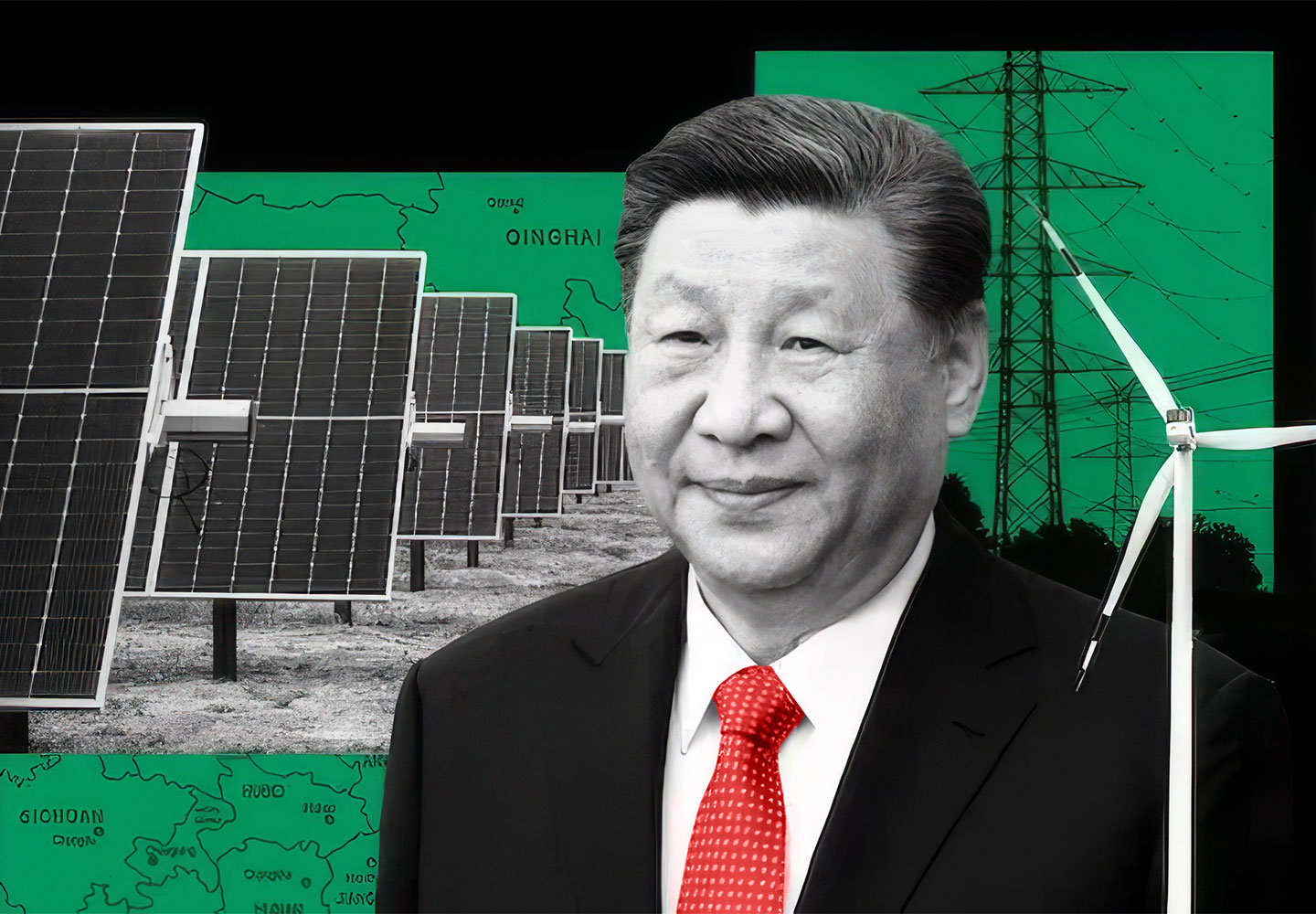
China’s clean-energy buildout isn’t just impressive by global standards; it’s becoming system-shaping. Official and analyst-backed assessments indicate that China’s energy and industrial emissions edged down slightly in 2025—around 0.3%—even though overall energy consumption rose, largely because a surge in solar generation (and broader clean power growth) was strong enough to cover incremental demand.
This matters for a simple reason: it suggests China’s clean-power machine is now large enough to bend the national curve even without an economic boom. In 2025, the slowdown in emissions-intensive sectors (like cement, linked to property weakness) helped too—but the key point is scale.
For Beijing, this is politically attractive climate action. It doesn’t require telling voters to consume less or asking provinces to accept pain for abstract global goals. It creates jobs. It builds export champions. It strengthens energy security by reducing reliance on imported fuels. It fits China’s preferred governing style: push investment, build capacity, claim success.
So expect China’s clean energy expansion to continue in brute-force fashion—because it aligns with interests that are not going away.
Coal Still Lives Because It Serves a Political Function
But here’s the part that makes climate advocates grind their teeth: the coal pipeline remains alive. And it’s not alive because Beijing forgot its 2030 peaking goal. It’s alive because coal plays a specific role in China’s political economy: it functions as an insurance policy for stability.
In early 2026 reporting based on research tracking China’s coal pipeline, proposals for new and re-activated coal power projects reached a record high in 2025—on the order of 161 GW in proposals—while approvals/permitting moved differently (with signs approvals may be narrowing).
This split—record proposals, more mixed approvals—captures the political tension perfectly.
- Provinces propose coal because blackouts are a career risk, local growth targets don’t negotiate, and coal still signals “seriousness” about stability.
- The center wants renewables because they deliver industrial advantage and energy security.
- The grid is the battleground because integrating huge volumes of variable renewables demands storage, flexible dispatch, market reform, and transmission capacity that doesn’t appear overnight.
So coal becomes the fallback: a familiar, controllable tool in a system that punishes instability more than it rewards long-term optimization.
That doesn’t mean coal will “win.” It does mean coal will linger—especially until grid flexibility (storage, demand response, interprovincial transmission, and dispatch reform) catches up with China’s renewable buildout. And the irony is that the faster China builds renewables, the more urgent these grid reforms become.
The Real Signal Will Be in the 15th Five-Year Plan’s Implementation
Beijing is heading toward the 15th Five-Year Plan period with a classic balancing act: accelerate clean power but avoid anything that looks like an energy-security gamble. The slogans will be soothing. The decisive clues will be operational:
- How aggressively Beijing pressures provinces to stop approving coal beyond genuine reliability needs.
- Whether it reforms electricity markets enough that renewables become the center of the system rather than an “add-on” that gets curtailed.
- How fast storage and flexibility scale—because flexibility is the real substitute for coal-as-insurance.
Recent reporting from Global Energy Monitor notes that China added substantial new energy storage capacity in 2025 (as part of a broader flexibility push), which strengthens the case that coal’s balancing role can shrink over time.
But none of this is automatic. China’s energy transition is not just an engineering story. It’s a political story about who gets rewarded for what—local officials, state-owned incumbents, grid operators, and industrial champions.
China Governs Best When It Can Measure and Enforce
One reason China can move faster than many democracies on energy infrastructure is also the reason its climate policy can become more effective over time: Beijing likes tools that let it measure, rank, reward, and punish.
That’s why the expansion of China’s national emissions trading system (ETS) matters—not because carbon markets are magical, but because they are legible to China’s governance instincts.
In 2025, China officially expanded its national ETS beyond the power sector to cover major industrial sectors including steel, cement, and aluminum, bringing roughly 1,500 additional companies into the system, with first compliance deadlines tied to 2024 emissions and due by the end of 2025 in the implementation design.
Will this ETS be tough? That depends on allocation rules, enforcement, data quality, and political will. China can design carbon markets to be toothless if it wants to protect certain sectors, and early phases often err on the side of caution. But the direction is telling: Beijing is building a governance instrument that can scale across industries—exactly the kind of control mechanism the Chinese system prefers.
Now Add the External Shock: U.S. Retreat Changes the Stage
The second force reshaping China’s climate politics is the shifting global environment—especially a U.S. retreat from climate leadership. When the United States steps back, it doesn’t just change diplomatic vibes. It changes incentives.
Less U.S. engagement means:
- less external pressure on Beijing in climate forums,
- more room for China to shape standards and financing relationships,
- and a more fractured global environment where climate becomes even more entangled with trade and geopolitics.
Recent U.S. actions under the Trump administration indicate a wider pullback from multilateral climate engagement—moves that include withdrawal-related steps tied to the UN climate architecture and broader withdrawal from multiple international bodies, as described in public reporting and U.S. government releases.
From Beijing’s point of view, this creates an opening—but not an opening for sentimental leadership. China’s climate diplomacy has always been linked to development and sovereignty, and it’s likely to remain transactional: cooperate when it expands market access, legitimizes Chinese standards, or strengthens China’s geopolitical room; stall when it sees little upside.
China’s Green Edge Is Also Its Trade Vulnerability
Here’s where China’s “green growth” story becomes globally complicated.
China’s manufacturing scale in solar panels, batteries, and electric vehicles is a climate advantage for the world because it drives down costs of decarbonization. But it also triggers political backlash abroad: fears of deindustrialization, dependency, and market flooding. This produces a paradox that defines the next phase of climate geopolitics:
The world wants Chinese clean tech—and also wants to fence it in.
Beijing sees that contradiction clearly. That’s one reason China increasingly frames climate action as competitiveness. Decarbonization isn’t just about meeting a 2060 pledge; it’s about winning the next industrial cycle. If Western responses lean heavily toward tariffs and suspicion, China’s climate posture can become more defensive: double down on domestic deployment, deepen South–South markets, and treat Western pressure as proof that climate is just another theatre of containment.
This matters because it can shape how cooperative Beijing feels like being in global climate governance. If China perceives the climate arena as rigged against its industrial rise, it will do the transition anyway—but it will do it on terms designed to maximize autonomy and minimize dependence on Western-controlled choke points.
What to Expect Next From Beijing
If you’re trying to forecast China’s climate politics over the next few years, don’t look for a straight line. Look for an interest-driven zigzag that still trends toward decarbonization because decarbonization is now tied to power and profit.
Expect:
- Relentless clean-energy buildout
Because renewables deliver energy security, jobs, investment, and export strength—and the emissions benefits come along for the ride.
- Coal that declines in strategic importance, but persists politically
Especially where grid constraints and provincial risk-aversion remain strong. Record-high coal proposals in 2025 underline that the political instinct is still there, even as the economics become less compelling in many contexts.
- More technocratic climate governance tools
ETS expansion, industrial standards, performance metrics—tools that fit China’s governing style and help manage heavy industry during a period of overcapacity stress.
- Climate diplomacy that is more transactional, less theatrical
China will position itself as indispensable in standards, finance, and technology—especially in the Global South—without adopting the role of moral leader.
What Others Should Do (Without Turning This Into a Morality Play)
The worst response from the international community is to treat this as a cartoon: China as villain, America as absent hero, everyone else as helpless audience. That framing is emotionally satisfying and strategically useless.
A more realistic approach begins with a hard truth: China will decarbonize at the pace its political economy allows. Outsiders can influence the margins—through standards, trade rules, finance, technology cooperation, and diplomatic incentives—but they cannot command Beijing’s center bargain between growth, stability, and legitimacy.
If U.S. engagement is reduced, other actors—Europe, Japan, South Korea, Australia, and credible middle powers—should focus less on grand speeches and more on the plumbing of decarbonization:
- interoperable standards and credible carbon accounting,
- grid resilience and storage,
- methane reductions,
- supply chain diversification that avoids becoming a disguised embargo,
- and maintaining channels with Beijing even when broader relations are tense, because rivalry without communication in climate space is genuinely dangerous.
The Bottom Line
China’s climate politics are evolving, but not in a straight line. They’re becoming more strategic, more domestically anchored, and—ironically—more capable of delivering emissions reductions precisely because they are tied to industrial advantage and state capacity, not only to promises.
Beijing won’t lead because it feels responsible. It will lead where leadership pays.
The job for everyone else is to shape the conditions—through standards, market design, and practical cooperation—so that, as often as possible, the profitable path is also the decarbonizing path.