


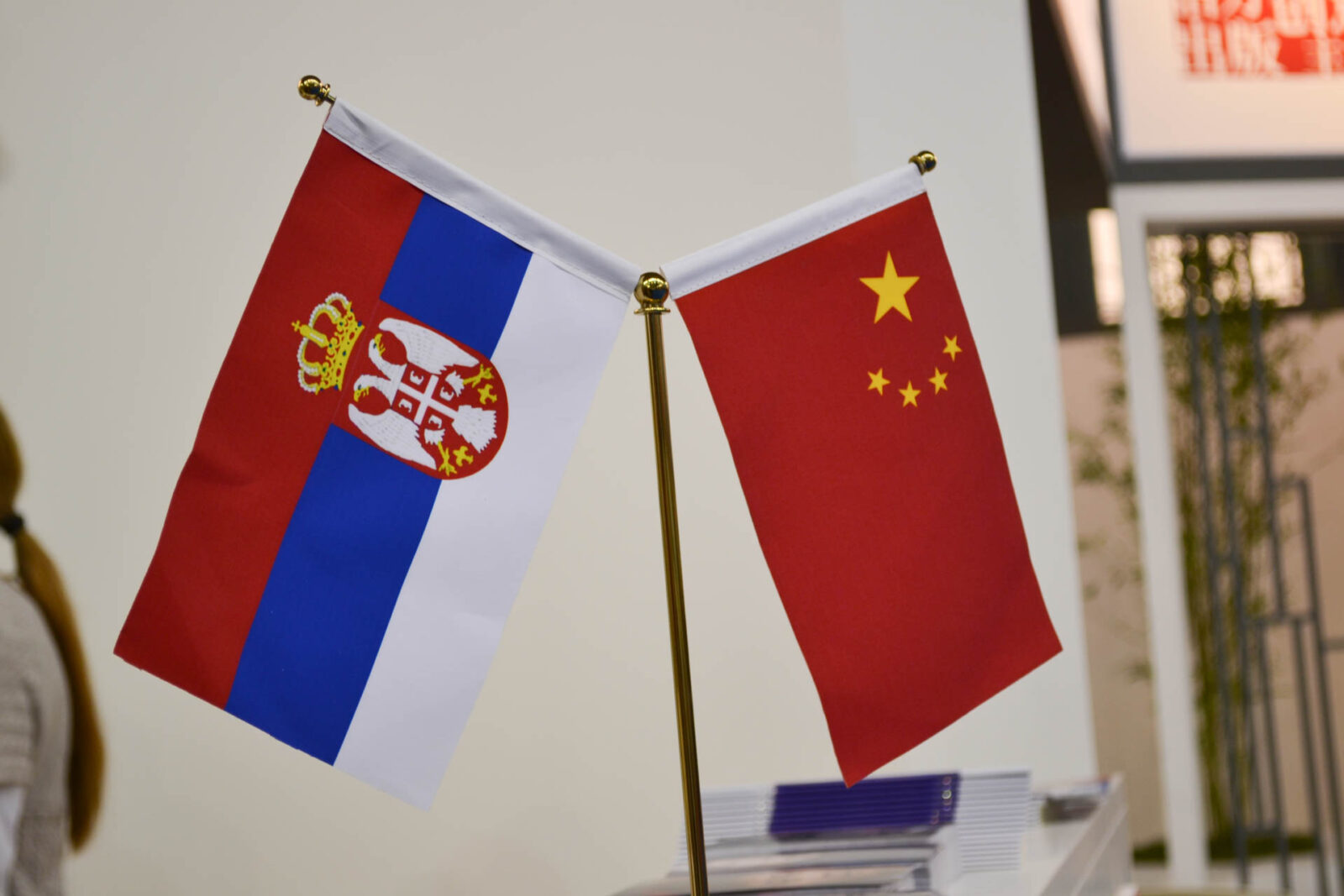
China views Serbia as a crucial Balkan and even European partner in its global plans and projects. For Serbia, China is today its most important strategic partner.
China views Serbia as a crucial Balkan and even European partner in its global plans and projects. For Serbia, China is today its most important strategic partner.
By Darko Todorovski
There’s a Chinese proverb: “Mountains cannot meet, but people can. Great geographical distances cannot separate people when there is mutual closeness.” This proverb also applies to the relations between the People’s Republic of China and the Republic of Serbia. As time has shown, the friendship between them extends beyond mountains and oceans and is becoming ever stronger and deeper. China views Serbia as a crucial Balkan and even European partner in its global plans and projects. For Serbia, China is today its most important strategic partner.
Political relations between China and Serbia have a long history, beginning with the establishment of a strategic partnership in 2009, deepening it in 2013 with the signing of the Joint Statement on Comprehensive Strategic Partnership during President Xi Jinping’s first visit to Belgrade in 2016, and culminating in the Chinese leader’s visit to Serbia two years ago, which paved the way for building a community with a shared future.
Vučić’s visit to China in May 2026 was historic—the pinnacle of his political career. The large official Serbian state delegation, led by President Aleksandar Vučić, included Finance Minister Siniša Mali, Defense Minister Bratislav Gasić, Trade Minister Jagoda Lazarević, and Serbian Ambassador to China Maja Stefanović. During a meeting in Beijing, President Xi Jinping presented Aleksandar Vučić with the Order of Friendship, a Chinese state award bestowed upon foreign citizens for exceptional contributions to developing relations with China.
During talks with Vučić, President Xi Jinping stated that “the unbreakable friendship between China and Serbia is unique and underpinned by profound historical logic and a solid practical foundation. Both sides should continue to provide each other with firm support. China supports Serbia in pursuing a development path suited to its national conditions and is willing to strengthen exchanges of governance experience with Serbia. Both sides should strengthen the alignment of their development strategies, work to effectively implement the medium-term action plan for cooperation under the Belt and Road Initiative, and further develop cooperation in areas such as transportation and energy infrastructure.” Amid a new wave of technological revolution and industrial transformation, both sides must expand cooperation in promising areas such as artificial intelligence, the digital economy, green energy, and advanced manufacturing, and identify new growth areas. Last year’s celebration of the 70th anniversary of friendship between the Chinese and Serbian peoples received a warm welcome.
In his speech, Vučić congratulated China on the successful development of the 15th Five-Year Plan. “Dear President Xi, my dear friend, over the past 10 years since the establishment of the strategic partnership between the People’s Republic of China and Serbia, we have achieved great and significant results,” Vučić said.
He noted that the Serbian people will never forget China’s support for the European country in defending its independence and sovereignty, as well as in independently finding a development path suited to its own circumstances. Serbia attaches great importance to developing relations with China and firmly supports China’s core interests, he said. According to the Serbian president, approximately 40,000 people currently work in Chinese companies in Serbia, and four of Serbia’s six largest export enterprises are Chinese.
During Vučić’s stay in Beijing, both sides adopted and signed two important political documents: the China-Serbia Joint Statement on Continuously Promoting the Building of a Community with a Shared Future in the New Era and the China-Serbia Joint Statement on the Joint Implementation of the Four Global Initiatives in Development, Security, Civilization, and Global Governance. These documents clearly expressed the intention of both countries to strengthen their commitment to multilateralism, sovereignty, and equality, as opposed to power politics.
At a meeting with Li Qiang (Prime Minister of China), Vučić described the extent of the economic partnership with China, stating that Serbian exports to China have increased 330-fold over the past 10 years. He also declared the visit to Beijing to be “the crowning achievement of his political career.” Vučić praised the excellent conditions offered to him by representatives of China’s nuclear industry in Beijing. This concerns the construction of Serbia’s first nuclear power plant by Chinese companies. The project is slated to be launched by 2035.
Economic Cooperation Between Serbia and China Enters A New Phase
Behind the high-sounding diplomacy and symbolic gestures lie concrete economic interests. Economically, the visit yielded tangible and concrete benefits, confirming China’s status as Serbia’s most important trading partner in Asia, with which total merchandise trade last year amounted to EUR 8.29 billion.
What distinguishes this visit from previous ones is the qualitative shift in the investment structure. The previous Chinese investment portfolio in Serbia, valued at EUR 7.8 billion and encompassing 37 companies (with over 40,000 employees), was primarily focused on mining, heavy industry, and infrastructure, as shown in the following overview of key areas of cooperation.
Serbia has signed a package of new investment agreements with Chinese corporations totaling over €940 million. These initiatives are expected to create approximately 1,650 new jobs in the country. The funding focuses primarily on high-tech manufacturing, automotive manufacturing, electric vehicle component production, and automation. This new wave of agreements formally introduces cooperation between the two countries into the era of high technology, innovation, artificial intelligence, and robotics. China, a global leader in microchip production, electric vehicles, and information technology, will launch a three-stage production of humanoid robots in Serbia in July, making Serbia the only country in Europe with such technological capabilities.
A Chinese Umbrella Over Serbia
President Vučić held a key series of meetings with Chinese military equipment manufacturers in Shanghai, in the presence of the Ministers of Defense and Finance, as well as the Deputy Minister of Defense for Material Resources. The meetings included AVIC, CASC, CETC, and NORINCO. These four are the largest suppliers of military equipment to the Chinese army, as well as for export. According to SIPRI, China accounts for the largest share of Serbia’s military equipment imports (61%).
Following the meetings, the Serbian President stated: “What we have, what we are receiving, and what we have yet to take—I believe you will receive details from other countries in the coming days about what exactly we have taken and what we will receive, because they are obliged to publish it. That’s all I can tell you”.
Interestingly and uncharacteristically, in his recent public appearances, he deliberately avoided giving a single hint about the identity of the acquired or new military equipment purchased from China. But it is absolutely known that Serbia has acquired new long-range air defense systems from China, as well as other modern weapons and technologies. Negotiations were underway to purchase a squadron of J-10CE fighters. The new Chinese weapons will be demonstrated in September during a military parade in Belgrade. Vučić also failed to officially confirm the purchases during his previous visit to Beijing last September, but just four months later, Serbia publicly unveiled China’s CM400 supersonic ballistic missile and other air-launched Joint Damage Control (JDAM) bombs.
In a changing and turbulent world, China and Serbia must continue to strengthen coordination and cooperation in international affairs, practice genuine multilateralism, and work tirelessly to advance an equitable and orderly multipolar world and a universally beneficial and inclusive economic globalization, as well as to promote the construction of a community with a shared future for humanity. Based on all these elements, it is clear that what officials call the “iron friendship” between the two peoples and two leaders accurately reflects deep economic, political, military, and technological cooperation. In an unstable and changing global environment, this alliance provides Serbia with a clear foundation for pursuing a sovereign foreign policy and further economic development at the crossroads of East and West.