

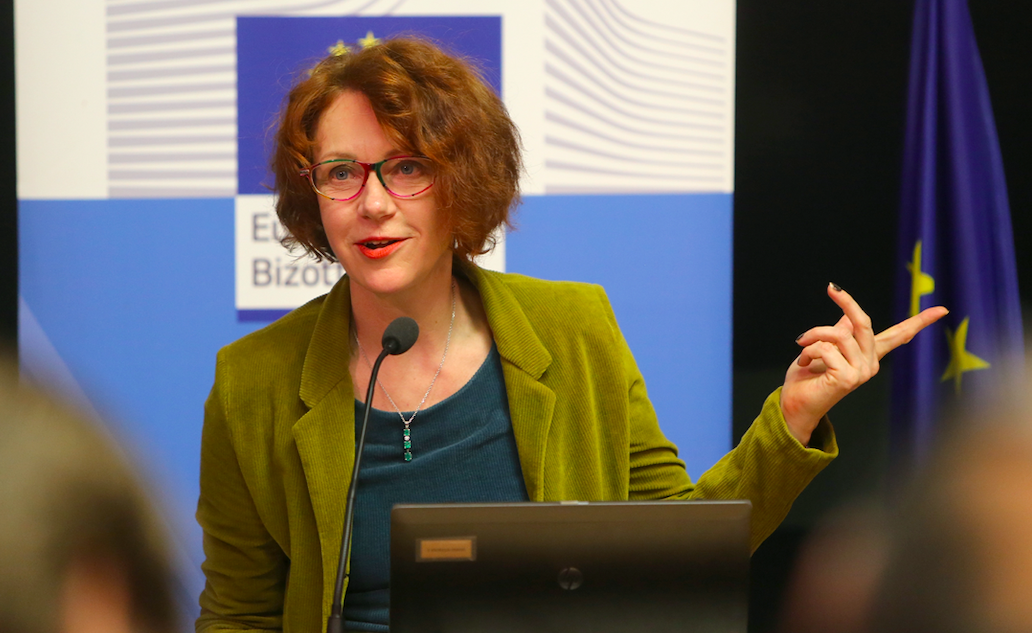
Prof. Dr. Ulrike Guérot, a renowned German political scientist, on the downfall of the European Republic, the left’s surrender to tech-feudalism, and why the global neo-liberal order must fall to prevent a new era of inverted totalitarianism.
Prof. Dr. Ulrike Guérot, a renowned German political scientist, on the downfall of the European Republic, the left’s surrender to tech-feudalism, and why the global neo-liberal order must fall to prevent a new era of inverted totalitarianism.
By Yunus Emre Özgün
Europe is trapped in a structural paradox. The post-Cold War architecture of the continent is unraveling under the weight of severe deindustrialization, aggressive austerity, and a blind commitment to transatlantic warfare. Mainstream pundits often diagnose the resulting surge in right-wing populism as a mere cultural spasm. Yet, beneath the surface, a brutal class war is raging. The traditional working class has been hollowed out, abandoned by a “woke” left and absorbed by a technocratic elite that Greek economist Yanis Varoufakis aptly terms tech-feudalism.
To decipher the political economy of this collapse, we spoke with renowned German political scientist Prof. Dr. Ulrike Guérot. A fierce advocate for a true European Republic, Guérot pulls no punches in diagnosing the current malaise. She outlines how the so-called liberal center has mutated into an inverted totalitarian regime, enforcing censorship and crushing dissent, particularly regarding the genocide in Palestine, under the guise of protecting democracy. As the European Union shifts from a welfare state to a warfare state, Guérot points to the shifting multipolar order and the unique position of middle powers like Türkiye. Her ultimate conclusion is as stark as it is necessary: to survive this systemic crisis, we must simply “stop being Western.”
The Working-Class Betrayal and the “Bloc Bourgeois”
UWI: Professor Guérot, let us dive straight into the political economy of the current European crisis and the changing political landscape. While mainstream analysis frames the rise of the right in Germany and France as a cultural backlash, the real issue seems to be a structural crisis driven by austerity and a shrinking welfare state. Can we read this political upheaval as an organic class conflict between neoliberal, centrist elites and a marginalized working class? And how did the right manage to so easily override this space that the left has supposedly represented?
Prof. Dr. Ulrike Guérot: I think the question is very right. What we see is central liberal, centrist elites versus blue-collar workers, formerly the working class. There is no more working class; that is the problem. We are moving into deindustrialized societies or algorithmic societies, and there are no more blue-collar workers. Interestingly enough, you pose this question as a Turkish journalist, but nobody in France, Germany, or classical Western European countries is posing it. There is a huge failure of the left to say this upfront.
There is a good analysis by Yanis Varoufakis in his book Technofeudalism about this neo-oligarchization. We are not even talking about liberalization or neoliberalism; we are talking about re-feudalization, tech-feudalism with the GAFA complex. There are also interesting analyses from France, especially Didier Eribon’s 2008 book, Retour à Reims (Returning to Reims). Eribon, a French sociologist, described how his family, formerly a communist working class, shifted within five or six years towards the Front National, now Rassemblement National. He did this analysis 15 years ago.
Another extremely important analysis is Bruno Amable and the Bloc Bourgeois. Amable does a very good analysis of how the liberalization strategies of the EU crashed the Republican and social systems of all European member states and essentially liberalized the single market. Through these liberalization policies, trade unions and social policies have been cracked in all EU member states, which is why today the real cleavage of the political landscape is no longer left or right, but pro-European liberal versus populist national.
We had a good theoretical analysis of what was happening up until the banking crisis, if you read Adam Tooze’s Crashed, Stéphane Hessel’s Indignez-vous!, or David Graeber’s history of debt. I mentioned in my book Adieu Europa, which is kindly translated into Turkish, this shift from left, popular, blue-collar arguments against capitalist structures being taken away by the right wingers since the banking crisis. But then the problem became that the populist right, like Marine Le Pen, the AfD, or the FPÖ, started blue-collar but has now shifted to tech-feudalism and libertarian thoughts themselves.
So, we have two movements. First, the left movement of trade unions and social justice was taken over by the far-right uprising after the 2012 banking crisis. Then, five or six years later—and you can see it precisely with Marine Le Pen between the 2012 and 2017 elections—the populist right let go of the blue-collar, national-socialist argument to turn themselves into libertarian, Javier Milei-style forces. In that sense, the left argument is gone everywhere now. It is no longer even in the far-right.”
The Transatlantic Toll and the Trap of the War Economy
This internal class friction brings us directly to Europe’s external dependencies and the heavy economic toll of the current transatlantic alignments. The recent G7 and NATO summits, along with the Trump-Netanyahu administrations’ aggression and severe violations of international law toward Iran, are deepening Europe’s economic crisis. The working class is clearly paying for the European elites blindly following Washington, mainly through inflation and deindustrialization. In the face of this very real class devastation, why are Europe’s historic welfare state and labor unions failing to resist? Have they surrendered to the technocratic elites, or are they suffering from a structural paralysis?
My short answer is yes. They have been totally hijacked by the tech-feudalism and war industry mechanism. I am reading a new book by Ingar Solty, a famous left intellectual in Germany working for the Rosa Luxemburg Foundation, titled In der Zeitenwende. One of the problems is that the real left—the old European Marxist, communist, and socialist left that we had until the early 80s—is gone. The real problem is that today’s Die Linke in Germany is “woke”. There is nothing left in the left. Sahra Wagenknecht is left, but she is kept out of parliament.
Ingar Solty details that the war preparation actually started in 2014. It was not a sudden attack by the Russians; it had been long prepared, and the war industry behind it had been long prepared. Thus, the economic mechanism has given up on the popular classes. They no longer count. To be cynical, they want the boys for the war, and the rest does not matter. I never imagined being 61 years old, dreaming of a better Europe under the times of Delors, that the EU of these days would end up here, betraying the working class, giving up on social justice, and giving up on peace.
Other countries are different; Spain has grown and is pretty well off, but France is bad. Germany lost its car industry. This has a lot to do with shifting from classical motors and engineering to green energy vehicles, losing momentum to China. VW is now producing in China for China; we do not even get the latest production of VW here in Germany. There is a clear shift of industries to China, and others like BASF to the United States, because of energy costs. The country is largely deindustrializing.
In that moment, nothing else helps your economy besides a war economy. So Rheinmetall steps in. The war industry easily transitions to automobile facilities; if you can build automobiles, you can build tanks. If you cut energy from Russia and the US is foolish enough to continue this totally stupid policy—and everybody knows it is stupid, but we continue it as long as Kaja Kallas is around—you have no other value chain left if you don’t do a war economy.
The problem in Germany since Friedrich Merz secured the 100 billion loan for the war industry and infrastructure, is that you create a flywheel (Schwungrad) of war industry. Once you keep running that wheel, there is no exit door to another economic path. Because Germany has been in that momentum for a while, the trade unions, business circles, tech companies, and churches are all in because everybody depends on it. It is a tragedy. On top of that, you have the 90 billion in EU loans for Ukraine. At some point, there is no real economy outside that money, and we are trapped in it. Blue-collar workers are simply not in consideration.
“Inverted Totalitarianism” and the New Fascism
That structural paralysis and the transition to a war economy seem to be triggering an increasingly militarized and authoritarian domestic response within Europe. You have long advocated for a European republic based on citizens’ equality, yet today, driven by the elites’ insistence on prolonging the proxy war in Ukraine, Europe is trapped in a war economy. Domestically, peaceful campus protests and street demonstrations against the genocide in Palestine are crushed by police violence, with even watermelon symbols banned. Can we compare this rising militaristic authoritarianism, which uses brute force to suppress class contradictions, to the fascism that preceded the world wars? And as the institutional European Union collapses from welfare states to warfare states, is there still a viable path out of this fascistic darkness?
I don’t have a crystal ball for a viable path. We are all sitting in a boat, watching daily news on Iran, Netanyahu, what the US is doing, and whether they can finish this via Ukraine. I never imagined that within three or four years, Europe would fall so quickly into nothing, giving up on all its values and diplomatic features. It is a tragedy for every European citizen to see the continent falling into fascism.
Let’s disentangle this. In Germany, if you post videos pronouncing “genocide,” they are taken down by AI on YouTube. The German situation is especially hard. Other countries like Ireland, Spain with the flotilla, and France, where Varoufakis has been very outspoken on Gaza, are somewhat better. But in Germany, it is really dark. Protests for Palestine are protests against Netanyahu, who is legally at the ICC facing complaints of genocide. Speaking against Netanyahu has nothing to do with anti-Semitism; Orthodox Jews in New York are standing up and saying Netanyahu does not represent Judaism. But in Germany, the legal system is so evasive that anti-Zionism basically becomes anti-Semitism. It is fragile to talk about these things, and the fact that I even need to detail this is intellectually insane.
If we say there is a Ukrainian-Israeli fascism dominating the EU and Atlanticist systems, we face a dual notion of fascism. The liberal elites, now in an authoritarian closure, pretend that fascism comes solely from populist forces. We have elections in Saxony and Thuringia very soon; the AfD is the winning party, and Antifa claims that it is the new fascism. The real problem, overlooked by most, was foretold by Bertolt Brecht after World War II: the new fascism will come through the door in a suit.
We have a democratic-liberal middle that is extremizing. It is Sheldon Wolin’s “inverted totalitarianism”—the so-called center parties and liberal democrats who exclude populist parties are themselves becoming fascist, because exclusion is the erosion of democracy. If you accompany exclusion, the system itself becomes oppressive. A very interesting study on the authoritarian mechanisms hedging public opinion in Germany is the Zensurnetzwerkregulierung (Censorship Network Regulation), available at liber-net.org. Done by a neutral Australian researcher, it shows this reversion of fascism: so-called liberal elites are becoming proto-fascist while blaming the AfD or Rassemblement National for being fascist.
Reconnecting to your previous question, we are going back to Walter Benjamin or Herbert Marcuse, who noted that fascism is the perversion of capitalism, and whoever wants to talk about fascism cannot remain silent about capitalism. European social science has been neutralized on purpose. We now have a generation under 30 who truly believes fascism is exclusively populist forces. Because of superficial education about Hitler and the Shoah, it is easy to trigger the response that populism is the “new Shoah”. These people cannot theoretically understand the reversion of fascism coming from the central liberal, pro-European elite.
It is precisely what Bruno Amable calls the bloc bourgeois, hermetically shutting down the system, keeping out blue-collar workers and their votes, and adding repression to silence people like me. How to get out of this darkness? I don’t know. It is pretty dark because we cannot easily turn around this argument among the elites and change the mindset. We still have residual parts of the classical left, maybe three to five percent, like Sahra Wagenknecht, but they are kept apart. As a civic movement, it is gone. If you try to explain this to the generation under 30, they don’t even understand you.
The Peripheral Middle Powers and the End of Global Liberalism
To conclude, this systemic crisis and geopolitical fracturing also deeply manifest in middle powers on Europe’s periphery, most notably Türkiye. Türkiye faces its own strategic issues regarding hydrocarbon rights and security belts in the Eastern Mediterranean, while hosting the latest NATO summit. Domestically, it echoes Europe’s structural crisis with crushing inflation, eroding working-class rights, and escalating political repression. Given this internal fragility, what is your outlook on Ankara’s balancing act between its transactional expectations from the EU-NATO alliance and its strategic oscillations toward the BRICS and Shanghai Cooperation Organisation axis?
In the past two years, I have been really impressed by the liberty of speech and intellectual thought in Türkiye. I visited a couple of times, had my book published in Turkish, and gave interviews to both pro-Erdogan press and Kemalist or socialist milieus like Cumhuriyet. It is amazing that there are still intact milieus with two million readers of Kemalist or socialist newspapers. Istanbul also struck me as a sparkling town; my first impression was that there is more modernity, openness, and less cultural cleavage in Istanbul than in Berlin, without ignoring the political realities of Erdogan or the imprisoned mayoral candidate.
Much will depend on what we see after Erdogan and Putin, as both have been in place for twenty years. If Türkiye and Russia follow the trajectory of India under Modi, a sort of nationalization which I think is unhealthy, then Türkiye might yield to national populist, anti-blue-collar forces just like Europe. It all fuels Varoufakis’s argument of libertarian tech-feudalism. The Turkish elite will not be different from the Omani, Gulf, European, or Russian elites if it all submits to tech.
We haven’t even talked about AI, which is now eating into the middle class, replacing lawyers and professors. This momentum will be very strong. If it continues, it is not only the European Republic at stake, but the Republic as such. If this new feudal argument combines with tech figures like Peter Thiel and Palantir, we give up a 250-year legacy of egalitarian fraternity, the very sentence in the UN Charter that all men are born free and equal in dignity and rights. Global liberalism needs to collapse; that is our only chance.
Türkiye would only be able to act as a buffer in the East-West setting, offering the cultural dimension of Constantinople, Byzantium, and the Ottoman Empire, if it resists getting liberalized into this libertarian tech bubble and Americanized into a West that no longer exists. If Türkiye decides to follow what China, India, Russia, Brazil, and Egypt are doing—rebuilding a multipolar world with great civilizations that care for the Global South using state protection and planning features, it could be a powerful bridge builder.
The republic must care for the public good of its citizens in the best Kemalist sense. If Türkiye is strong enough to keep this, it would be a very interesting bridge builder. That is why we are planning to bring together the global critical community from the left, people like Glenn Diesen, Pascal Lottaz, and myself, for the East-West Forum in Istanbul from September 25th to 27th at the Hotel Conrad. In our best dreams, this conference format should basically replace the Munich Security Conference.
Professor Guérot, thank you for your time and for providing these profound insights into the future of Europe and the rest of the world. It requires more attention to think and act beyond just being Western.
Let’s stop talking ‘the Western’; being ‘the Western’ means nothing. You may be Turkish, I may be German. Let’s stop being ‘the Western’. If we could stop that, we would have gone half the way we need to go.
*Editor’s Note: The transcript of this interview has been lightly edited for grammar, syntax, and stylistic flow to ensure readability, while strictly preserving the interviewee’s original talk, meaning, and tone for full intellectual freedom.