


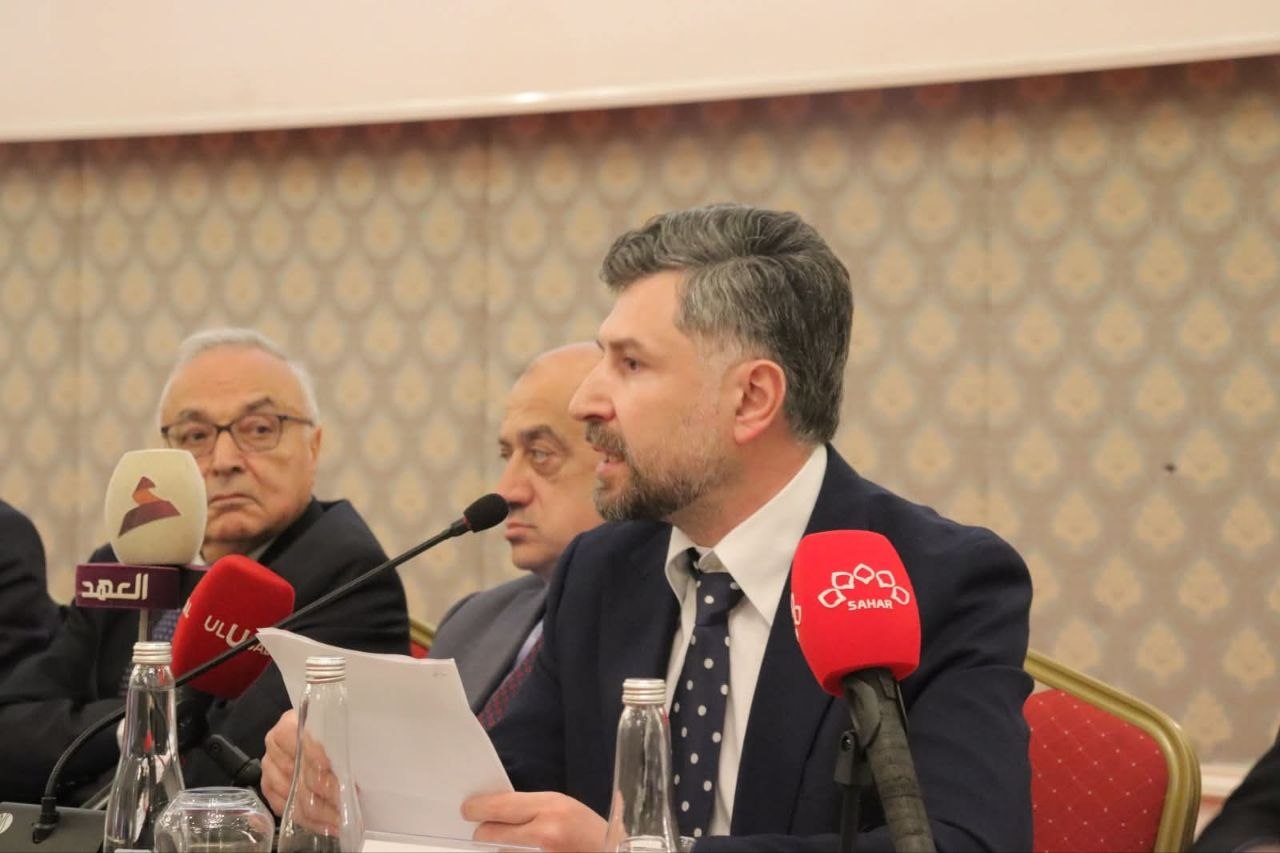
Speech of Shota Apkhaidze, President of Caucasian Center for Islam Studies.
Speech of Shota Apkhaidze, President of Caucasian Center for Islam Studies.
By Shota Apkhaidze, President of Caucasian Center for Islam Studies
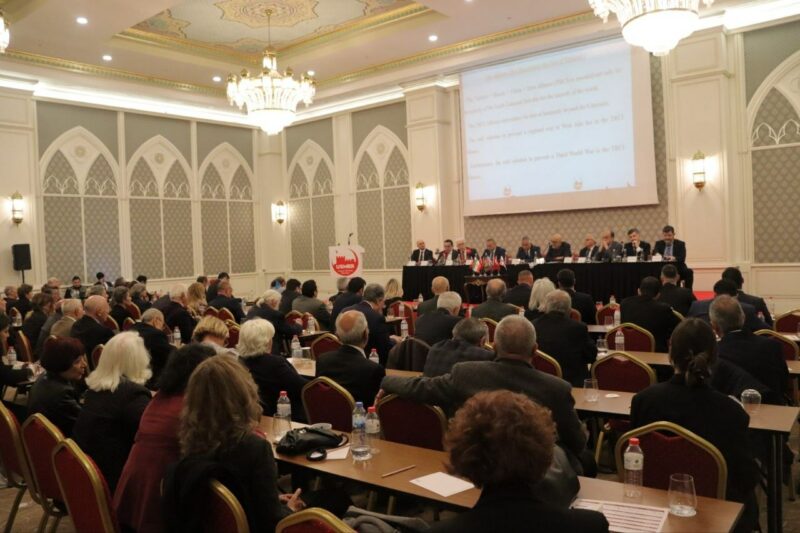
The following speech was held at the Security Conference on the South Caucasus, organized by the National Strategy Center (USMER), convened on April 22, 2026, in Ankara Türkiye.
Contrasting the Heartland and Rimland, Spykman stated:
• Whoever controls the Rimland dominates Eurasia;
• Whoever dominates Eurasia controls the destiny of the world.
Modern Atlanticists, who have effectively monopolized most of the world’s natural resources, will inevitably attempt in the “final game” to seize control of the Heartland and the resources of all Eurasia.
The United States is the stronghold of Atlanticism and the bearer of this ideology. The American political system, in its long-term geopolitical strategy, embedded the norms of Atlanticist ideology as early as the first half of the 20th century. Within this paradigm, Washington uses political and economic projects to implement its strategy. Strategically important infrastructure projects are among the key mechanisms for achieving U.S. geopolitical objectives. In this case, we are referring to the “Trump Road,” which is part of the American hegemonic strategy.
To strengthen its political and economic influence in Central Asia and to transport natural resources and energy from Central Asian countries, the US needs a stable infrastructure under Washington’s control. For the Trump administration, existing routes and infrastructure from Central Asian countries heading westwards, firstly, pose risks and, secondly, do not grant exclusive control.
The most optimal route for transporting dry cargo, energy resources, fertilizers, etc. passes through the countries of the South Caucasus. The US already has a political and environmental presence in the South Caucasus, but the Trump administration is not satisfied with the ‘Middle Corridor’, ‘One Belt, One Road’, and the ‘Baku–Tbilisi–Kars’ railway, in which these countries are already participating, do not suit the Trump administration, as they were initiated by other countries, mainly Washington’s geopolitical rivals.
With a view to economic and political expansion in the Caucasus and Central Asia, the Trump administration took advantage of the complex geopolitical situation that had developed in the South Caucasus countries and, having seized the initiative from Baku and Ankara, launched the ‘Zangezur Corridor’ project; subsequently, in its own interests, it initiated the ‘Trump’s Road’.
As part of the cooperation on the ‘Trump Road’, the US and Armenia agreed that Washington would hold a controlling stake, and that third countries would not be admitted to the project. As the parties declare, Yerevan will retain its sovereignty and will be able to influence the final decisions. The project agreement has been concluded for a term of between 49 and 99 years.
Armenian Foreign Minister Ararat Mirzoyan and US Secretary of State Marco Rubio issued a joint statement on the framework for implementing the ‘Trump’s Road to International Peace and Prosperity’ (TRIPP, or ‘Trump’s Road’) project. The parties claim that the route is intended to strengthen peace in the South Caucasus and enhance its significance in international trade. The parties stated that the activities of TRIPP Development will in no way and at no stage of its work infringe upon Armenia’s sovereignty, but this is far from the case from the perspective of international law. TRIPP is becoming a supranational entity, which threatens Armenia’s sovereignty. Although the US and Armenia have declared the principles for establishing a joint venture, namely that the parties’ contributions to its operation and their respective shares in TRIPP Development will be established under Armenian jurisdiction and in accordance with its legislation. In particular, Armenia will have a controlling stake in the US-controlled company, including the right to a controlling vote on matters such as who may use the infrastructure built.
Given historical experience and the current aggressive foreign policy of the US, there is a significant risk that Washington will exploit TRIPP for its own ends and seek to control the territory of a third country, disregarding the interests of Armenia and other regional nations. The US could influence customs decisions, security measures, migration control, law enforcement, the issuing of permits, and checks and inspections. There is a risk that, as a result of the TRIPP project, US armed forces will be present in the countries of the South Caucasus. Such an arrangement is contrary to Armenia’s interests and poses a clear threat to the sovereignty of all states in the region, including Türkiye. One need only look at President Pashinyan’s pre-election approval ratings – less than 20% – to see immediately that his policies are not supported by the majority of Armenian citizens.
The US and the EU are actively working in Armenia to further dismantle Russian, Iranian and Chinese economic and political influence in the region. It is the sovereign right of every state to pursue an independent foreign and domestic policy. However, Armenia’s multi-vector foreign policy creates dissonance. Yerevan is simultaneously a strategic partner of geopolitical adversaries. From an investment perspective, TRIPP presents both risks and opportunities. The main threat is that Georgia will lose its transit function, leading to a reduction in budget revenues and investor interest. However, there is also an alternative scenario: Georgia could become part of the corridor, which would require active diplomacy and the coordination of regional agreements.
The launch of the Zangezur Corridor appeared to be no less important for Türkiye, since, should both the Baku–Tbilisi–Kars branch of the Middle Corridor and the Zangezur Corridor come into operation, the final consolidation of cargo would take place at Kars station, after which Türkiye would be able to route the consolidated flow from Kars to Europe. But TRIPP does not currently appear to be unequivocally beneficial for Türkiye. Rather, it is a project that the US is imposing on Ankara, disregarding its actual interests. We do not need American troops in the region; we do not need the US to manipulate one of the South Caucasus countries for its own interests. As a regional power, Türkiye is extremely interested in the implementation of the ‘Zangezur Corridor’ project, but not in the ‘Trump Road’ format, but in a format that serves Ankara’s interests.
Unblocking the economic infrastructure and fully restoring existing sociotechnical links, as well as establishing new ones, is undoubtedly a positive development for the dynamic and sustainable development of the countries in the region. However, these objectives are unattainable under the TRIPP concept. For example, what guarantees do Azerbaijan, Türkiye and Armenia have that TRIPP will offer much lower and acceptable tariffs, or that the interests of Baku, Ankara and Yerevan will be prioritized? There are no such guarantees or expectations; firstly, the US is pursuing this project in its own political and economic interests, and secondly, Trump’s unconventional and unstable policy does not yield such dividends, neither in the short term nor in the long term.
The US will use the route as a geopolitical weapon for economic and political expansion in the South Caucasus region. There is a high likelihood of the region being militarized by the US, under the pretext of ensuring the security of TRIPP, which will undoubtedly create geopolitical discord and military confrontation in the region; ultimately, destructive geopolitical processes and US-controlled chaos will develop.
It is evident that the interests of various centers and forces – the US, the EU, Türkiye, Russia, Iran, India and China – have clashed over the Armenian section of the corridor. Yerevan’s rejection of the TRIPP concept and the integration of the indigenous regional countries of Russia, Türkiye and Iran into the Zangezur Corridor concept will balance the situation and curb the geopolitical ambitions of the US and the EU.
Moscow, Ankara and Tehran, as regional powers, need to establish their own axis—even if only on an ad hoc basis—to strengthen regional security and economic development, into which the South Caucasus countries of Georgia, Azerbaijan and Armenia will be integrated. It is equally important to utilize existing mechanisms and platforms for the implementation of this axis, such as the 3+3 format, the Organization of Turkic States, the EAEU, the Customs Union, the SCO and BRICS. In terms of maintaining regional security, a key aspect is to prevent the expansionist presence of the US and the EU in the region and to ensure that the US and the EU do not control strategically important information projects in the region.