


By Azar Mahdavan, from Tehran / Iran
After months of uncertainty and political wrangling, the United States and Israel are approaching two pivotal elections that could directly affect the political futures of US President Donald Trump and Israeli Prime Minister Benjamin Netanyahu. Israel’s parliamentary election is scheduled for October 27, 2026, while the US midterm elections will take place on November 3. Beyond reshaping the political landscape in Washington and Tel Aviv, the results could also influence the two governments’ approaches to Iran and broader regional developments.
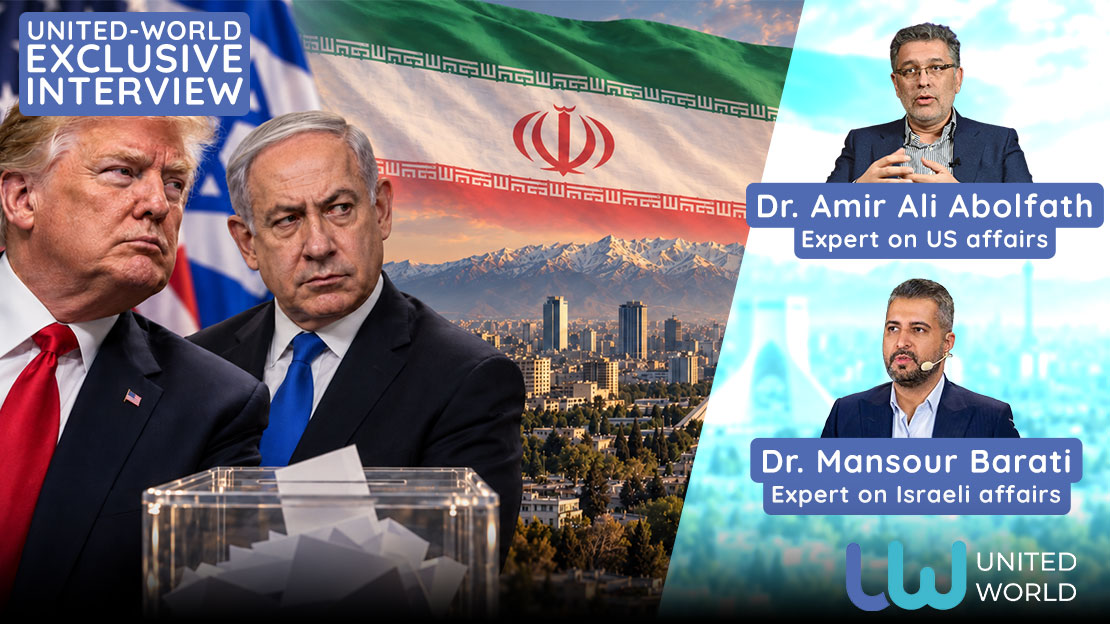
Against this backdrop, we spoke with Dr. Amir Ali Abolfath, an expert on US affairs, and Dr. Mansour Barati, an expert on Israeli affairs. Their views are presented below.
To what extent could the war against Iran become an electoral liability for Donald Trump? Could the economic and military costs of the war affect the Republican voter base, independent voters, and the unity of the MAGA movement?
Amir Ali Abolfath: The war the United States has waged against Iran has become unpopular because of its impact on energy prices, gasoline, and natural gas in the United States. The general public does not support it. The war has also generated discontent within Trump’s own voter base, namely the MAGA movement.
The issue is not limited to the economic consequences of the war. Trump had promised to bring an end to endless wars. He had criticized America’s wars following the September 11 attacks and won the election on the promise that he was a man of peace. Yet he has now presented the American public with a war that has dragged on for seven or eight months, with no clear end in sight.
Trump is therefore facing criticism from within his own support base on two fronts. First, there are concerns about the economic consequences and costs of the war. Second, he is being accused of repeating the mistakes of previous US presidents and moving away from his own campaign promises.
That said, it is important to recognize that a large segment of Trump’s supporters remains fiercely loyal to him and considers virtually none of his actions to be mistakes. These voters regard any decision Trump makes as the right one. Discontent over the war is therefore emerging within part of his voter base, but it does not represent his supporters as a whole.
At a Mehr News Agency meeting, you appeared somewhat skeptical about the Democrats’ chances of winning the midterm elections. However, suppose the Democrats do win and take control of the House of Representatives or both chambers of Congress. Would Congress have the authority to influence Trump’s policies or impose restrictions on them? What tools would the Democrats actually have at their disposal?
Amir Ali Abolfath: I did not say at the Mehr meeting that the Democrats would lose. In any case, we have to wait for the results. The Democrats may well win the House of Representatives, but it is too early to say with certainty whether they will win or lose in the Senate.
Even if we assume that the Democrats take control of one or both chambers of Congress, several points need to be considered.
First, the current Congress will remain in office from Election Day, November 3, 2026, until January 3, 2027. This means that even if the Democrats win, there will be a gap of approximately two months before the new congressional makeup formally takes office. During that period, Trump can pursue his policies without having to contend with a change in the balance of power in Congress.
Second, Congress does not, in practice, have sufficient power to prevent a president from pursuing his foreign and security policies. If a president decides, for whatever reason, to launch a war or continue an existing one, Congress cannot easily stop him.
The War Powers Resolution was passed in 1973 with the aim of limiting the president’s authority to initiate and continue military operations. Under the law, the president must notify Congress of the reasons for military action within the legally prescribed period. The law allows military operations to continue for up to 60 days, after which congressional authorization may become an issue if the operation is to continue. However, this does not mean that Congress can automatically prevent a war from the outset.
Another issue is war funding. A Congress controlled by the Democrats could impose stricter conditions on funding or create obstacles for the administration. Ultimately, however, Democrats would face a dilemma: withholding funding for a war could put US national security and the lives of American service members at risk. They would not necessarily be willing to take that risk.
Finally, Democrats should not automatically be viewed as opponents of war. Many are more opposed to Trump himself and his policies than to war as such. Some Democrats also take a harder line against the Islamic Republic than certain Republicans do.
Given these circumstances, how could the outcome of the midterm elections affect Trump’s policy toward Iran and the future of relations between Tehran and Washington? Can we expect the election results to change the US strategy toward Iran?
Amir Ali Abolfath: My view is that the midterm election results will have little impact on the broader strategy Trump is pursuing toward Iran. Therefore, another US attack on Iran after the elections remains a possibility.
Congress could take genuinely effective action only if public opposition to the war grew significantly beyond its current level. For example, the economic pressure caused by the war would have to intensify sharply, pushing prices—particularly energy prices—to levels that trigger widespread public anger. Alternatively, the number of American military fatalities would have to rise to a level that exceeds what the public is willing to tolerate.
Under such circumstances, public pressure on Congress would increase, and lawmakers might put pressure on the administration to halt the war or prevent it from continuing.
Unfortunately, that is not the situation at present. It is true that the war has put pressure on the US economy, but prices have not yet reached levels that are unbearable for a large portion of the population. Nor have US military casualties reached a level that, by themselves, would trigger widespread public outrage. Even if American fatalities during the 40-day war stood at around 20 to 25, or if estimates in the range of 50 to 80 were cited, the numbers have not reached a threshold likely to provoke broad public anger on their own.
Therefore, unless the economic burden and human cost of the war exceed the American public’s threshold of tolerance, it is unlikely that the midterm election results alone will force Trump to make a fundamental change in his policy toward Iran.
Could Israel’s upcoming Knesset election lead to a meaningful change in the country’s foreign and security policies, particularly toward Iran, Palestine, and Lebanon? Or will the next government follow the same strategic course as its predecessor? How should we distinguish between a change of prime minister and governing coalition, on the one hand, and a change in Israel’s security doctrine and regional priorities, on the other?
Mansour Barati: In general, elections, their outcomes, and the political forces that emerge victorious can have a significant impact on Israel’s broader foreign policy strategy. The composition of the parties forming the cabinet and the bloc holding a parliamentary majority can strongly influence the country’s foreign policy.
For example, if far-right parties led by figures such as Itamar Ben-Gvir and Bezalel Smotrich are part of the cabinet, Israel’s policies toward the Palestinians, the normalization of relations with Arab countries, and the concessions it might be willing to offer in exchange for recognition and normalization with Saudi Arabia will differ from those pursued without these parties in government. The composition of the cabinet therefore has a direct impact on Israel’s foreign policy direction.
The same applies to Likud. The foreign policy strategy of a government in which Likud is the central party in the governing coalition would differ considerably from that of a government in which Likud is in opposition and excluded from the ruling coalition.
Iran is one of the most important issues in Israel’s foreign policy. The way Israel confronts Iran, whether it continues its current strategy, repeats its wars, or intensifies its approach will depend heavily on the election results.
If Netanyahu’s coalition wins, we can expect the strategy of repeated wars to continue, along with what Netanyahu describes as the goal of overthrowing the Islamic Republic. If the opposition wins, however, Israel is likely to reconsider aspects of this strategy.
That does not mean an opposition victory would bring Israel closer to reconciliation with Iran. If figures such as Naftali Bennett became prime minister, or if positions such as defense minister and foreign minister went to Netanyahu’s opponents, including Yair Lapid, this would not necessarily mean that Israel would move toward reconciliation, mutual recognition, or an end to its confrontation with Iran.
Nevertheless, the intensity of the conflict could decrease. Instead of broad confrontation and conflicts framed as existential struggles, Israel might shift toward lower-intensity operations, including covert missions, assassinations, sabotage, and cyberattacks. This is because the opposition’s priorities differ, to some extent, from Netanyahu’s.
At least in their public statements, Netanyahu’s opponents have criticized his strategy of involving Israel in seven fronts simultaneously. In their view, the various issues should be separated, addressed individually, and managed through distinct approaches. The opposition’s different outlook would therefore not necessarily change the fundamental nature of Israel’s confrontation with Iran, but it could change the methods and intensity of that confrontation.
Another important issue is the future of Israel’s relations with the United States, the European Union, and its other international allies. Israel’s actions following October 7, 2023, the support it has received from the Trump administration, and the close personal relationship between Trump and Netanyahu have all played a role in shaping the current foreign policy approach.
Trump has even openly supported Netanyahu. If Israel changes its prime minister, relations between Israel and the United States could experience a degree of distance or disruption. The close relationship between Netanyahu and Trump, through which the two leaders pursued a particular approach to the Middle East, could change, potentially creating difficulties for bilateral cooperation.
Meanwhile, restoring Israel’s international image would likely be a higher priority for Netanyahu’s opponents. Following Israel’s actions after October 7, criticism of the country and opposition to its policies have grown, particularly in Western countries. A successor government could therefore make a greater effort to repair Israel’s international relations.
By contrast, if Netanyahu wins again or remains in power, we can expect the same right-wing and hardline ideas and approaches to continue, potentially with greater intensity.
Another possible scenario is the formation of a national unity government. Under such circumstances, Likud, led by Netanyahu, one or two of his current coalition partners, and part of the opposition—including figures such as Gadi Eisenkot—could join a common government under pressure from the Israeli president and the US president.
Even in this scenario, Israel’s priorities could be adjusted to some extent, but the changes would not necessarily be fundamental. There might be more significant changes in areas directly associated with the far right, for example. However, that would not mean Israel was moving toward reconciliation with Iran or abandoning its confrontation with the country.
Overall, it is important to distinguish between a change in the composition of the government and a change in the fundamental principles of Israeli foreign policy. Election results can affect priorities, the implementation of policies, the intensity of conflicts, and Israel’s relations with its allies. But a change of government alone does not mean that Israel will abandon its confrontation with Iran or fundamentally revise its security doctrine.
What factors could compel Israel’s next government to reconsider its regional policies? What role will the costs of war, public pressure, domestic divisions, relations with the United States, and security considerations play in its decision-making? Could these factors change Israel’s approach toward Iran and the Palestinian issue, or would security institutions and the main political parties’ consensus on strategic matters prevent fundamental change?
Mansour Barati: The most important factor is the election result. If Netanyahu’s opposition wins and succeeds in forming a government, a process of change in Israeli foreign policy is likely to begin. In that scenario, the opposition’s political approach and priorities will have a significant impact on the country’s future foreign policy.
In recent years, we have seen that the costs of war have failed to fundamentally change Israel’s behavior. Public pressure has also failed to bring about a meaningful shift in the country’s policies. However, domestic divisions, particularly the divide between Netanyahu’s supporters and opponents, could create the conditions for significant change. If the opposition succeeds in forming a government, it will likely seek to move away from some of the approaches adopted during Netanyahu’s tenure, improve Israel’s international image to some extent, and repair some of the damage to its relations with Western allies.
The new government would also face a series of domestic challenges that could affect how much attention it can devote to foreign policy. One of the most important is the issue of military service for Haredi Jews, or ultra-Orthodox Jews. This issue could generate serious tensions between the government and the Haredi community and trigger domestic protests. As a result, the new government would have to devote part of its political and administrative capacity to managing the issue, potentially reducing its focus on foreign policy and regional developments.
The opposition would also face other domestic challenges, including how to cooperate with Arab parties in forming a government, efforts to pass legislation preventing Netanyahu from returning to the premiership, and proposals to draft a constitution for Israel. These are ambitious initiatives that some Netanyahu opponents have discussed and that could become part of the agenda if they form the next government.
Taken together, these issues would affect the next government’s ability to focus on foreign policy, regional adventurism, and military confrontation with Iran. An opposition victory could therefore lead to a relative reduction in the intensity of the conflict and a change in the way Israel approaches regional issues.
This is why the identity of those who form the cabinet and the balance of power among the governing parties are so important in determining Israel’s foreign policy direction. The issue is particularly evident in the case of normalization with Saudi Arabia.
One of the objectives a future Israeli government might pursue is the normalization of relations with Saudi Arabia. Achieving this goal, however, would depend on the cabinet’s composition and its willingness to meet Saudi demands. Riyadh has made demands related to the Palestinian issue as part of the normalization process, and the composition of the Israeli cabinet will determine how much room the government has to offer concessions in this area.
If the far right is represented in the cabinet, the Israeli government will have very limited capacity to make territorial concessions to the Palestinians. Such concessions could range from limited territorial measures and strengthening the Palestinian Authority to expanding its powers and security role. At the broader end of the spectrum are proposals such as accepting the establishment of an independent Palestinian state within the 1967 borders. The presence of far-right parties in government would severely constrain the ability to pursue these options.
By contrast, if Netanyahu’s opponents come to power, there may be a reassessment of these policies. A new government could adopt a more moderate approach to regional issues and show greater flexibility in managing certain disputes. This would not necessarily mean accepting the establishment of an independent Palestinian state or abandoning Israel’s security objectives. Rather, it would suggest the possibility of changing how these issues are addressed.
Relations with the United States will also be a decisive factor
If Netanyahu’s opposition forms the next government, it will likely become more reliant on Washington and attach greater importance to obtaining US approval for its regional policies. Netanyahu’s government, by contrast, has pursued a more unilateral approach in some areas, seeking greater freedom of action in implementing its policies.
Under a future government, coordination with the United States and greater attention to Washington’s positions could play a more prominent role in foreign policy decision-making. This could affect Israel’s approach to issues such as its confrontation with Iran and the normalization of relations with Arab countries.
Overall, the election result and the composition of the next cabinet could have a major impact on Israeli foreign policy. An opposition victory could lead to a reassessment of certain regional priorities, a relative reduction in the intensity of conflicts, efforts to repair relations with Western allies, and greater flexibility on some issues.
However, these developments should not necessarily be interpreted as a fundamental shift in Israel’s security outlook or the end of its confrontation with Iran. What is more likely to change is the way Israel pursues its strategic objectives, its willingness to take risks, and the priorities it assigns to different foreign policy issues.