


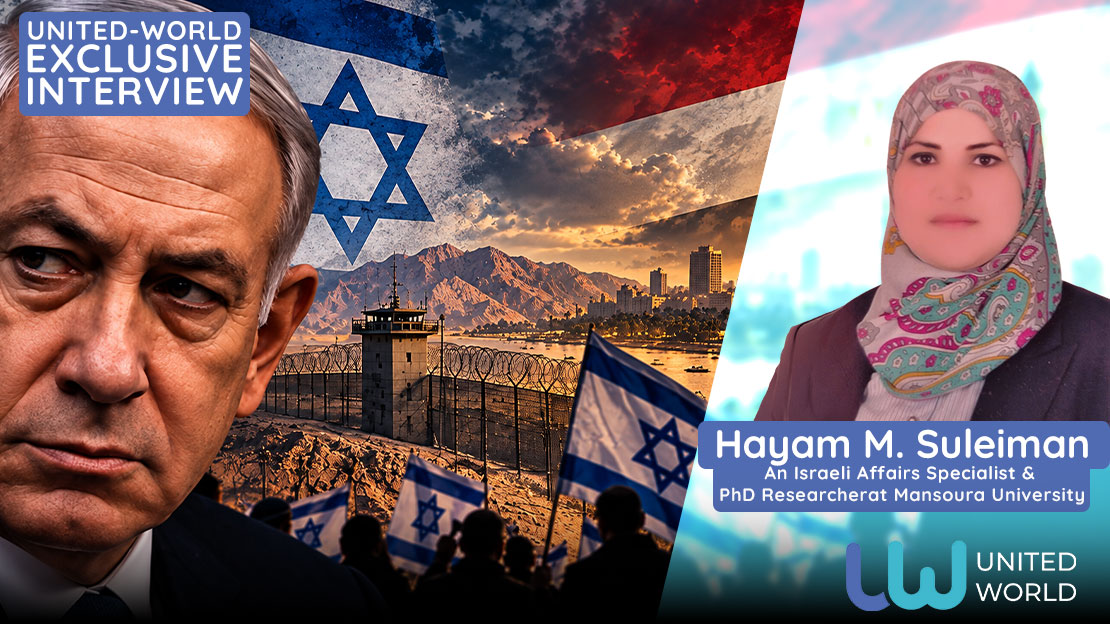
Israel heads into its upcoming elections weighed down by a multi-front war, media leaks accusing its prime minister of ignoring regional warnings prior to October 7, 2023, and opinion polls that deny his coalition the majority needed to form a government. Meanwhile, peace advocates within the Israeli public are receding, reverse migration is gaining momentum, and open escalation between Iran on one side and the United States and Israel on the other casts a long shadow over the entire region. Amid this complex landscape, a fundamental question emerges: Can Netanyahu leverage the war into a new political asset, and what is the fate of the Washington-brokered normalization path?
To answer these questions, we spoke with Hayam Suleiman, a researcher specializing in Israeli affairs and a Ph.D. candidate at Mansoura University in Egypt. Suleiman contends that while Netanyahu is well known for his maneuverability and ability to leverage security crisis for his political survival, this alone does not guarantee him the premiership, even if Likud remains the largest party. She also emphasized that the United States exerts a powerful influence over Israeli elections, as voters consistently seek a prime minister with strong ties to Washington. Furthermore, with the right wing dominating the public mood following the events of October 7 and the conflict with Iran, prominent voices for peace have virtually vanished—with the exception of Yair Golan, whose party polls at no more than 10 seats.
In her interview with UWIDATA, Suleiman addressed several other issues, including the brain drain Israel is experiencing due to reverse migration, the stalled efforts to repair its relations with neighboring West Asian nations, and the future of the Abraham Accords—which she argues have slowed down but not ended. She also highlighted the risks of a expanding confrontation with Iran and evaluated Egyptian-Israeli relations in light of post-Gaza War challenges, noting that the “cold peace” that previously defined ties has severely eroded, leaving the two countries locked in a persistent tug-of-war. Below is the full text of the interview.
Do you expect Benjamin Netanyahu to remain in power after the upcoming Israeli elections?
Despite intense pressure and growing allegations following recent leaks in the Israeli press—which revealed that Netanyahu ignored pre-October 7, 2023 warnings from regional actors like the UAE and Egypt regarding major military plans by Hamas—he remains renowned in Israeli political circles for his political maneuvering and ability to exploit severe security crises. The multi-front war following October 7 has allowed him to project an existential threat to voters, particularly on the right, framing himself as the sole leader capable of navigating a war for national survival. Nevertheless, recent Israeli opinion polls indicate that his ruling coalition would fail to secure a majority, projecting Netanyahu’s bloc at just 52 seats—well short of the 61-seat threshold required to form a government in the Knesset. While Likud will likely remain the largest single party, this alone does not guarantee him the premiership.
Is there an American influence on Israeli elections, and if so, what is that influence?
Absolutely, the United States exerts a powerful influence on Israeli elections. The Israeli voter consistently desires a prime minister on close, amicable terms with Washington, driven by a firm belief in the global role played by the U.S. and the necessity of having an Israeli leader accepted and supported by Washington to secure maximum foreign policy gains, as well as diplomatic and military backing. Furthermore, U.S.-Israeli alignment ensures a secure standing for Tel Aviv within its regional environment—a dynamic clearly demonstrated in recent years through Washington’s pivotal role in engineering and implementing the Abraham Accords between several Arab nations and Israel. Without a doubt, Washington’s stance serves to portray a prime minister either as capable of managing strategic alliances or as a figure jeopardizing national security due to friction with the White House.
Are there candidates advocating for peace in Israel, or does the ongoing path of war constitute a structural problem that causes these voices to disappear?
Currently, there is no strong voice advocating for peace within Israeli political circles, aside from Yair Golan, the leader of The Democrats party, who leans closest to the left. However, opinion polls indicate that his party will not win more than ten seats in the Israeli elections due to the events of October 7 and the conflict with Iran, as the Israeli public opinion has shifted further to the right. Moreover, any talk of establishing a Palestinian state or pursuing a political settlement is perceived as a form of treason amid wartime conditions; nevertheless, this stance is not set in stone, and priorities may shift once the current war concludes.
How do you view Israel’s demographic future as a state built on immigration, given that it has begun witnessing reverse migration following the war?
The latest demographic reports indicate that 2025 witnessed a significant surge in reverse migration among Israelis due to the war and economic and security crises, estimated at some 69,000 departures while only 19,000 returned. This means approximately 50,000 Israelis chose not to return, preferring to live either in the United States, Canada, or Europe—particularly Italy, which saw a notable increase in Israelis opting for permanent residency in the Italian countryside by purchasing and renovating rural homes to make them habitable, in an effort to escape daily pressures and wartime tension in Israel. Additionally, a Tel Aviv University study points out that around 270,000 individuals left for at least three consecutive months between 2023 and 2025, the majority of whom hold university degrees. This has triggered a brain drain affecting human capital, physicians, academics, and tech and engineering professionals, though its severity may subside once the current war ends.
Is it possible for Israel to repair its relations with the rest of West Asian nations?
I do not think so. Israel’s war of annihilation in Gaza has negatively impacted Israeli relations with West Asian nations due to deepening hostility among Arab and Islamic peoples toward Israeli policies. If we take Azerbaijan as an example, in recent years it was one of Israel’s closest partners; however, as a result of the Gaza war and recent regional tensions, bilateral relations have been severely affected. Azerbaijan has neither severed ties with Tel Aviv nor halted energy and arms deals, but the political relationship—once described as robust—has begun to recede while maintaining enough distance to preserve the benefits of Israeli cooperation without paying a political price in its relations with Ankara, Tehran, and the broader Islamic world. Relations between Tel Aviv and Ankara have also entered an exceptionally dangerous trajectory. Israel now views Türkiye as a significant threat, according to statements by Israeli Defense Minister Israel Katz—not only due to persistent Turkish criticism of the Netanyahu government following the war on Gaza, but also because of what Israel perceives as rivalry between the two nations in Syria. Israel is attempting to demonize Türkiye in much the same way it has targeted Iran over past years. Unless the two countries reach mutual understandings regarding Syria, tension will remain the defining hallmark of Tel Aviv–Ankara relations.
Do you still consider the “Abraham Accords” viable and capable of continuation?
I believe they will experience a phased standstill. There are major obstacles preventing them from continuing at the rapid pace they enjoyed prior to the events of October 7, 2023. The current war has stripped the Abraham Accords of much of their public and political momentum, and they are currently limited to security, intelligence, and perhaps military interests exclusively at the level of the signatory governments. However, at the popular level, their future is contingent upon a shift in the Israeli political landscape. In my view, they will persist anyway, as none of the parties can abandon the security, economic, and intelligence interests they have achieved, and a reversal of these gains remains unlikely. At the same time, however, none of the countries previously slated to sign the accords will dare take that step in the current period. Saudi Arabia was on the verge of signing an agreement with the Israeli occupation state, but conditioned that step on a comprehensive settlement of the Palestinian issue and the establishment of a Palestinian state along the 1967 borders—an outcome Tel Aviv is entirely incapable of accepting amid the region’s current circumstances and regional tensions. Therefore, the expansion of the accords is temporarily on hold until the regional political landscape shifts.
Do you expect the war between Iran on one side and the United States and Israel on the other to escalate?
All indicators point toward this possibility; the likelihood of escalation is extremely high. All previous negotiations have failed to the point that Iranian President Masoud Pezeshkian described them as futile, especially after the United States launched three separate attacks on Iran following negotiation rounds. Consequently, Iran has kept the strait closed as a leverage tool against the United States to pressure for an end to the war. However, the U.S. side appears more inclined toward escalation—particularly in light of recent statements regarding the potential involvement of the United States in the war against the Houthi militia in Yemen, after the U.S. State Department held the Iran-backed militia responsible for the recent attack on Riyadh, even though the Houthis have not claimed responsibility for it thus far.
How do you generally evaluate Egyptian-Israeli relations?
Ever since Egypt signed the peace accord following the 1978 Camp David Accords between Egyptian President Anwar Sadat and Israeli Prime Minister Menachem Begin under U.S. sponsorship, Egyptian-Israeli relations have experienced a cold yet stable peace. We can say it is a peace strictly at the governmental level rather than a popular one. Despite more than half a century passing since the agreement, the psychological barrier among the Egyptian public remains a solid wall against any attempt by the Israeli side to transform this into a popular peace. However, this has not prevented ongoing security and intelligence coordination between the two countries, even amid existing disagreements regarding Gaza, the Rafah crossing, the Sinai Peninsula, and the displacement of Palestinians. The summary of the current landscape is that Egyptian-Israeli relations are in a state of tug-of-war, where regional tensions and political conditions impact bilateral ties; yet, under all circumstances, we can say that the relationship remains stable and firm.