


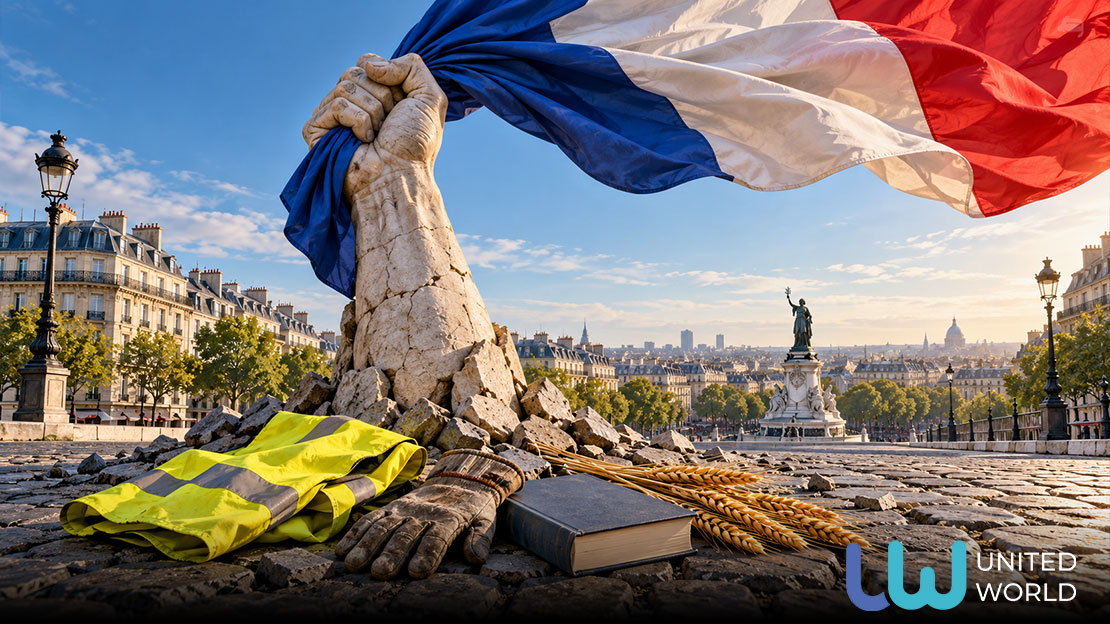
The French people have crossed a threshold.
Hundreds of thousands of people have taken to the streets across the country, particularly in Paris, to protest the neoliberal regime despite police violence.
Violence bred violence.
Crowds of workers and students surged toward the gates of the Élysée Palace.
Protesters and police clashed throughout the night on the streets leading to the Palace. The regime had to deploy special forces around the Palace.
Courthouses, town halls and police stations were set ablaze.
There were attempts to infiltrate military barracks in Paris.
Barricades went up.
Shops were looted.
There are no confirmed figures for the number of people lost their lives or seriously injured.
Government officials accuse Jean-Luc Mélenchon, the leader of the left-wing opposition, of organizing and inciting the unrest.
A campaign has been launched to ban his party.
Marine Le Pen, the leader of the right-wing opposition, has also taken a hard line against the protesters and Mélenchon, calling for the demonstrations to be suppressed by force.
It is worth noting that Le Pen’s position is hardly surprising. Having reached agreements with MEDEF and Israel, Le Pen is pursuing policies entirely consistent with those arrangements. In doing so, she is securing the backing of international and “national” capital in the second round of the presidential election.
Meanwhile, disarray reigns within the French state.
Interior Minister Nuñez offered his resignation following the unrest, but Macron refused. There is also talk of further resignations among senior officials. Also, reports have emerged that the mayors of Marseille, Lyon and Lille have expressed frustration over the limited support provided by the central government in dealing with the protests.
The pro-government media, dutifully playing their part, have focused on images of looting, attempting to portray the unrest as nothing more than a suburban uprising.
A brief point about the looting is worth adding here. Numerous eyewitness accounts suggest that on the night of October 18, police deliberately withdrew from certain areas of Paris, leaving the streets open to groups of looters. Hardly surprising. Regimes resort to such provocations to divide, discredit and turn against one another the masses rising up against them.
During the Tahrir uprising in Egypt, Mubarak employed a similar tactic. He withdrew police forces and deliberately gave free rein to gangs known as baltagiya, allowing them to confront the protesters. The aim was to remind the people that they had no choice but to depend on the security forces for protection.
Mubarak’s tactic failed. He lost power and was put on trial.
In short, ahead of the presidential election scheduled for April 2027, the French state is in disarray, while the streets have taken on an atmosphere reminiscent of civil war.
If we are to draw a historical comparison, the uprising in France resembles the great revolt of 1905 in Tsarist Russia: A state defeated on the Ukrainian and African fronts, a heavy economic price being paid at home, income inequality, and masses rising against a decaying system, yet still partly lacking a political leadership.
Where does the process go from here?
Students are at the forefront of the protests.
The middle classes have joined the movement through the Yellow Vests.
The stance taken by the workers will be decisive. Trade unions, particularly the CGT, have declared their support for the protests. Calls have been issued for demonstrations and a general strike on November 5. If a general strike is carried out, the movement will move to the next level.
Another decisive factor will be the determination of Mélenchon. So far, he has chosen to stand behind the protests despite all the pressure.
What matters now is how he responds to attempts to discredit the movement, particularly through the portrayal of protesters as “looters.”
He is trying to strike a balance on a thin line. On one side are students and unionized workers; on the other are more conservative shopkeepers and farmers, alongside the youth of the banlieues who are difficult to keep under control.
The right constantly fuels identity politics, pitting native-born French people against immigrants, and Christians against Muslims. It is crucial for Mélenchon to avoid falling into this trap and maintain his ties with workers and farmers rather than turning his party to become one supported only by immigrants and students.
Politics capable of bringing together workers, farmers, students and the youth of the banlieues on the basis of class is the only way out for Mélenchon, and indeed, for France itself.
Otherwise, the vicious cycle will continue.
Identity politics, fueled by neoliberalism, would drive France toward a new civil war.
Macron-like neoliberals would be replaced by Trump-like neoliberal fascists.
The conflict would deepen.
The legacy of 1789 would be erased altogether.
All that would remain are tribes governed in the interests of giant corporate conglomerates and vassals of capital.
Yet if the revolutionary process unfolding in France can find the appropriate political leadership, the door will be thrown wide open to a new era capable of shaking not only France, but all of Europe, and even the entire world.