


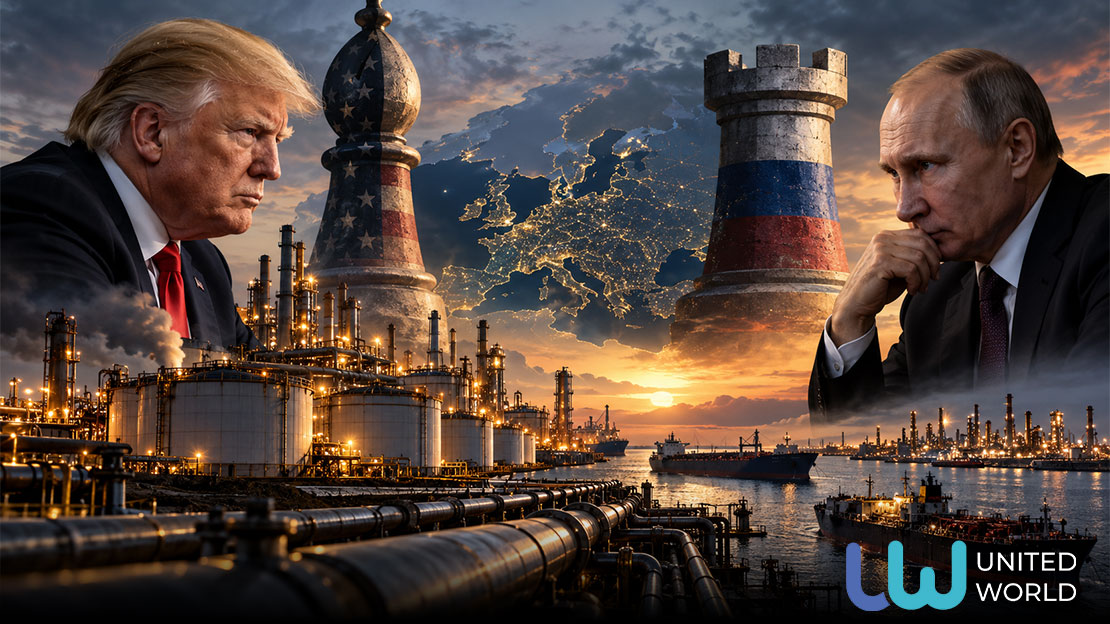
UWI author, political scientist Dr. Onur Sinan Güzaltan was guest to Ceyda Karan from Sputnik Türkiye. Here is the transcript of his interview.
Ceyda Karan: Our guest is Onur Sinan Güzaltan. Welcome to the program.
Hello. Thank you for having me.
Over the weekend, news emerged of a remarkable agreement that caught the world’s attention. On October 9, a telephone conversation between Russian President Vladimir Putin and US President Donald Trump resulted in an agreement that surprised many Western observers. The two sides agreed to allow Russian diesel fuel to be supplied to global markets. Meanwhile, Trump made some very harsh statements about Zelensky. What overall picture do these developments present?
Relations between the US and Russia have experienced numerous ups and downs over the Ukraine conflict. Particularly during Trump’s term, there have been several telephone conversations and face-to-face meetings between Trump and Putin, and American delegations have visited Moscow on numerous occasions. Most recently, the CIA director made a significant visit to Moscow. The communication channels have never been completely severed, and the possibility of reaching an agreement has always remained on the table. So, first of all, I would not describe this agreement as unexpected. Both the Americans and the Russians have been working toward some form of compromise for quite some time.
The second point is that this is an interim arrangement, not a structural solution. According to energy specialists, the quantities of diesel fuel in question in the agreement are not to make a significant difference. So, this is not a certain or structural agreement, but perhaps a first step towards that.
The American elections are approaching. Diesel prices affect the “rednecks,” the rural population that forms an important part of Trump’s electoral base. Trump needs to retain their support in the upcoming elections. To do that, he needs to bring fuel prices down. From Trump’s perspective, viewed in the narrower context of domestic politics, this agreement is an electoral investment.
From Russia’s perspective, any retreat from sanctions represents a gain.
At the global level, the agreement may provide some relief to markets. But easing pressure on global markets also means easing pressure on the US-centered petrodollar system. Nevertheless, as I said, the quantities in question are very small.
The very next day after the agreement, Trump made a statement about Zelensky, saying that it was time for him to leave and that elections should be held in Ukraine as soon as possible. Here, we see Washington taking a step back in Kyiv. If we put together what each side has given and received, assuming, of course, that the agreement is implemented, a picture emerges: Russia sacrificed little and gained much.
Are the US and Europe moving further apart with this agreement and Trump’s statement about Zelenskyy?
In fact, Europe has been at the heart of this entire issue from the beginning. The origins of the Ukraine issue are closely connected to Europe’s future. I have always emphasized that the fundamental question has been “Will Europe remain within the Atlantic camp?” or “Will Europe pursue a policy of Eurasian integration, developing relations with Russia, China, Iran, and Türkiye in a way that is more consistent with its geographical position and the natural course of economic and political life?”
The objective of the war in Ukraine was to sever relations between Russia and Europe. With this objective, the American state and the Atlanticist governments in Europe pushed for this war. that encouraged this confrontation.
But at this point, that policy has collapsed. How? First, Kyiv has big difficulties in continuing the war. Second, and in my view the most importantly, the Atlanticist governments in Europe are becoming increasingly incapable of maintaining their hold on power.
Look at the election results in Germany. The AfD has received an exceptionally high share of the vote. There is a strong possibility that it will come to power in the period ahead. Look at France. There is a great popular movement that has started with high school students, and is increasingly bringing in workers, farmers, and the middle classes. In a sentence: neoliberal Europe, Atlanticist Europe, is collapsing as a whole.
As this happens, the US is naturally searching for a new way forward. Trump is, to some extent, a reflection of this very reality. Yes, he is trying to make Europe more dependent on the US in certain issues, but I believe the Americans also recognize that the existing arrangement is no longer sustainable.
Let me outline a possible scenario. This is only a hypothesis, but it is worth considering: Russia and the US may eventually find common ground on certain aspects of Europe’s future. That possibility exists.
If we look at the ideological dimension, there are also similarities in certain respects. Consider the political line that brings Trump and Marine Le Pen together. In the past, there were even theories extending this political axis all the way to Moscow. Those are open to debate.
And if we ask who would be making concessions in such a scenario, I would say it is the US. Because the US has exercised control over Europe since the Second World War, using various economic, political, and military instruments, as well as provocations.
I think it would be more fruitful to assess the diesel agreement, the energy negotiations, and the various advances and retreats by both sides of the war within this broader perspective.
When Trump announced the deal, criticism immediately emerged from Europe. However, during the first nine months of 2026, European countries spent €7.8 billion on Russian Arctic LNG. That represents an increase of almost 10 percent compared with the same period last year. France, the Netherlands, and Portugal are among the largest buyers. And 85 percent of all LNG produced by the Yamal project was shipped to the European Union. One cannot help wondering how these positions can possibly be reconciled. Isn’t there a certain hypocrisy here?
Absolutely. We are moving toward an absurd situation in which European countries end up buying Russian natural gas and other Russian energy resources through the US. This shows us that the existing system is no longer working.
In a recent speech Jean-Luc Mélenchon said that the neoliberal order had already collapsed and that it is impossible to manage the emerging new world according to the rules of the old one. This is an accurate assessment.
The existing governments mentally trapped in the old order are still trying to preserve it, and their efforts are producing increasingly absurd results. The system has reached an impasse. As you pointed out, we can describe these as inconsistency, hypocrisy, or something else. But whatever term we use, it is clear that the current arrangement is no longer functioning.
And I believe this will change in the coming period. We are not talking about a very distant future. Europe’s political map will change dramatically, either through elections, popular movements, or other means, leading to a decisive fall of the governments representing the old order. In fact, this very process is unfolding before our eyes.
One question here: Could the forces of the old order in the US and Europe resort to major provocations in an attempt to preserve the existing system? Of course. Could their actions even involve nuclear weapons? We cannot rule out that possibility. After all, they are supplying missiles capable of striking targets inside Russia. They are providing air defense systems. They travel to Kyiv to show their support. Their rhetoric is extremely aggressive.
But still, when we look at the situation structurally, it is becoming increasingly contrary to the normal flow of life for these governments to remain in power in Europe. And the people can see that. Why else are they taking to the streets? Why are they voting for political movements outside the established system? Why in Germany, one of Europe’s most conservative countries, a large segment of the German electorate is turning toward an alternative like the AfD? Whether one agrees with the AfD’s politics is a separate question, but the point is that it stands outside the boundaries of the established political order.
Finally, I would also like to ask about the situation in Russia. There is an ongoing talk of “major problems in the large cities” due to fuel supplies shortages. So, what is the latest situation? Are you able to buy gasoline in Russia?
Well, I prefer taking the metro anyway! I am a supporter of public transportation.
Yes, there have been problems with fuel supplies. The attacks on refineries have naturally created logistical difficulties and other disruptions. However, there is something important to understand about Russia: This country knows what war is, and its social structures and state institutions have been shaped by war experiences.
The war in Ukraine has been going on for more than four years. Russia has faced extremely severe sanctions. It has lost access to markets, and numerous foreign companies have withdrawn from the country. There have been significant strikes against logistics networks and strategic infrastructure. Energy trade with the West has almost ended. It is an enormous undertaking. Considering all these pressures together, the situation inside Russia has remained relatively stable.
Thank you very much for sharing your observations and analysis.
Thank you for inviting me.