


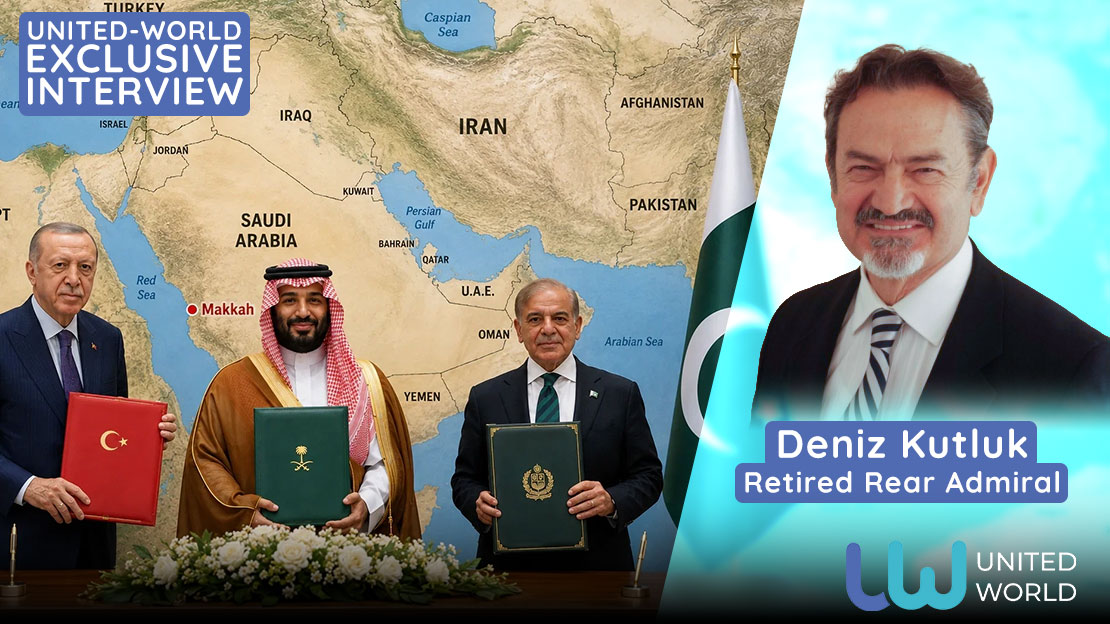
On August 7, Türkiye, Saudi Arabia, and Pakistan signed the “Mecca Mutual Defense Agreement.”
The agreement came as a surprise. But that surprise is hardly surprising: there had been no sign that such a pact was in the works. At least not for those “outside the state apparatus.”
The process that led to the agreement remains as obscure as the agreement itself. Apart from a handful of details reported in the press, there is still no document or official statement setting out its actual content.
Against this backdrop of uncertainty, we tried to shed at least some light on the matter. We turned to Dr. Deniz Kutluk, a retired rear admiral of the Turkish Naval Forces.
Kutluk is one of the figures best placed to shed light on both the background and the substance of the Mecca Mutual Defense Agreement, drawing on his experience with international agreements and his legal expertise. He offered a detailed assessment.
He also shared his views on the geopolitical drivers behind the agreement and its possible consequences for the region.
As he begins to navigate this murky terrain, Kutluk first asks whether what we are dealing with is really an “agreement” at all. Kutluk says it looks less like an agreement and more like a “treaty”.
—
Before looking at the consequences of the agreement, we first need to look at the process and procedure by which it was signed.
An agreement like this does not simply appear out of nowhere. There are procedures for concluding international agreements: the government authorizes a delegation, issues its credentials, adopts a cabinet decision; the delegation then goes to the negotiations based on that decision, negotiates, comes back, and the government either approves what has been negotiated, rejects it, or says, “Go back and revise this.” Then the negotiations continue. Eventually, an understanding is reached, and the agreement is generally signed on behalf of the government by the foreign minister. If it creates obligations for Turkish citizens, it is subject to approval by the Grand National Assembly. If it does not, it is submitted to Parliament for its information. It is then promulgated by the President and published in the Official Gazette.
“Behind the backs of the citizens”
In other words, you do not make agreements behind the backs of the citizens. Citizens need to be able to follow them and know what they entail in every respect. After all, obligations are being imposed on them. You send your son off to military service expecting him to serve within Türkiye’s borders and defend his homeland. If he suddenly finds himself in the Arabian desert, how are you going to explain that? Of course, it is natural that some aspects of negotiations are conducted confidentially, but so far, we have not even heard that negotiations are under way.
I spent many years in Türkiye’s national institutions working specifically on international agreements, and I also have legal training. So I know how an agreement is made from beginning to end; I have personally worked on dozens of them. And we still don’t know what the agreement actually includes. An English text being presented as the agreement has been taken from a Saudi Arabian media outlet and posted on a website. But that is Saudi Arabia’s press statement. It is not the agreement.
Not an agreement, but a treaty
Now, what we have before us is a signed document, and they are calling it an “agreement.” But is this really an agreement, or is it a “treaty”? Because apparently, if things go badly, countries will be expected to put their lives and properties on the line. That is not an ordinary agreement. That is a treaty.
But let us assume that it is an agreement. This agreement apparently says that, under the conditions of self-defense laid down in Article 51 of the United Nations Charter, the other parties undertake to assist the party defending itself. Fine. But such an undertaking has many shades. Is this an undertaking to maintain deterrence? Is it an undertaking to calm down the party claiming to have been attacked? Is it a commitment to show understanding and support? Does it mean granting passage through certain airspace, maritime areas, or land territory? Or does it mean taking up arms alongside that country on certain fronts? Does it mean diplomatic solidarity? What exactly does it mean?
Article 4 comes before Article 5
Take NATO’s Article 5. Since NATO was founded, it has been invoked only once, after 11 September 2001, and even then it was in response to an abstract “terrorist threat.” Article 5 contains the principle that an attack on the territorial integrity of one member will be met collectively by all. But putting it into operation is nowhere near as straightforward as the provision might make it sound.
Before Article 5 comes Article 4. Article 4 is where you discuss whether the conditions for using force actually exist, what form solidarity should take, whether the requesting country is exaggerating the situation or assessing it reasonably. Suppose, for example, a single drone crosses the Polish border and crashes, and Poland tries to invoke Article 5. NATO’s more experienced members would simply laugh that off. Because there is a definition of what constitutes an attack. What exactly amounts to aggression? If two aircraft cross your border, is that aggression? No. NATO has rules of engagement for situations like this. They may stipulate, for example, that if more than two aircraft violate the airspace, certain immediate-response measures can be activated.
So if you have regulated none of these things, if you have no equivalent of an Article 4 under which these matters can be discussed, how are you going to run this arrangement? From that perspective, I do not see a properly constructed agreement here.
Military solidarity?
Let us continue. Is this a military solidarity organization? Implicitly, yes, although, again, we have not seen the text. If it is a military solidarity organization, who will coordinate its military planning? In which country will its military headquarters be established? Which countries will be represented there, and by what kind of personnel? What emergency defense measures will be prepared, and what sort of contingency planning? What immediate-response measures will be planned? At what stage will war plans come into effect? And who will draw up those war plans and all the rest? Once they are drafted, through how many layers of review will they pass before being submitted to the member states for approval? And once the states approve them, only then will they enter into force. Where are any of these arrangements? They are not there.
And political control?
And what about political control? Political control over the military? Saudi Arabia may not be very fond of that idea. Pakistan may not be, either. But political control over the military is indispensable. The military is eager by nature. It has been taught a certain way of fighting, and when the moment comes, it wants to put that training into practice. Politics operates differently. Political leadership wants negotiation, diplomacy, open door, a half-open door, flexible language, megaphone diplomacy; it wants a whole range of instruments. That is precisely why the political headquarters and the military headquarters have to be parts of the same structure, and both have to be established. Where are they? Is there any indication of them? No.
If none of this exists, then in practical terms one might say that the commitment itself does not really exist either. To me, this commitment is like something written on ice. The moment the sun comes out, it disappears.
If such a decision is considered necessary to remove the US from the Middle East and enable the regional countries to become self-sufficient in security terms, then that decision would be good for all. But build safety valves into it. Put safeguards in place against unwanted situations. For example, one of the three signatory states may have an ongoing conflict with another country, perhaps even a state of war merely frozen by a ceasefire. Why should the other parties become part of that conflict? The same could apply to us. In Cyprus, we are still technically in a state of war halted by a ceasefire; there is no peace treaty. Why should Pakistan or Saudi Arabia become a party to that? So some kind of protective mechanism is needed here. You can formulate that through an equivalent of Article 4.
There are other issues as well, very practical ones. If one country is going to enter a war alongside another, their military stocks need to be sufficiently interchangeable and mutually supportable. If you are using artillery ammunition, for example, you need to be able to draw on the other country’s artillery stocks. So, these three countries face a major standardization problem.
Who is the “threat”?
Then, if you are going to prepare war plans and the like, you need a definition of the threat. We are now being told, “We do not regard any country as a threat.” Fine. So, what do you regard as a threat? You cannot organize defense against a threat if there is no threat. What are the offensive capabilities of the country you consider a threat? Unless you analyze those capabilities, you cannot prepare for a war with that country. So at some point you have to define the threat.
Yes, diplomatically speaking, that can amount to political suicide. Put Israel in the threat category today, and you create tensions with the US. Put Iran there and you become part of the current war. Put Yemen there, and you become embroiled once again in the conflict between Yemen and Saudi Arabia. There is no need for any of that. But military planning requires a common threat assessment.
NATO lived for more than thirty years without a clearly defined threat, and in the end it was relieved when, in April 2022, it once again designated Russia as the threat. Otherwise, what are you supposed to base military planning on? What standards do you use? What level of armament? How much force and what kinds of weapons are you planning to employ?
Long road to standardization
And of course, standardization is not something you achieve simply by wanting it or by having the political will. It takes time. And by time I do not mean a few years like five or ten years, it takes longer. For example, Türkiye has around 1,100 standardization agreements with NATO. If you listed all the subjects, you would struggle to find a single person with a command of all of them. They are extraordinarily complex and extraordinarily detailed. Now, between these three countries, perhaps you won’t need 1,100, but you may need a hundred. And each one has to be negotiated. Someone has to put the issue on the agenda, explain why it is necessary, persuade the others, and then all of you have to sign up for it. Only then can you decide, for example, on a common firing procedure for artillery ammunition, or on how your forces will initially engage or identify one another when they encounter each other at sea, and so on and so forth. So if you don’t have what is called “interoperability” (the ability to use force together, to conduct joint operations), then what concrete result do you get from declaring that “a threat to one of us is a threat to all of us”?
Priority: reassuring Iran
As for the political and regional implications of this “agreement,” the priority should be to reassure Iran.
Türkiye, Saudi Arabia, Pakistan, and Egypt have been holding talks for around four months. Their foreign ministers have been meeting once a month. What was this quartet supposed to do? In the wake of US’s forced de facto withdrawal from the region, it was supposed to make a regional security architecture workable.
How? There are countries in the region that have become deeply alienated from one another. Some maintain openly hostile positions. The idea was to soften those positions. And how do you do that? There are established packages of confidence- and security-building measures; these have long since become part of the standard toolkit of international relations. Those measures were supposed to be brought into play.
And this quartet had opened this process to Iran. Iran, after obtaining the approval of its National Security Council, said in effect, “If this is within the framework of a Helsinki-type process, we are in.” Then, following the Mecca agreement, the Turkish foreign minister said, “Iran was once part of this process.” Yet Iran isn’t included in the Mecca agreement. Egypt isn’t either. The foreign minister has also said something to the effect of, “Egypt is our brotherly country; it can join whenever it wishes.” So, there are a great many grey areas here to be clarified.
Let’s move to a cost-benefit analysis of the agreement. Start with the risks.
There is a danger of being dragged into unwanted conflicts, and mechanisms need to be created to manage that risk. An Article 4-type provision could provide some protection. Alternatively, to prevent themselves from being drawn into conflicts they don’t want, the countries could undertake not to bring into this structure their existing disputes with states with which they are currently in hostile relations.
If this trilateral alliance regards Iran as a threat, and I say this quite comfortably because I assume such a thing has not even crossed their minds, that would be extremely damaging for Türkiye. We have five hundred years of friendship with Iran. We are neighbors. We have religious ties. We have national ties as well, millions of people in Iran regard themselves as Turks. And the dissolution, fragmentation, or defeat of Iran would serve the success of imperialism. If this trilateral alliance were to designate Iran as a threat, that would be the greatest mistake it could make, and one from which it couldn’t recover. For thirty years, the US has done everything it could to pit Türkiye against Iran. For thirty years, the Turkish state, acting with strategic reason, has resisted the pressure of the US in this regard.
Building a new structure
As for the potential benefits of the agreement; all the complex and challenging processes are managed well, and the three countries could immediately establish a small advisory group as the nucleus of the organization (Türkiye, has the institutional know-how to guide the other two countries because of its NATO experience), such a core group could first determine the basics: what has to be prioritized when building an organization of this kind, how long each stage will take, what kind of personnel will be required. From there, step by step, they could build the military and political structures, establish the headquarters, make force allocations, develop interoperability between those forces, prepare war plans and contingency plans, establish joint rules of engagement, set up periodic consultation mechanisms, determine how decisions are submitted for approval, and so on and so forth.
A possible second nuclear umbrella for Türkiye
There would also be a nuclear dimension here. They will have to address how nuclear weapons are to be used, how Pakistan’s nuclear capabilities are to figure in the response to a nuclear threat, and how many Pakistani nuclear warheads, if any, would be stationed on the territory of which country. This relates to what is called “quick alert”: forces capable of rapid reaction, which means having the relevant capabilities positioned in those countries.
If all of this were done, if an organization of this kind could genuinely be built, Pakistan’s capabilities could provide Türkiye with a second nuclear umbrella alongside NATO. That could give Türkiye an additional layer of deterrence against countries that either possess nuclear capabilities or are close to acquiring them and may have designs on Türkiye’s territory or territorial integrity. It might also give Türkiye greater freedom from the haughty use of sanctions by the US, which is NATO’s principal nuclear provider.
Second, there are currently a number of alignments forming around Türkiye that are directed against Turkish interests: France and Greece; Israel and Greece; the Greek Cypriot Administration of Southern Cyprus (GCASC) and France, and so on. A new alliance of this kind could make Türkiye’s deterrence to such configurations stronger.
Preparing for the post-NATO era
And then there is the question of NATO itself. NATO is moving toward disintegration, so what will the post-NATO world look like? In fact, everyone is already preparing for it. The European Council on Foreign Relations published a document whose argument, in essence, was this: “We will create a NATO without the US. Türkiye won’t be part of it, but Sweden, Germany, Poland and Ukraine will be, and we will bring them to the nuclear threshold.” Türkiye was left outside.
France and Greece, despite the fact that we are NATO allies, have formed an alliance directed against us. The US and Greece probably have arrangements of this kind behind the scenes as well. The US has such arrangements with the GCASC. Israel has them with the GCASC.
So everybody is, in fact, preparing for the post-NATO era. And what does all this resemble? The period before the world wars, when countries clustered into rival blocs, formed alliances, and prepared to put pressure on the opposing camp. Seen as part of that wider process, I think Türkiye, Saudi Arabia and Pakistan can also be understood as preparing themselves for what comes next.
For Türkiye, such an alliance could provide solid ground to stand on amid the chaos likely to emerge in the near future as the NATO alliance fragments. And later, the alliance could open outward toward Asia. Asia has no organization of this kind; neither the Shanghai Cooperation Organization, nor BRICS, nor ASEAN, nor any of the other existing structures has this character.
Would such an alliance affect Türkiye’s commitments to NATO? If it is badly managed, yes. The first question NATO will ask is this: “You had allocated this many divisions to us. How are you now going to allocate the same divisions to another alliance under a different cooperation arrangement? You have this many ships and this many aircraft serving in rapid-reaction forces directly under our command. How are those forces now going to be used in another alliance? And when they are used there, what happens to the commitments you made to us?” Those questions will be asked. If Türkiye manages these issues properly, if it communicates these developments to NATO headquarters with the right explanations, and if it provides information before being asked, then Türkiye will retain the initiative and can navigate the process successfully.