

The truth is that left-wing governments, in most cases, have created a new bureaucracy, also corrupt, nepotistic, and often incapable of generating policies that benefit the people. The time has come to reverse this situation.
The truth is that left-wing governments, in most cases, have created a new bureaucracy, also corrupt, nepotistic, and often incapable of generating policies that benefit the people. The time has come to reverse this situation.
The collapse and dissolution of the Soviet Union marked the end of an era characterized by a bipolar international system in which ideology dictated the role of countries, governments, and organizations in the international arena. Since then, the world has failed to establish a system that structures and orders it.
It has been more than 35 years of instability, from a decade of chaos at the end of the last century, the establishment of unipolarity after the terrorist attacks in the United States on September 11, 2001, Washington’s material inability to sustain this system after the 2008 financial crisis, the emergence of Russia and China to the pinnacle in 2012 to begin to place themselves on par with the United States, the decline of Europe and the crisis of the multilateral system that could not successfully manage the COVID-19 pandemic, as well as its inability to prevent the genocides that the West produces in various parts of the planet, one of which forced Russia to react through a special military operation in Ukraine.
Similarly, the indiscriminate killing of children and women in Gaza, the two wars against Iran in June 2025 and February 2026, and the contradictory attempts emerging from the United States must be considered as central elements of the crisis, when Trump simultaneously sought to reinstate a unipolar system while Marco Rubio and the American neoconservatives, in alliance with the Cuban-American lobby, aimed to bring the planet back to a bipolar ideological confrontation, this time with the Communist Party of China as the adversary of Washington’s imperial power.
This inability of countries and governments to reach even minimal consensus, not even to confront a common enemy of humanity like the COVID virus, is an expression of a systemic crisis that reveals the failure of capitalism to sustain a model that has been unable to provide solutions to humanity’s most pressing problems. Conversely, in countries like China, Vietnam, and others, socialism is finding ways to lead its people to live in increasingly favorable conditions for the development of life. More than 1.5 billion citizens (almost 20% of the world’s population) live in socialist systems that demonstrate their superiority in this systemic confrontation.
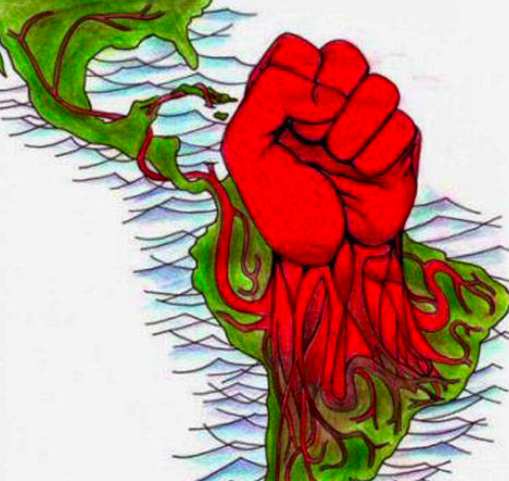
Latin America and the Caribbean, after overcoming the dark night of dictatorial governments that implemented sinister neoliberal policies and the persecution of their people through subordination to the national security doctrine developed by the United States in the context of the Cold War, embarked on a search for an alternative to the narrow limits imposed by Washington.
It seemed that in 1998, exactly 25 years after the overthrow of President Salvador Allende, a new reality was emerging for the region. The electoral victory of Commander Hugo Chávez in Venezuela signaled the beginning of a new era, one that other countries, peoples, and governments of varying political orientations joined, all sharing a common goal: democracy, the defense of sovereignty, and progress toward integration initiatives that would strengthen the region’s presence on the international stage. For the first 15 years of this century, this was the guiding principle.
Taking note and faced with the emerging international situation that was becoming adverse to it in various latitudes and longitudes of the planet, the United States decided to take refuge in Latin America and the Caribbean, safeguard its control over the region and consolidate its position there in order to continue maintaining its status as a global power.
All of this is underpinned by the strengthening of an extreme right-wing ideological base never before seen in US domestic politics. The entrenchment of a Nazi-fascist government in Washington, which attempts to emulate Hitler’s worst practices—supremacism, racism, attacks on democracy, the multilateral system and international law, misogyny, contempt for minorities, and its blatant desire for world domination—marks a dynamic that even calls into question the capitalist system itself. This system arose economically from the Industrial Revolution that began in Great Britain during the second half of the 18th century and politically from the French Revolution, which established Western-style representative liberal democracy as the sole model.
Likewise, the policies of the Trump administration have undermined the international system that emerged after the end of the Second World War, which allowed for a new multilateral architecture in political, economic, and security matters, creating the conditions for the birth of a new international system that takes into account the profound transformations that have occurred on the planet in the last 80 years.
This chaos, which has engulfed the entire planet like a deluge, has had profound political and ideological repercussions in Latin America. The left seems to have lost its way, the very foundation that kept it at the forefront of society’s most progressive ideas, at least for the last 150 years.
In some cases, the left has come to power through elections only to forge alliances with business interests and right-wing groups, assuming that this would broaden its social base of support—a grave mistake. It has been these same right-wing groups that have worked to reverse the political and social processes that had the people at their forefront. They have forgotten that their true strength lies in establishing solid ties with popular and social organizations, and that coming to power should serve—above all—to generate mechanisms for increasing popular participation, transforming the people from mere objects of government policies into agents of social transformation.
The confusion is immense; it’s no longer even clear what it means to be on the left. In the current situation, sectors of this political orientation, including those within the government, are forging alliances with the United States to create governability, disregarding the fact that this very governance is being used to increase the profits of transnational corporations and large companies at the expense of their own people.
Others, especially in Europe, support the Nazi-like government of Ukraine in defense of a supposed democracy and a regional security system that only benefits the corrupt European bureaucracy, even at the cost of undermining the living conditions of their own people. For example, in Spain, they have reacted when they see the right wing attempting to reap the benefits of the crisis, given their inaction and an apathy that makes it increasingly difficult to define the line between them and those same right-wing parties. They are frightened because they haven’t forgotten that in the last century, Hitler and Mussolini came to power through elections under political and economic conditions similar to those of today.
Finally, after passively observing the genocide perpetrated by the United States and the Zionist regime of Israel in Palestine and supporting the wars against Iran, these “leftists” now rebel when Zionist barbarity has surpassed any extermination practice, including that of the Nazis in the mid-20th century. The indiscriminate attacks on Iran were welcomed until their repercussions began to affect the living standards of its citizens after the rise in fuel and food costs, without any mechanism being offered to prevent this situation. Meanwhile, they display utter cowardice by avoiding pointing to the true culprit behind this situation, which is none other than the United States.
The traditional left is fragmented. It has shown a complete inability to even explain to the people what is happening, much less to point out a viable path to confront and overcome this situation. The mechanisms that have existed until now have proven utterly ineffective, paralyzed by pusillanimous, hesitant, and even cowardly attitudes. It is necessary to formulate a long-term proposal that establishes guidelines, instruments, methodologies, and ways of acting in this situation, which is unfavorable for the people.
Throughout history, the left and revolutionaries have demonstrated their capacity to build even under the most adverse conditions; countless generations of fighters have given their lives in over a century of struggle. The rise to power of some leftist forces, far from increasing their capacity to fight, seemed to foster a certain acceptance of passivity and the assumption that bureaucracy and greater resources would solve everything.
The truth is that left-wing governments, in most cases, have created a new bureaucracy, also corrupt, nepotistic, and often incapable of generating policies that benefit the people. The time has come to reverse this situation. As General Secretary Xi Jinping said at the centennial commemoration of the founding of the Communist Party of China, “we must return to our origins” in order to uphold an ethic and morality that distinguishes us from capitalists and gives us the strength and conviction necessary to defeat the powerful American empire. Perhaps we cannot match its military and financial potential, but—as has always been the case, even if we have forgotten—the power of our ideas is invincible.
It depends on us, on no one else; it’s in our hands and we must do it. As Commandante Ernesto Che Guevara said, “The present is a struggle, the future is ours.”