



After nearly six decades of membership in OPEC, and despite being the organization’s third-largest oil producer, the United Arab Emirates announced its withdrawal from the organization at the end of last April. This decision by the Gulf state has raised numerous questions regarding its underlying motives and sparked speculation about the future of the organization, which has played a pivotal role for over half a century in steering the global oil market.
Motives for withdrawal
Many have ventured to provide answers to these two questions, but Yousef Al Otaiba, the UAE Ambassador to the United States, was exceptionally candid in his recent op-ed in The Financial Times. He emphasized that his country’s decision to exit the organization goes far beyond production quotas or wartime disruptions.
Al Otaiba argued that the move reflects structural changes in global energy markets and profound shifts in the international economy. However, his statement that the decision reflects a “clear vision of where the UAE stands today and where it is headed” represents, in my view, the primary motive behind all other reasons and pretexts.
This broad statement—which Al Otaiba attempted to explain by asserting that his country is no longer an emerging state almost entirely dependent on oil revenues, as its economic reliance on fossil fuels has diminished in recent years under extensive diversification plans—cannot be taken at face value by any serious observer.
When Abu Dhabi announced its withdrawal, Sultan bin Ahmed Al Jaber, the UAE Minister of Industry and Advanced Technology, made a striking statement affirming that the decision was not directed against anyone. This type of political denial evokes the common Arabic proverb, “There is no smoke without fire.” Why did the Emirati official find such a denial necessary? Simply because all the facts and circumstances surrounding the decision link it to a specific party whose dominance and hegemony the UAE seeks to break free from: the Kingdom of Saudi Arabia.
The struggle for influence and leadership
The Kingdom of Saudi Arabia acts as the de facto leader of OPEC and the primary architect of its policies and decisions, being the largest producer within the organization. Riyadh has long utilized its massive production capacity to influence global prices as part of its maneuvers to project economic and geopolitical power internationally, particularly in its dealings with superpowers to secure its strategic goals and interests.
It is no secret that relations between the two nations—Saudi Arabia and the UAE—have been strained for some time due to significant and fundamental divergences in their foreign policies, particularly regarding the conflicts in Yemen and Sudan, and even the American-Israeli confrontation with Iran. This is compounded by their friction on economic fronts, ranging from oil production quotas to the competition for attracting multinational corporations.
Dubai was long the preeminent and most successful hub in the Middle East, attracting multinational firms and massive capital in vital sectors, from logistics to Artificial Intelligence. However, a decade ago, Saudi Arabia launched a development plan known as “Vision 2030” aimed at diversifying the Kingdom’s economy and propelling it to the forefront. In doing so, it enacted laws and adopted practices that the UAE perceived as a direct targeting of its own economic capabilities.
While economic competition between nations may be legitimate, Saudi Arabia’s objectives behind this Vision were not purely economic. Riyadh was aggressively seeking to assert its leadership across all political and economic levels. From this perspective, it viewed Abu Dhabi’s geopolitical rise in recent years with growing suspicion. Riyadh perceived any political success for Abu Dhabi, when added to its economic prowess, as a challenge to its own self-perceived entitlements—especially as it began to view the UAE as part of an alliance encircling the Kingdom regionally.
Repositioning
In recent years, the outlines of an emerging, undeclared alliance between Abu Dhabi, Tel Aviv, and Addis Ababa have begun to surface. The existence of this bloc can be discerned from the alignment of their stances regarding regional conflicts and their shared interests, which stand in contrast to the priorities of regional heavyweights like Saudi Arabia and Egypt.
Within this alliance, the UAE acts as a front for the other parties. In Yemen—where Ethiopia or Israel cannot intervene overtly—the UAE entered in 2015 as an acceptable Arab partner alongside Saudi Arabia to prevent the Iranian-backed Houthis from seizing power. However, in recent years, it has backed southern separatists, a move that strikes at Riyadh’s interests in the unity of its neighbor.
In Sudan, Abu Dhabi has aligned itself with the Rapid Support Forces (RSF) against the national army, supporting a situation that could ultimately lead to the country’s partition. This poses a significant threat to Egypt, while simultaneously altering the composition of the states bordering the Red Sea—long regarded as an “Arab lake.” Such a shift could create a new reality favoring Israel and Ethiopia; the former seeks to manipulate the Red Sea’s geopolitical calculus, while the latter aims to secure a port that would grant it strategic leverage in the Horn of Africa. For both countries, this gain would come at the direct expense of Cairo and Riyadh’s regional influence.
Consistent with this dynamic, we find a unified stance among Abu Dhabi, Addis Ababa, and Tel Aviv in supporting the breakaway region of Somaliland at the expense of Mogadishu.
Thus, quite simply, Al Otaiba’s remark in the British newspaper—that the UAE’s withdrawal from OPEC reflects its vision of its standing and trajectory—can be interpreted as Abu Dhabi’s desire to gradually liberate itself from anything that compels it to submit to Saudi hegemony. In reality, Saudi Arabia does not merely dominate OPEC, but also exerts influence over the Arabian Gulf states through the GCC and dictates much of the decision-making in the Arab world.
This perspective provides a framework for understanding how the UAE views itself within its Arab and Gulf surroundings and the basis upon which it operates regionally and globally. The UAE no longer views its interests through a purely Arab or Gulf lens; instead, it increasingly sees itself as part of a regional alliance alongside Israel and Ethiopia—and at times, an even broader coalition that includes India.
From soft power to shock initiatives
In recent decades, the UAE has successfully captured global attention through its successive achievements in economic diversification—with Dubai serving as its cornerstone—effectively doubling the clout of this oil-rich nation. It managed to convince global investors that it was the ideal destination for profit and freedom. The world watched this experiment in awe, while its neighbors in the Gulf and the wider Arab world looked on with a sense of envy.
However, this envy gradually transformed into controversy following the outbreak of the Arab Spring. The nation, whose name was once associated with nothing but economic success, began to be increasingly linked to proactive political maneuvers.
At times, the UAE intervened to support the new Egyptian regime following the ousting of the Muslim Brotherhood-led government; at others, it joined the international coalition against ISIS. At the time, such interventions were deemed acceptable, as many regional states opposed the rise of political Islam. This was understood under the premise that the Emirati model is, ultimately, a Gulf model rooted in tribal rule, which could not tolerate political frameworks threatening existing Gulf legitimacy.
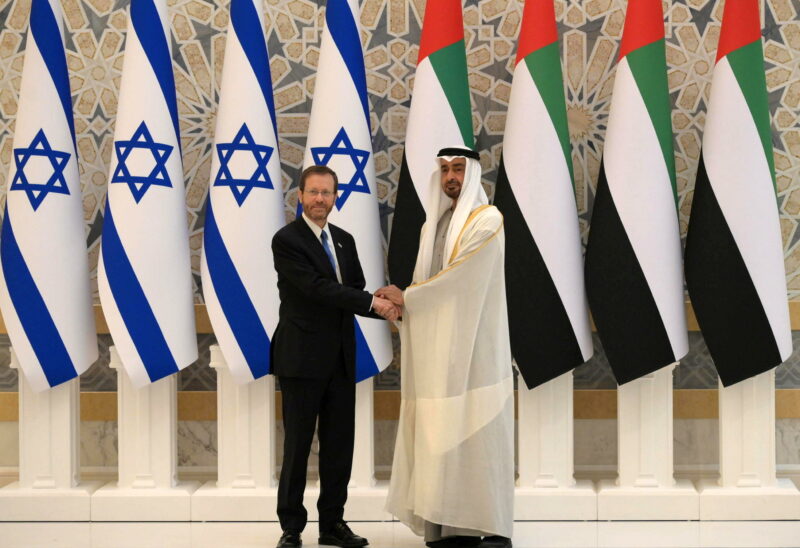
Yet, no convincing justification remained for the bold steps the UAE took thereafter. In 2020, Abu Dhabi joined the “Abraham Accords,” paving the way for full normalization with Israel. This move sent shockwaves through the Arab public, especially since the Arab-Israeli conflict remained unresolved according to the 2002 Arab Peace Initiative. That initiative, proposed by then-Saudi Crown Prince Abdullah bin Abdulaziz, offered full Arab recognition of the Hebrew state in exchange for the establishment of a Palestinian state on the 1967 borders and a resolution to the refugee crisis.
A warm normalization
The Emirati normalization was not “cold,” as is the case between Egypt and Israel. Rather, it was a “warm” normalization, characterized by a mutual exchange of all forms of cordiality and cooperation—be it economic, political, or security-related—at both official and popular levels. Even the UAE’s staunchest defenders struggled to find a justification for its actions. A few attempted to frame it as an Emirati desire to maximize economic and geopolitical gains, operating on the premise that Israel represents the “royal gateway” to securing defense, security, and technological advantages from the White House.
Opponents of Abu Dhabi’s stance, however, viewed the move as an attempt at geopolitical repositioning—one through which the UAE could divest itself of any commitments toward regional causes. This, they argue, facilitates its integration into emerging regional alliances, far removed from any regional hegemony exerted by Saudi Arabia or others.
The UAE is betting its future in the region on alliances with non-Arab powers. On this basis, it has become embroiled in fronts where it has no significant interests, or where its interests could have been secured through far more diplomatic means.
Flexing muscles
In a video clip that circulated in September 2024, Ebtesam Al-Ketbi, President of the Emirates Policy Center, acknowledged her country’s support for the Rapid Support Forces (RSF), citing the existence of Emirati interests in Sudan that require protection. However, the most significant part of her remarks was her assertion that her country has become a “major player with muscles.”
When placing this statement alongside those of other Emirati officials over the past two years, a clear picture emerges: Emirati initiatives and their trajectory are unmistakable. This is precisely the “standing and direction” Al Otaiba referenced. Abu Dhabi is no longer content with merely receiving support from a superpower like the United States, nor is it willing to remain hostage to the dictates of regional powers like Saudi Arabia.
The UAE is a small country in terms of landmass and population compared to neighbors such as Saudi Arabia and Iran. However, its oil abundance has generated immense financial wealth—multiplied exponentially in recent decades through major investments in vital sectors across the world’s leading nations. This wealth has been further bolstered by securing control over key geopolitical nodes, primarily through acquiring management rights for some of the world’s largest and most significant ports. These monumental successes and vast fortunes, both domestic and foreign, have emboldened the UAE to project political influence.
The only obstacle to these ambitions is the presence of regional powers that will not tolerate such Emirati expansion. For this reason, the UAE has chosen to align itself with powers that share similar orientations and circumstances—namely Israel—so that together they can weaken the region’s heavyweights, clearing the path for their own expansion and the consolidation of their influence.
Coordination with Israel
Abu Dhabi has found in Tel Aviv an ally that mirrors its own characteristics: small landmass and population, coupled with an inclination toward expansion and the assertion of dominance. Crucially, this new ally possesses a track record of achieving its objectives through broad Western alliances, significant advancements in military industrial software, and economic diversification.
Consequently, Emirati boldness cannot be read in isolation from this alliance, which came to light through the Abraham Accords. Simultaneously, it is impossible to rule out that both parties are operating in full coordination—a reality made evident by their aligned stances on various regional issues and the nature of the factions they support.
Through this undeclared alliance, one can better understand the Emirati position regarding the Israeli-American war against Iran. As the United States utilized its military bases in the Gulf states to launch strikes against Iran, those states bore the brunt of Iranian retaliatory attacks on their facilities and infrastructure. Furthermore, those nations resisted American pressure to be drawn into a direct war against Tehran.
However, Abu Dhabi did not subscribe to this collective stance. Numerous Iranian reports have indicated that the UAE is no longer content with merely supporting the Israeli-American war efforts through logistical and technical facilities for military operations against Iran; rather, it has effectively become an indirect partner in the conflict.
An Iranian view of the UAE
This Iranian perception of the UAE has prompted Tehran to reclassify the Gulf state as an actively involved party in the conflict. Consequently, the Port of Fujairah was subjected to an attack attributed to the Iranians. While many analysts rightly argue that the attack was not merely an act of revenge against the UAE, it was intrinsically linked to the joint efforts of the UAE and the United States to undermine the strategic importance of the Strait of Hormuz. This is being achieved by bypassing the Strait and rerouting oil flows to Fujairah, which can be accessed without transiting the waterway.
A connection can be drawn between the UAE’s decision to withdraw from OPEC and the targeting of the Port of Fujairah; Abu Dhabi has begun to act openly as a partner to President Donald Trump’s administration—both in the war effort and in his initiatives to stabilize oil prices.
Oil prices, which surged exponentially following the war on Iran, represent the sole factor pressuring the U.S. administration to halt hostilities, even without a decisive victory. The administration’s hesitation to escalate the war stands in stark contrast to the position of Tel Aviv, which seeks to prolong the conflict until the total collapse of the “mullah regime” in Tehran.
Thus, by withdrawing from OPEC, the UAE presents itself as a solution capable of flooding the global market with exceptional quantities of oil, unconstrained by the organization’s quotas. Abu Dhabi believes that by doing so, it resolves President Trump’s predicament and alleviates the pressures he faces ahead of the midterm elections, thereby enabling him to pursue the war until a decisive victory is achieved—an outcome desired by both the UAE and the Hebrew state.
Saudi conviction
However, affairs in the Middle East do not always unfold according to the wishes of its actors; every party has its own calculations and interests that it will not easily relinquish.
Saudi Arabia recognizes that Abu Dhabi’s withdrawal from OPEC is aimed at stripping the “oil card” from its hands. Consequently, it was hardly surprising when American sources revealed to NBC News that Saudi Arabia had refused to grant the United States permission to use Prince Sultan Air Base, southeast of Riyadh, for aircraft sorties or for overflight rights in support of “Project Freedom.”
The Kingdom has become convinced that de-escalating tensions with Iran serves its interests and prevents the perpetuation of a war from which Israel or the UAE might reap geopolitical gains. Thus, the Gulf is no longer a monolith, and the visions among its capitals regarding Iran are no longer unified. Everyone in the region has re-evaluated their positions in light of the “big picture” that the war’s outcome might produce.
This Saudi stance stems from a reading which suggests that any regime change in Tehran could grant Abu Dhabi and Tel Aviv immense influence by eliminating a major regional rival. This would allow them to jointly lead the region and, furthermore, enable them to monopolize regional files in a manner that serves their ambitions and orientations, ultimately to the detriment of Riyadh and its regional leadership.
The Sparta Complex
In my estimation, the experience of the UAE—a small state attempting to exert significant influence that far exceeds its geopolitical capabilities—is not a new phenomenon in history.
One of the fundamental geopolitical realities that led to the fall of Sparta was military attrition, demographic decline, and economic frailty. If history, as they say, repeats itself, then its recurrence often manifests as a farce.
Regardless of the financial abundance the UAE enjoys, it remains a small nation, seemingly ignoring the reality that it was formed only decades ago as a federation of smaller emirates. During those decades, it thrived by presenting itself as a politically neutral state, detached from conflicts. This neutrality encouraged vast amounts of capital to seek refuge there, in pursuit of both protection and profit maximization.
Today, however, by aligning itself politically with one side against another, the UAE has transformed itself into an arena of conflict and a targetable state. This situation deals a fatal blow to its reputation as a premier tourist destination and a safe haven for capital, trade, and investment. The consequences of its actions are already manifest—observable and subject to scrutiny and re-evaluation by many of its partners.
The UAE, like Sparta, is not a large state capable of weathering major shocks. It possesses nothing but a “model” that it attempts to inflate and aggrandize through the exercise of geopolitical influence. Yet, it now finds itself wielding the very pickaxe that could demolish this model; and should that model fail, everything else will collapse.
Great nations may be poor, but they are rich in population, national unity, history, and geopolitical advantages. These are not merely theoretical assets; they manifest themselves in times of challenge. The UAE, conversely, is akin to a corporation: if it cannot sustain its growth, it will face no option but liquidation.
After the storms subside
The accountability the UAE faces for its stance will not be merely financial, as the domino effect will inevitably take hold once the storms of war subside. The smaller emirates within the federation may find themselves paying the price for positions they did not personally adopt. Regardless of the rumors regarding rifts among the ruling families of the seven emirates over Abu Dhabi’s policies, it is simply illogical to claim there is no internal dissent regarding the UAE’s recent departure from a model that prevailed for decades. Consequently, we may witness in the coming years a re-evaluation of the feasibility of remaining within this union if the costs prove too exorbitant.
More importantly, however, once the storms settle, we will inevitably witness a grueling round of political maneuvering in which enemies may transform into friends. In such a scenario, these new allies might agree on disciplining those who broke ranks or those whose ambitions lured them into challenging the major powers.
In the recent war, all the UAE did was simply surrender the very model that gave it its value. It will be difficult for it to hope to rise or succeed with a different one, in a region that knows nothing but perpetual conflict and shifting calculations.