


The convergence of these nations’ interests, coupled with the retreat of traditional powers from regional security management, will breathe life into such an alliance.
The convergence of these nations’ interests, coupled with the retreat of traditional powers from regional security management, will breathe life into such an alliance.
A few years ago, even the most optimistic observers would not have dared to imagine the Middle East, or the Islamic world at large, witnessing an alliance between its traditional or central powers. This was simply because those powers were embroiled in varying degrees of dispute and rivalry.
The rivalry between Egypt and Türkiye was stark and overt following the ousting of the Muslim Brotherhood-led regime. Similarly, relations between Ankara and Riyadh witnessed unprecedented levels of tension following the assassination of Saudi journalist Jamal Khashoggi on Turkish soil at the hands of individuals linked to the Saudi apparatus.
From hostility to cooperation
However, the normalization of relations between Egypt and Türkiye, coupled with Riyadh moving past its differences with Ankara, paved the way for these actors to coordinate during the Israeli war on Gaza that erupted in 2023. This coordination served as a prime opportunity for these nations to explore areas of convergence aimed at safeguarding the regional order and fending off the threats posed by the Hebrew state to their respective interests.
Consequently, as Israel’s unrestrained aggression in the Middle East persists—marked by its strikes on Iran and attempts to embroil the United States in the conflict—it was hardly surprising that the region’s influential states found themselves facing a test that demanded proactive leadership. This comes after Israel has repeatedly declared, through Prime Minister Benjamin Netanyahu, that its actions are aimed at redrawing the maps of the Middle East.
This overt scenario, which Tel Aviv is implementing on the ground in defiance of all red lines and international law, strikes in every direction and undermines all regional interests. In the occupied Palestinian territories, this plan seeks to displace the people of the Gaza Strip—a direct threat to Egypt’s interests and strategic calculations. Furthermore, it disrupts global trade routes, depriving Egypt of significant hard currency revenues typically generated by maritime traffic through the Suez Canal. Simultaneously, it encroaches recklessly upon Syrian territories, which constitute a vital depth for Turkish security interests, potentially signaling direct confrontations between Ankara and Tel Aviv.
Geopolitical earthquakes
The Israeli scenario does not stop at neighboring states; the strikes on Iran threaten the collapse of the Iranian regime, which could trigger geopolitical earthquakes across the Arabian Gulf. Such tremors would not only jeopardize the economic interests of Gulf states—specifically by disrupting oil production and trade—but also pose an existential threat. As relatively young states with tribal foundations, they may lack the resilience to withstand such upheavals, potentially driving them toward the abyss and leading to the dissolution of their borders.
The Gulf states are not alone in fearing the repercussions of an Israeli-American war on Iran. Even distant Pakistan is wary of such scenarios, driven by pragmatic rather than emotional or ideological motives. Despite being a Sunni-majority state neighboring Shia-majority Iran, Pakistan perceives a supreme national interest in the stability of the regime in Tehran.
Pakistan shares a long border with Iran, and any collapse of the regime could open the door to chaos within the clerical state. Any internal strife or security disintegration would have a direct impact on Pakistan’s border regions, particularly the province of Balochistan, where armed groups are already active. Furthermore, Pakistan is home to a significant Shia minority; consequently, it fears that any major upheaval in Iran could tip the sectarian balance within its own borders and exacerbate domestic tensions.
Put plainly and unequivocally, Islamabad fears a recurrence of the post-2003 Iraq invasion scenario, where the state’s collapse facilitated the rise of militant groups like Al-Qaeda and, later, ISIS. Pakistan dreads a repetition of this pattern on its doorstep. Furthermore, Islamabad believes that any radical change in Iran could reshape regional alliances, potentially granting India greater leverage in West Asia—a development that would run counter to Pakistan’s strategic interests.
A high-stakes litmus test
For all the aforementioned reasons, the four nations (Egypt, Türkiye, Saudi Arabia, and Pakistan) viewed the Israeli-American escalation against Iran as a direct blow to their interests and a latent threat to the future of regional maps and the fragile regional balance of power.
These nations realized that any victory over Iran would constitute a strategic Israeli gain, granting it regional hegemony. Consequently, their reactions to the war came as a surprise to many. Türkiye overlooked Iranian missiles that accidentally landed on its territory, while Egypt maintained a reserved stance regarding the conflict. Even Saudi Arabia, despite being subjected to some Iranian strikes, refused to be drawn into American and Israeli attempts to embroil it and other Gulf states in the war. Pakistan, for its part, positioned itself as a suitable venue for ceasefire negotiations, and the four nations played a pivotal role in these efforts during their representatives’ presence in Pakistan.
The war on Iran served as a high-stakes litmus test for the resolve and determination of these nations to prevent Israel from unilaterally dominating the interests of our region and the Islamic world. It appears, according to many observers, that the efforts of this ‘Islamic Quartet’ could form the nucleus of a deeper rapprochement and more transparent coordination. While the results of this test may have solidified the decision-making within these four capitals on this matter, the most critical question remains: what form will this rapprochement and coordination ultimately take?
A starting point
The Israeli media is closely monitoring these developments with grave concern. According to the Israeli platform ‘NzivNet,’ there are concerted efforts to form a regional ‘Quartet Alliance’ comprising these four nations. The objective of this alliance is to redefine the regional balance of power, underpinned by a Pakistani nuclear umbrella.
The Hebrew news platform indicated that these endeavors stem from a desire to reshape regional security equations independently of Western powers. Moreover, this move represents an attempt to counterbalance the geopolitical ambitions and influence of both Israel and Iran alike.
While the precise structure of this anticipated alliance remains unclear, it will likely create a margin for political maneuver against Israeli machinations in its dealings with Washington regarding regional conflicts. Furthermore, the inclusion of Pakistan as a nuclear-armed state will constrain Israel’s military freedom of action in the region, while simultaneously diminishing Iranian influence.
However, achieving this objective is contingent upon the alliance’s ability to walk a tightrope, ensuring they do not trigger the anxieties of other parties or inadvertently spark a regional arms race.
In my estimation, the more these nations expand their cooperation beyond the framework of a traditional military alliance, the more likely they are to achieve their objectives and attract further partners. Effective diplomatic coordination, deep integration in military and technological manufacturing, and structured security understandings that prioritize common ground—these elements combined could grant this alliance genuine weight in an increasingly multipolar world. This is especially true given that each member state brings a unique added value to the collective strength of the group.
Nonetheless, there is no reason why the starting point should not take the form of a quadrilateral security cooperation framework. As reported by the British outlet ‘Middle East Eye’ a month ago, such a framework would aim to bolster coordination on defense and security issues and confront the shared regional challenges that currently represent the primary pressure points on the region.
A double-edged sword
According to observers, the anticipated cooperation initiative mentioned by the site does not aim to establish a binding defense alliance patterned after traditional models. Instead, it seeks to create a flexible cooperation platform focused on coordinating efforts and enhancing the autonomous capabilities of the four nations, in light of the mounting security challenges currently facing the region.
In my view, this formula represents a double-edged sword. Developing a framework for institutional cooperation that spans multiple fields—such as intelligence sharing, coordination against transborder threats, and defense industry collaboration, in addition to establishing continuous political consultation mechanisms—reflects a profound understanding of the differing strategic calculations and the sensitivities of various regional actors regarding the emergence of such an alliance.
While this approach allows the concept to mature and stifles any perceptions that might trigger the formation of counter-alliances, it could simultaneously sow the seeds of its own destruction during the first real test where the interests of the four nations collide.
An Unfolding Vision
The ‘Middle East Eye’ report states that the discussions represent an extension of a trajectory of bilateral rapprochement witnessed over the recent period. This path has included the signing of security and military agreements among several of these states, as well as the expansion of cooperation in defense industries and related trade exchanges.
However, this perception suggests that such endeavors are merely a reactive response dictated by current circumstances, rather than a reflection of deep-seated convictions regarding the long-term necessity of such alliances. Notably, the British report indicated that these nations are conditioning future steps on mutual trust-building and the development of regular communication channels to coordinate positions and bolster regional stability.
Such terminology, amidst the geopolitical upheavals the region has witnessed for years, confirms that the vision for this alliance has yet to fully mature—even though the combined potential of these four nations invites a formidable and robust coalition that far exceeds their currently modest ambitions.
Strategic power assets
These four nations possess the collective potential to establish an institutional alliance capable of imposing a new balance of power across Eurasia and the Middle East. Saudi Arabia commands vast financial resources, while Türkiye boasts a robust civilian and military industrial base. Meanwhile, Egypt and Pakistan offer a demographic weight and market scale that are simply too significant to be overlooked.
Furthermore, these nations collectively possess unique geographical control over the world’s most critical maritime trade arteries. Egypt and Saudi Arabia, for instance, overlook the Suez Canal and the Red Sea, through which 12% of global maritime trade and 10% of seaborne oil trade pass. Türkiye, meanwhile, controls the Bosporus and Dardanelles straits, the conduits for a vast portion of global wheat exports and Black Sea energy shipments. Pakistan, for its part, overlooks the Arabian Sea and the port of Gwadar, providing it with a strategic vantage point for accessing the Indian Ocean.
Additionally, the combined Gross Domestic Product (GDP) of this prospective alliance exceeds $3.3 trillion, supported by advanced infrastructure capable of seamlessly circulating and absorbing intra-alliance capital flows. Furthermore, the collective military expenditure of the four nations surpasses $100 billion annually, positioning the coalition among the most influential defense powers globally.
Consequently, any institutionalized alliance between these nations could easily exert a genuine and effective influence on reshaping regional security equations and informing global policies—provided their respective capabilities are correctly leveraged within the coalition.
Türkiye, for instance, could lead joint military manufacturing, while Pakistan specializes in strategic deterrence, utilizing its nuclear capabilities, advanced fighter jets, and missile systems. Meanwhile, Saudi Arabia and Egypt could deepen their integration by mobilizing their combined financial, human, logistical, and geographical assets. This functional synergy is the essential starting point that must precede any discussion of comprehensive military and defense integration, which fundamentally necessitates a high level of political alignment.
Regional Self-Reliance
According to an informed Egyptian source, discussions regarding this regional alliance remain in their nascent stages. Above all, the source emphasized that such an endeavor requires building a security integration framework rooted in self-reliance—a task that remains difficult to achieve in the current climate.
However, according to the same source, the very existence of this idea confirms that these nations now clearly recognize the futility of relying on extra-regional powers to safeguard their interests.
“Due to the challenges they currently face, traditional global powers are no longer prioritizing the region. The European Union, for example, played a pivotal role in brokering the 2015 nuclear deal between the United States and Iran; however, in the current conflict, this role has significantly diminished,” the source said.
He pointed out that the ‘Islamic Quartet’ initiative to end the war represents the first practical manifestation of their recognition of this new reality and their conviction that they must safeguard their interests through their own agency.
Regional Ownership Doctrine
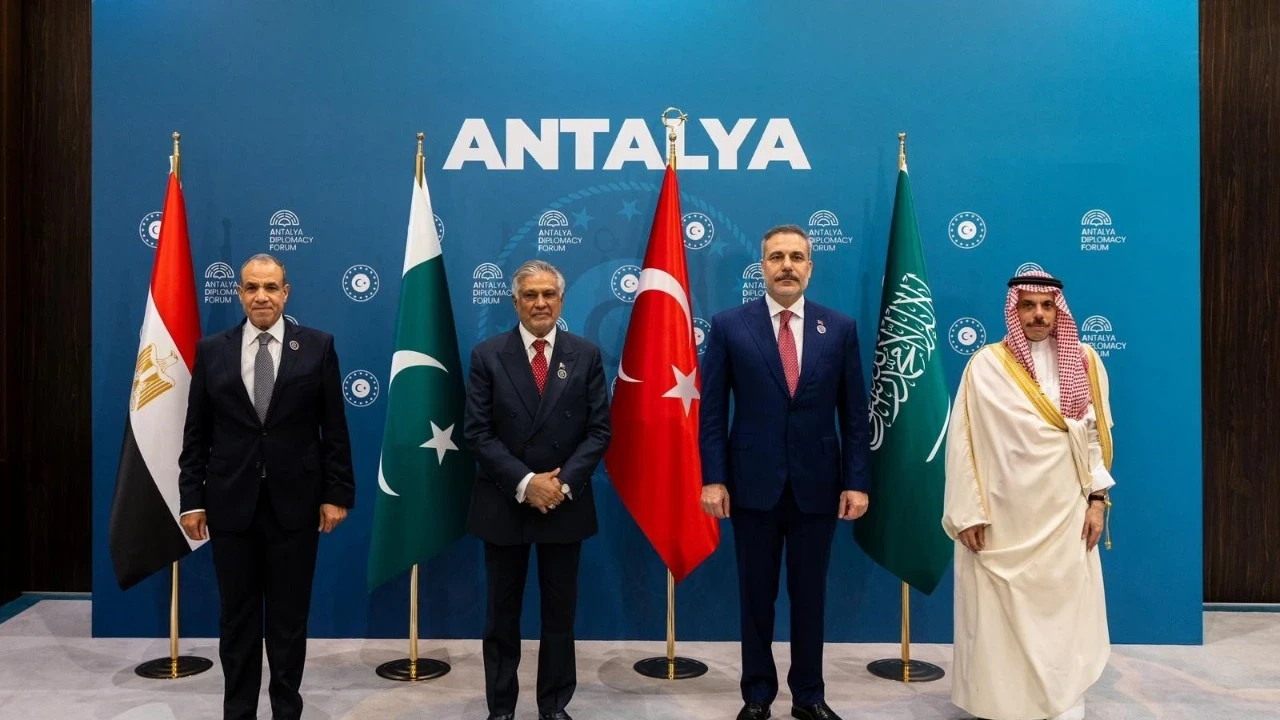
According to another source, the meeting of the four foreign ministers a few days ago on the sidelines of the 5th Antalya Diplomacy Forum further reinforces these new convictions. Their discussions focused on finding solutions to regional issues under the principle of ‘Regional Ownership’—a doctrine predicated on resolving the region’s problems without foreign interference.
“This meeting was the third within a single month, following two previous gatherings: the first in Riyadh on March 18, and the second in Islamabad on March 29. This rapid succession reflects a high degree of seriousness in coordination between these nations, regardless of whether these efforts eventually evolve into a formal cooperation framework or a structured institutional entity that serves the region’s interests,” he said.
“While these four nations are classified as middle powers, they remain highly influential actors within their respective geographic spheres. As the parties with the most to lose from instability, their prospects for success are high; their cooperation is rooted in a strategic necessity to safeguard security, national, and economic interests. These interests have been severely compromised by three years of regional warfare, fueled by Israel’s unrestrained actions,” the source added.
Fading Trust in Washington
In my personal estimation, the convergence of these nations’ interests, coupled with the retreat of traditional powers from regional security management, will breathe life into such an alliance. However, the catalyst that will accelerate its growth and prevent its members from backtracking is the fact that the region has fundamentally lost confidence in the United States.
Over the past years, Washington has failed to demonstrate any commitment to its promises regarding the establishment of a Palestinian state. Furthermore, it has remained indifferent to all appeals to compel Israel to end the war or to halt its violations of international law.
Even the Gulf states, which maintain mutual defense agreements with the United States and host American military bases established specifically for their protection, have seen these assets exploited to the detriment of their interests and in favor of Tel Aviv’s crimes. Washington remained indifferent when Israel struck the Qatari capital, Doha, to assassinate Hamas members—despite the fact that Qatar was hosting them specifically to facilitate communication and negotiations aimed at ending the war.
This incident, despite its atrocity, was initially overlooked under the assumption that it was merely a ‘blunder’ by an ally. However, this American perspective toward the Gulf states was solidified when Washington committed every possible resource to shielding Israel from Iranian strikes, while leaving the Gulf nations to face Iranian attacks alone. It was as if all the wealth spent on purchasing American protection had simply vanished into thin air.
This lesson was not intended for the Gulf states alone; it served as a wake-up call for all of America’s allies—including the nations of the ‘Islamic Quartet.’ These countries are now coordinating among themselves, driven by the urgent need to salvage what can be saved in the years to come.