


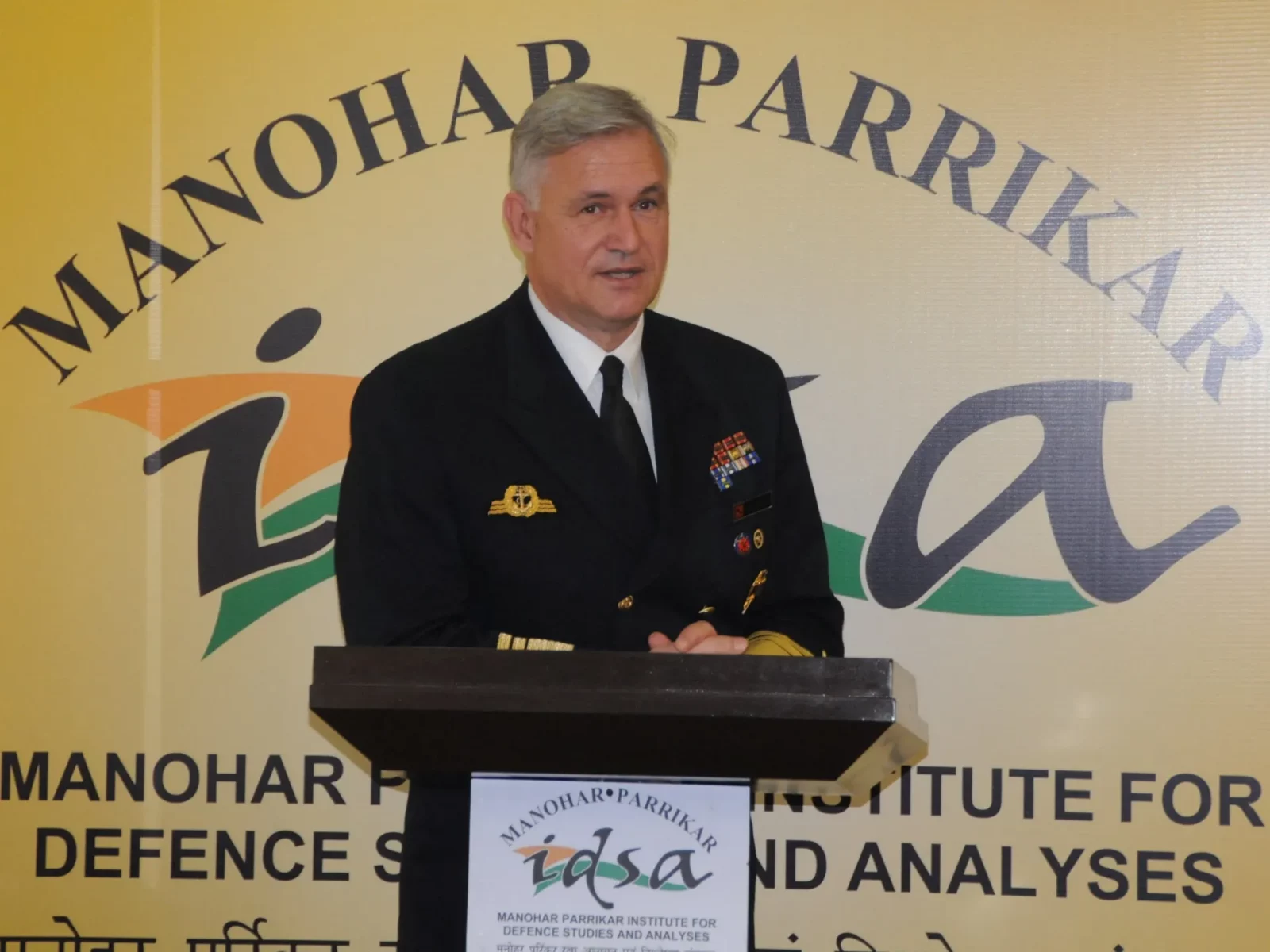
Interview with the former Head of the German Navy, Vice Admiral Kay-Achim Schönbach, on Germany’s new military strategy, the proxy war in Ukraine, and domestic troubles.
Interview with the former Head of the German Navy, Vice Admiral Kay-Achim Schönbach, on Germany’s new military strategy, the proxy war in Ukraine, and domestic troubles.
By Yunus Emre Özgün
Caught between a self-inflicted economic disaster and a mandated military buildup, the German state is navigating a geopolitical minefield. In an exclusive interview with UWI Data, retired Vice Admiral Kay-Achim Schönbach dissects Berlin’s new April 2026 military strategy (Militärstrategie und Plan für die Streitkräfte Verantwortung für Europa). He exposes the dangerous “blind loyalty” tying Germany to a proxy war in Ukraine, the establishment’s silence over the Nord Stream sabotage, and the alarming rise of domestic illiberalism that threatens the very democratic fabric of the republic.
The tectonic plates of European security are shifting rapidly. Following the release of the highly anticipated April 2026 Military Strategy, Berlin has signaled its intent to forge the strongest conventional army in Europe. Yet, this militarization unfolds against a backdrop of severe deindustrialization, fractured energy infrastructure, and an escalating suppression of free speech.
A staunch strategic realist, the former naval commander delivers a searing critique of Germany’s current trajectory, demanding a return to hard national interests and pragmatic diplomacy.
The “Parabellum” Posture and the Mirage of European Autonomy
UWI: Admiral, the April 2026 military strategy explicitly aims to make the Bundeswehr the strongest conventional army in Europe. While officially targeting Russia, the document notes the US strategic pivot to the Indo-Pacific and demands that Germany build independent, national, and European projection capabilities. From a realist perspective, is this massive rearmament truly about preparing for a kinetic war in the East, or is it a covert step toward European military autonomy and independence from the US security umbrella?
Kay-Achim Schönbach: First of all, the publication of the military strategy now just in April, just a couple of weeks ago, was a deliberate move for the first time after such a long time, to produce a document that underpins the calls to rebuild the German Armed Forces with a view to perhaps eventually becoming, as you said, the strongest conventional army in Europe. And just a brief aside, because I just read it, I think it was yesterday in one of the French or was it a British newspaper, the well-known writer Carton Ash recently remarked that this declaration of an intent to rebuild a stronger German military is stirring up unease in Germany’s neighboring states. I don’t know if this is correct, but he said it. So one can therefore only hope that our politicians and officials will adopt a considerate and politically, not politically correct, but politically sensitive tone.
But you’re right. The document is certainly directed at Russia and its language, yet it also contains an indication of how Germany intends to position itself in an omnidirectional manner on the international stage. So also to, probably to the Far East. To answer your question specifically, I say, Si vis pacem, para bellum—if you want peace, prepare for war. Since 1945, as I said, Germany has not had any kind of military strategy. We have white papers and such, but no military strategy in such a concrete form of this document. And the last white paper was published several years ago. So, a new document was certainly necessary to ultimately document both internally and externally where and for what purpose the German government intends to direct its armed forces.
Regardless of how one assesses the Russian invasion of Ukraine, and you know, my problems with that, in terms of the wider European context and the strategic balance, it cannot be denied that Germany perhaps needed a so-called trigger more than other countries to realize that the Bundeswehr situation requires re-equipment or rearmament in order to be put in a position to successfully withstand a conflict in the probably near future. So in this respect, this document… can also be seen as being directed at what is regarded in Berlin as the most likely adversary, namely the Russian Federation. But also, you’re right, beyond that, it is also about Germany in conjunction with other nations in Europe, by which I mean the European NATO member states, strengthening the so-called European or Euro pillar of NATO.
Does this really mean genuine European military autonomy? In other words, does Germany want NATO Europe to be able to act independently of the United States of America, or is it ready and willing to separate from the US in the midterm? I don’t think so. I cannot detect any desire amongst the political elites of the Federal Republic of Germany to actually take this step towards a separate autonomy. But one of the key lessons of the Second World War is that the US and Europe were, and remain, I think so, not to abandon the European continent again. And Germany cannot want that either. So, I wish to make it clear that this is certainly more than just the nuclear doctrine that affords Western European states security. In conventional terms, too, and aspects of cyber and space warfare, it is a partner that is the US, it’s a partner that is decades ahead of the European states. The focus on US President Donald Trump, who by no means represents the US as a whole, is characterized by dangerous shortsightedness.
Should the US actually withdraw from Europe, the possibility of development similar to that during the interwar period from 1918 to 1933 is not inconceivable. So, to summarize your question, the war in eastern Ukraine was a fresh wake-up call for Germany and for Europe. The new military strategy is therefore merely a logical consequence within the hierarchy of documents in the German security sector. The most likely adversary and the so-called worst-case scenario would be a war against the Russian Federation in response to a possible attack on a NATO partner, such as in the Baltic area. But the Bundeswehr rearmament efforts are therefore logical. But personally, I am an advocate of the sui generis principle, which means the sovereign nation has an inherent right and duty to establish its own strong armed forces.
How sustainable is this militarization with a historically pacifist German public?
For some time now, I would say for at least 10 years, probably 15 years, there has been and still is a surprisingly clear majority among the German population in favor of improving the Bundeswehr’s military capabilities and consequently of increased investment in its defense. We had always 0.9% of the GDP, now it came to 2%. Then, 2% what is said in Wales, the NATO summit is now 3%, and is now going up to 5%. I think this is linked, not solely to the war in Ukraine. It is about the public perception that the shifts in power in the geopolitical arena, the resurgence, if you want so, of the Russian Federation, the increasingly aggressive stance of the People’s Republic of China, and not least an intellectual detachment, or rather distancing, of the US from the fortunes of Western Europe, now affect the security of every individual. You feel it, you can perceive it.
So, you’re right, historically speaking, since 1945 at least, a certain pacifism has taken root among the German population. The heyday of this German variant of a denial of reality came with a rearmament linked to the NATO double-track decision in the late 70s and early 1980s. The latest, however, with the events of the Maidan in Kyiv and the war in eastern Ukraine, public perception has shifted. But as I said, it was not just the war in eastern Europe, in the Ukraine per se, but the perceived increase in wars and military conflicts around the world, perceived, because many of the conflicts and skirmishes around the world have now found their way more strongly into the living rooms of the German public, thanks to the media presence of bloggers like you, and social media activists.
In fact, however, I think that if peace breaks out in eastern Ukraine this year or next, many mayors, district administrators, or other local and regional political representatives will call for the reallocation of funds previously earmarked for the Bundeswehr. So I think at the end, pacifism is a hard thing for Germany, it was always triggered, but I hope that the responsible people in the government and the parliament will draw the right and pragmatic conclusions from other problems we have, like the failed energy transition and many post-bomb reforms.
Economic Sabotage and the “Homegrown” Disaster
That brings us to the economic front. The 2026 document stresses that modern warfare targets the state and the economy. Yet, materially, the most devastating threat to German industry today isn’t a Russian missile; it is the sabotage of Nord Stream, the forced reliance on expensive US LNG, and deindustrialization driven by the US Inflation Reduction Act (IRA). How do you evaluate this objective material conflict between Washington and Berlin?
You’re right, of course. At present, this day, a Russian missile worries me less. Not zero, but less. And I think this also applies to sensible people in the government district in Berlin, and the devastating situation and developments in the Federal Republic of Germany regarding the economy, as you said correctly, energy, infrastructure, and its role in foreign policy. The sabotage of North Stream 2 has, of course, returned to the center of investigations in recent weeks. It was quite calm, it was light stone, but now it comes back into focus.
As far as I’m currently aware, as far as I know, this was carried out by Ukrainian soldiers, so to say, special forces, I don’t know, possibly with the knowledge of the Ukrainian leadership. And if so, the necessary conclusions for a government or country under such an attack, even if it comes from a supposed partner or even an ally, are relatively clear. This probably applies to the majority of countries in the world, but not so for Germany, at least now. The German government, and not just the current one, the current administration, but the previous administration as well, has unequally sided with Kiev and is now unable to extricate itself from this dilemma. Even though I have personally been accused in the past of being an unconditional supporter of Russia and its president, and that was wrong even then, I nevertheless urge the German government to take a more resolute and tougher stance against the Ukrainian leadership, the president, and the government, particularly on this issue of sabotage.
Yes, this (the US-LNG and IRA) does indeed influence the economy in Germany, and it shifted dependence away from the Russian Federation and towards the United States of America with regard to oil and gas. That’s correct. But nevertheless, and we have to be honest with ourselves in Germany, the processes and decisions that have led to this economic disaster, what we see right now, with a seemingly unstoppable downward spiral, are 90 percent, or probably even more than 90 percent at least, homegrown. In my opinion, and this reflects what has already been said, Germany needs an overarching strategy that addresses all key policy areas and steers us away from what has happened in recent years in Germany, which steers us away from the ideological politicization of all sectors of society. It is not just foreign policy, police, and economy; it goes much deeper.
So, what Germany needs, and I’m firmly convinced that the majority of people in our country want this too, is a pragmatic, fresh start, without any kind of ideology. Reset, so to speak. So we must accept the dominance of fossil nuclear energy sources in the coming years. And as a nation and an ally, we must have a strong army worthy of the name. As a country with few natural resources, we need an educated, highly functional society. We need infrastructure in our country, both conventional and digital, that meets the demands of the 21st century. We all know that.
And even though you didn’t ask, our biggest problem at present, and we heard that last year at the security conference by the Vice President of the US, JD Vance, a very good speech, is the growing public perception that freedom of expression, freedom of speech, and freedom in general are being too severely restricted. A country that does not respect and, so to speak, nurture these vital pillars of a functioning democracy is doomed to a creeping decline. Once again, it is not the Russian missile that worries me. The growing climate of illiberalism in my country is my greatest concern.
And last but not least, when this ill-fated war is over, because it is, of course, the war is wrong, we all know. All wars are wrong, probably, except for self-defense. But when this is over, trade relations with Russia must be resumed without any ifs or buts. Only if we reach out to Moscow again, in the medium term, not forgetting what happened, will we have a chance for more lasting peace. That does not mean we have to accept everything that Russia wants. However, we must certainly respect the fact that Moscow, too, has legitimate interests on its western border. And that does not mean appeasement. It is in all our interests to have good relations with Russia, and in doing so, to eliminate it, once again, from the real winner in the background, what is always forgotten, the People’s Republic of China. This is the real winner in the background.
The Eurasian Disconnect and the Trap of “Nibelungentreue”
Historically, Germany’s wealth relied on a synergy of cheap Eurasian energy combined with exports to markets like China, Russia, and Türkiye. By perpetuating the proxy war in Ukraine, Europe is effectively severing itself from the Eurasian landmass. What is the true long-term cost of these pro-war policies on Europe’s prosperity, and how vital is a peaceful resolution in Ukraine?
It’s an interesting way of putting it, and especially when you say proxy war. Normally, we say it always when we look at Iran, but you’re right, it’s an interesting way to express it. If, as I mentioned earlier, a ceasefire or a peace agreement is reached within the next year or two, as I hope, it remains to be seen whether European diplomacy will be able not only to dare to make a fresh start, but also to achieve it successfully. We just heard it yesterday when Vladimir Putin brought the former German Chancellor into the game, and you see what the European and German reaction was. No, no, no way.
So as a graduate, and I was a graduate of the German-Ukrainian officer seminar, and through the contacts I had during my active service and continue to have with former Russian admirals, I’m both surprised and pleased, really pleased by an interesting attitude within military and diplomatic circles in the Russian Federation. Of course, my contacts are not representative enough to make a definitely accurate prediction, but I think they are good enough to sketch a reasonably reliable assessment of the real mood in certain cycles. They are, and this is an unamused view, there is a definite desire to restore the good relations with Germany that were previously maintained. Unlike the UK, which is historically perceived in Moscow as a rather unreliable partner, so to speak, derived from the great game fight during the 19th century, or Paris, which vacillates back and forth always, even in the relations with us, Germany is seen as an important, but important dialect partner for the future still. This, broadly speaking, is the prevailing expectation in the circles with which I have contact.
The costs, the actual costs of the policy that provides Ukraine with such sustained support and supplies, equipment, financial aid, expertise during the war, medical service, and above all with political backing, are enormous. Not just what we give to Ukraine, but also what we are denied from taking from Russia. So even more than these sheer figures, the funds transferred to Kiev, the growing domestic political debate about the imbalance in financial support for its own citizens of Germany in this disastrous and becoming more and more disastrous economic situation, is a topic of concern for many citizens. We see it on German media, it’s really turning, I wouldn’t say it’s turning the tide of the mood, but it really changed. The atmosphere is changing right now. At present, there is no indication in Germany that responsible members of the government, of our administration, are considering a redirection or reassessment of aid to Ukraine.
I venture to use a dangerous term from German history, namely that of, I don’t know if you know it, Nibelungenloyalty, this is Nibelungentreue, just as in the run-up to the First World War, and Nibelungenloyalty meant that those days, this close relationship we had with Austria-Hungary. So in the run-up to the First World War, we have sided with Ukraine now to repel the Russian attack. Ukraine itself, however, driven solely by an instinct for self-preservation, has the greatest interest in dragging countries such as Germany and others into this war. And that is why, although I fully understand the dire situation in which Kiev finds itself, I’m nevertheless concerned about the dangerous overall situation facing our country and Europe.
And yes, maybe a truism, but considering all strategic directions where Germany, I think, is going wrong, increasingly hostile towards the East, against Russia. In the Far East, in rivalry with the People’s Republic of China, you know our former Foreign Minister called Xi Jinping a dictator. Towards the West, against the USA, whose, honestly, I don’t believe that many people really understand the geopolitical initiatives and what this is all about, in what happened in the White House. And then the danger of an overarching, overreaching European Commission under German leadership, and the migration crisis from Africa, which Germany helped to cause, and in part is still driving forward. One must be concerned that Germany and Western Europe are misjudging their own weakness and are once again taking on more than they can handle. Yes, the devastating role of morality or even moralism in politics, particularly in foreign trade policy, is the greatest threat to Europe’s prosperity.
The one theatre approach you mentioned, which has finally found its way into our new military strategy, what I think is fine, plays, and I do not wish to be a killjoy, only a minor role, is my perception, as a minor role in restoring stability to the Eurasian continent. And not because I reject or even deny this term or the idea behind it, but because I believe that this term is merely a more military version, a military version of the concept of globalization adopted from Anglo-Saxon usage. Yet history shows that we had waves of globalization early on, driven by worldwide trade, even in the 18th century or the beginning of the 19th century, which was interrupted then by national economies that subsequently tended to close themselves off. Now, however, no nation can claim to remain exclusively autonomous or self-sufficient, not even China. As this applies to the economy, it was quite clearly the case for global health during the COVID-19 pandemic, and also applies, for example, to space exploration and many other areas. It also applies to the implementation of defense and security policy by major nations.
However, this requires the necessary instruments. The fact that the Bundeswehr, and thus the Federal Republic of Germany, is concentrating on one theater, on the theater in this case in eastern Ukraine, and I think that makes it absolutely clear due to the fact that Germany, which is currently still relatively weak with its weak armed forces, would be just unable to carry out operations across a wide variety of climatic zones. What we can do is call some ships to East Asia to make a diplomatic route or something like that. But this is just now Ukraine. So whether, as I have previously argued, the funds will be made available for such a military force remains to be seen. I don’t see it for the more distant future. For I stand in my view, if there’s one constant in German politics, this is quite different, for example, to Türkiye, at least since 1945, it is that armed forces and global operations cannot be used to pursue a successful policy, politics also, that translates into votes at the ballot box. And because this is the case, and the political professionals in Germany, in Berlin, know this full well, the focus is currently still on the Ukraine issue. Once this war is hopefully over soon, as I said earlier, the focus will shift back to social and economic consolidation.
So, I’ve got off on a tangent to answer your question, the one theater mindset is holistic. Yeah, it’s okay, it’s cool. But ultimately, a federal republic that is diminishing its own stature will seek to stand shoulder to shoulder with its partners. This does not necessarily serve the stability of Europe, which was your question. Stability is achieved through balance, diplomacy on an equal footing, and the pursuit of a win-win process. What is absolutely forgotten now in this negotiation, or not negotiating the contact with Russia, we just see a win on our side, we’re not on the other side. As a former and hopefully soon-to-be revitalized power of peace, and above all, diplomacy, as I said, which is what we have always been, we Germans, we are primarily called upon to promote peace, reconciliation, and prosperity through dialogue and diplomacy. In concrete terms, this can only be achieved with Russia, not against it. Who says something else is dumb? We will have to cast aside our moral preconceptions and return to interest driven what we Germans are, real politics. And to make a compliment, Türkiye is a good example of this.
The Erosion of the Basic Law: Illiberalism and the Israeli Taboo
Admiral, touching upon the deepening crisis of free speech—experts, including US Vice President JD Vance at the Munich Security Conference, as you mentioned, are warning about the alarming rise of illiberalism in Germany. We see the political establishment harshly suppressing democratic protests against Israel’s blatant violations of international law and geopolitical exceptionalism. From a realist perspective, how dangerous is this massive disconnect between the state and the people?
I think going back to what, as I said in the first and second question, what J.D. Vance said during the security conference in Munich last year, this is not just in Germany, but we have this. I think this speech triggered more than all the criticism. We’re all over social media, not so official in the, we call it state media, the two main channels, plus radio. It triggered us a lot, and it goes much deeper than many people think. Many people in Germany, normally not interested in what happens at the security conference, know all about this speech. And now people are focused on it.
And on the same side, simultaneously, we, and I’m not a guy who has, I’m not afraid of any problems with the government. Normally, we have this joke, you have to have your coat with you always ready to take in case of the police on Saturday morning or Sunday morning at six o’clock at your front door. This is standard. We have problems with the press and freedom of speech, more and more.
But I think you connected it now with Israel or something like that. I think Germany is quite different from the rest of Europe, from the rest of the EU. And you can’t really compare them, for example, with Türkiye or other countries like that. Without what we call Grundgesetz, this is our basic law, it was so important because our patriotism and the focus of the citizens is always towards what stands there in the basic law. So this is the overarching. So if you look at America, you look at Israel, what happened there. And I think the most important thing was always to have this free speech. You express your freedom in all aspects. And this has experienced a real degrowth over the last few years.
So when I can stand you correctly, Israel is just an example of that. But of course, you certainly know that Germany’s stance and Germany’s attitude towards what happens in Israel. We’re not criticizing it. We’re also criticizing the Israeli government. But if it comes to the foundation of the relationship between Israel and Germany, I think right now it’s still a no-go, even if we have demonstrations in the streets.
I think, and I said it in one of my speeches last week with 600 guests on the set, we can look at security policy, we can look at Russia, and so on and so on, and the economy, and it’s all good. But the main factor for a successful country is what we have with the last question. It is the expression of how you live freely and express yourself in culture, in the press, in the media. It must be allowed, you must be permitted to stand on the street and criticize the government as long as you stay within certain boundaries, before you get probably court-martialed. But I think this is the most important, and we’re talking so much about Russia and other things. This is, of course, yeah, this is geopolitics, but not many people are very interested in this. It’s a small sector, a small group of people who are really interested in. But if we lose this freedom of speech and freedom at all, then nothing is left over.
*Editor’s Note: The transcript of this interview has been lightly edited for grammar, syntax, and stylistic flow to ensure readability, while strictly preserving the interviewee’s original meaning and tone.