


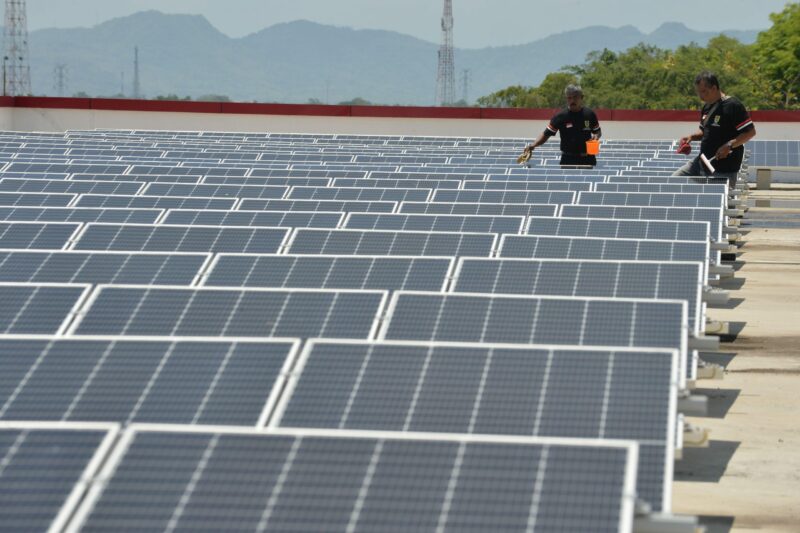
If ASEAN can couple its natural resource endowments with effective institutions and well-considered finance, it can become the leader in equitable and replicable decarbonization.
If ASEAN can couple its natural resource endowments with effective institutions and well-considered finance, it can become the leader in equitable and replicable decarbonization.
By Mehmet Enes Beşer
As the momentum of the world towards carbon neutrality picks up speed, ASEAN is at a turning point. Most ASEAN member countries have already submitted updated Nationally Determined Contributions (NDCs) to the Paris Agreement, while others have formally set themselves on a path towards net-zero in the mid-century. But these promises—beautifully worth a lot as they are—are themselves inspirational in the absence of robust sectoral blueprints and implementation overlordship. ASEAN’s largest and fast-growing source of emissions, its power sector, must be positioned at the crossroads of this transformation. It will require ASEAN countries to deeply transform their energy system through more deployment of renewables, harmonization of policies, investment in technology, and regional collaboration to shift from the NDCs to a net-zero electricity sector by 2050.
ASEAN’s energy course up to now has been one of fossil fuel dependence, population increase, and development priorities. At least 75% of the power generation in the region remains coal, oil, and gas-reliant until 2024. The coal electricity alone provides more than one-third of ASEAN’s total electricity, and Indonesia, Vietnam, and the Philippines are some of the largest consumers of coal. Despite the economic imperative to deploy renewables—due to falling solar and wind costs—the vested fossil gas and coal incumbency is facilitated by investment in infrastructure, utility planning, and pro-incumbent political economies.
ASEAN member states must move decisively on five connected fronts: technology deployment, market reform, regional integration, mobilizing finance, and transition equity, towards a net-zero power sector by 2050.
1. Technological Acceleration
The basis for the net-zero electricity system is the rapid growth of the zero-carbon technologies. Solar photovoltaics, onshore wind, offshore wind, large- and small-hydro, geothermal, and biomass all must together replace fossil-fueled generation without destabilizing the system and making it unaffordable.
Vietnam has demonstrated that deployment is possible rapidly. It installed over 16 GW of solar capacity between 2018 and 2021, demonstrating the effectiveness of feed-in tariffs and private sector engagement. Thailand and the Philippines have also made considerable solar and wind strides, though usually with usually slower regulatory timelines and spotty policy support.
Demand response flexibility and utility-scale battery storage will be essential in the future to hedge the intermittency of renewables. Grid-scale investment in inverters, together with distributed systems and smart grids, must be up-scaled. Green hydrogen and ammonia can also be utilized for seasonal storage, as well as dispatchable fuels, especially for Indonesia and Malaysia when they attempt to replace gas-fired capacity without compromising grid stability.
2. Governance Reform and Energy Market
The current power market arrangements of ASEAN—vertically integrated monopolies, hard generation planning, and administrative pricing—are not amenable to net-zero transitions. Structural change must be fostered to advance open access, competition, and innovation.
Independent power producers (IPPs), time-of-use tariffs, and open wholesale electricity markets can be utilized to release investment and increase efficiency. Vietnam’s step-by-step liberalization of its power market as well as the Philippines’ competitive electricity market, already operational, have a lot to learn from. Regulation institutions will also need to be strengthened so that grid codes, licensing, and procurement rules are harmonized with net-zero targets.
Second, long-term integrated resource planning (IRP) will have to replace ad hoc power development plans. That is, combine emissions reduction targets, renewable energy opportunities, and transmission planning into an overall adaptive plan that can evolve with new technologies and climatic risks.
3. Regional Grid Integration
A net-zero power industry is impossible across national boundaries. ASEAN’s energy heterogeneity—surplus hydropower in Laos, solar power in Cambodia and Myanmar, and high demand in Singapore and Thailand—makes cross-border electricity trade rational and unavoidable.
The ASEAN Power Grid (APG), while yet in its infancy, is the portal to a regional decarbonized power grid. An integrated grid will facilitate agglomeration of resources, balancing of loads, and reduction of curtailment, which translates to cost savings and reduced emissions. Its attainment, however, necessitates political convergence, conformity of technical standards, investment in interconnection infrastructure, and regional institutions with planning and enforcement capacity.
Singapore’s efforts to purchase clean power from regional countries, and the Lao-Thai-Malaysia-Singapore (LTMS) power trading arrangement, are first successes. ASEAN, in brief, must institutionalize the structure of regional power markets, with generic rules across ASEAN for emissions accounting, certificate trade, and cross-border tariff regimes.
4. Mobilization of Finance and Investment
Net-zero power in ASEAN will require over $1.5 trillion of clean energy investment through 2050, regionally estimated. Investment today is still far short of that.
Carbon pricing in the form of taxation or emissions trading can provide unambiguous price signals for decarbonization and generate public revenues to finance the transition. Singapore has already introduced a national carbon tax; Indonesia and Vietnam are developing market-based instruments, and Thailand has shown interest in carbon pricing. These efforts must be scaled up and harmonized at the regional level to establish an integrated carbon market.
Blended finance, green bonds, and guarantees will be essential to mobilizing private finance. Multilateral development banks and climate funds and bilateral initiatives such as the Just Energy Transition Partnerships (JETPs) with Indonesia and Vietnam will need to listen not only to financing hardware, but also to filling policy reform and capacity building.
5. A Just and Inclusive Transition
Decarbonization cannot come at the cost of excluding poor communities or undermining development goals. Indonesia and the Philippines, most notably, have the added challenge of phasing out coal use without aggravating poverty, unemployment, or energy shortage disadvantages.
Just transition calls for fossil fuel industry workers to be retrained, investment in impacted areas, and access to clean electricity for everyone. National policy should include gender equity, local ownership models for renewable energy, and community engagement. Mini-grids, rooftop solar, and community renewables have the potential to provide clean electricity to off-grid communities while improving resilience and empowering the local area.
Social protection, green skills programs, and economic diversification funds must be ready today—and not tomorrow—if the transformation is to be considered legitimate and equitable.
It will require a revolution in the NDCs to cause ASEAN to consider not only roads for emissions but also structural transformation. It’s not a technical ride towards a 2050 net-zero power sector—it’s a policy transition of priorities, a governance transformation, and a regional solidarity feeling. If ASEAN can couple its natural resource endowments with effective institutions and well-considered finance, it can become the leader in equitable and replicable decarbonization. Its choices in the next decade will either tie the regional energy future to the old carbon-based economy or to an integrated, sustainable, and climate-resilient system.