


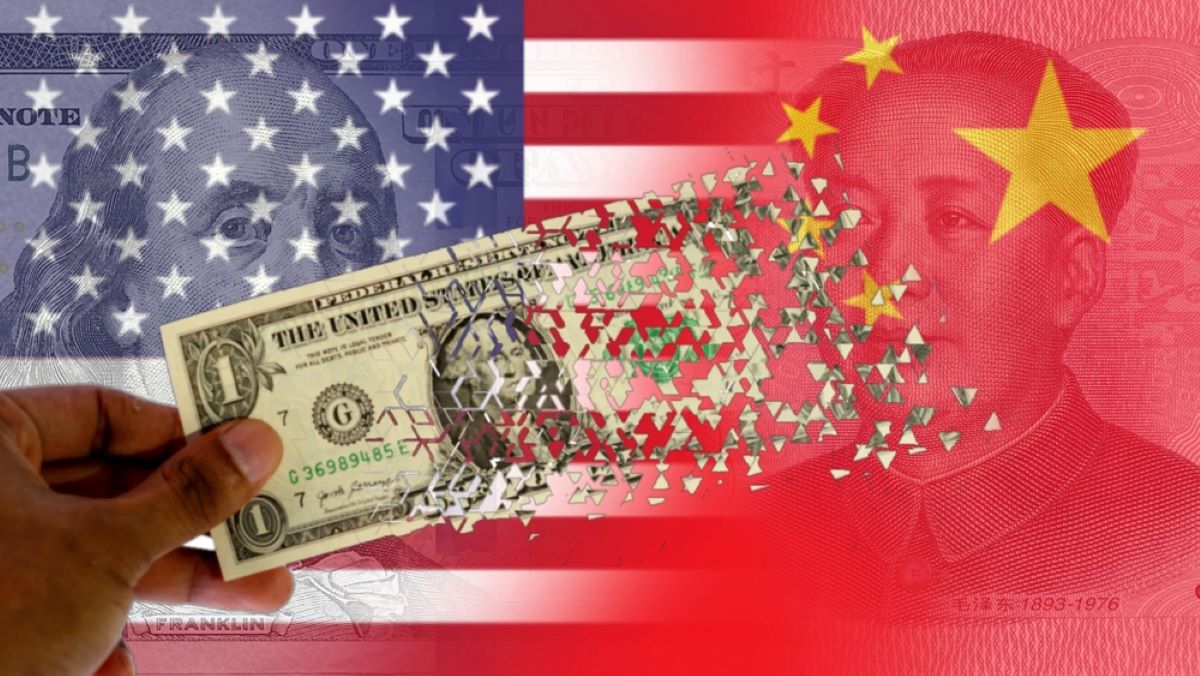
Under the current circumstances, the US’ sanction threats amount to empty rhetoric only. A new system has been built, and it will grow even stronger with the participation of numerous countries following the war in Iran.
Under the current circumstances, the US’ sanction threats amount to empty rhetoric only. A new system has been built, and it will grow even stronger with the participation of numerous countries following the war in Iran.
By Serhat Latifoğlu
The threat by US Treasury Secretary Scott Bessent by sending letters to 2 Chinese banks threatening sanctions if Iranian money found is a manifestation of the US’ military desperation and defeat. It is already evident that sanctions to be imposed on China will prove futile, much like those imposed on Russia. The most concrete proof of this has been the successful execution of China-Russia trade entirely “dollar-free” and the widespread adoption of this practice among numerous BRICS members.
Though the West may refuse to see it, BRICS countries, through the Belt and Road Initiative, independent payment networks, and banking systems, have already constructed the means to settle payments not through the dollar, but by bypassing it.
BRICS: A savior in the dollar crisis
The Trump administration targeted BRICS members with heavy sanctions. Today, however, BRICS is transforming from a mere block into a “corridor” and a network of alternative systems against dollar hegemony.
This system is fueled by four fundamental pillars:
– The BRICS Bank (New Development Bank),
– The mBridge money transfer system,
– An independent reserve system,
– The BRICS Pay payment system.
The US’s attempts to encircle BRICS were, in fact, the clearest expression of its desire to preserve the reign of the dollar. Yet, as sanctions deepened, BRICS countries succeeded in developing their own systems by surpassing it. This is a sign that the architecture of the new economic order is now being established not just in theory, but in practice.
Not a new IMF
The development bank of the BRICS countries, the New Development Bank, is not a “new IMF.” The NDB offers an alternative architecture to the dollar-centric credit regime. By evaluating development projects through its own credit discipline, the Bank moves beyond the traditional credit models dependent on the US. It aims to gradually reduce reliance on the dollar in the long run by offering loans and credit packages in local currencies, particularly for energy, logistics, and infrastructure projects. Despite being a relatively new bank, the New Development Bank has contributed to the development of the countries it lends to through numerous infrastructure projects. In contrast to the IMF’s hidden agendas and its approach that sabotages economies, the NDB has already begun providing significant contributions to the growth of poor and developing nations.
The initiative ending SWIFT
BRICS countries have integrated their national payment systems to build a structure independent of the US-dependent classical banking channels and SWIFT. In this framework, Russia’s SWIFT alternative, SPFS (System for Transfer of Financial Messages), and China’s CIPS (Cross-Border Interbank Payment System) play a central role in BRICS’ economic and financial infrastructures.
BRICS nations have established a working framework that integrates their respective payment systems. Russia’s SPFS, China’s CIPS, India’s UPI, and Brazil’s PIX operate within an interaction group at the BRICS level. Thanks to this integration, they could have a direct inter-system message and payment flow between BRICS countries, bypassing the dollar and SWIFT.
mBRIDGE and a new banking network
In both technological and institutional terms, mBridge represents a “second layer” compared to SWIFT. The infrastructure developed by BRICS is pivoting toward something specific: an independent payment chain not reliant on the US. The mBridge project aims to shorten settlement times, reduce transfer costs, and decrease dependency on the dollar. Having completed its testing phase, the system has already integrated several prominent Western banks and even some Western central banks. It is inevitable that mBridge will become an alternative money transfer option for a vast number of banks within the next few years.
Russia, China and Iran
Russia and China have developed a model aimed at the complete elimination of the dollar. For the first time in history, a trade volume of $250 billion between the two countries was done without the dollar. The experience gained in this system has been transferred to BRICS.
Another concrete example is revealed by BRICS member Iran whose trade is largely done outside the dollar system. Iran succeeded in breaking the embargo by accepting payments based on yuan, gold, and cryptocurrencies.
A new reserve currency
To reduce the structural dependency on the US dollar within the global reserve system, BRICS countries have put the idea of developing an alternative reserve mechanism based on a commodity basket and member state currencies on their agenda.
The model under discussion is based on a multi-layered structure where the Russian ruble is linked to natural gas and wheat, the Brazilian real to agricultural commodities and iron ore, the Chinese yuan to industrial exports, and the South African rand to gold and platinum reserves. The Indian rupee is positioned as a critical balancing element in this basket, representing the service economy and technology exports.
It is understood that the reserve currency discussed in BRICS meetings will be mainly backed by gold. The evidence of this is that BRICS central banks have significantly increased the share of gold in their reserves through intensive gold purchases over the last five years. While it is certain that the basket will consist of gold, other commodities, and currencies of the members, the debate over the specific ratios continues. The gold purchases by BRICS central banks have already shifted the global reserve balance to the detriment of the dollar.
BRICS Pay: Payment without the dollar
BRICS countries are attempting to circumvent the West’s dollar-centric financial system through their own controlled payment networks. The most prominent among these is BRICS Pay. BRICS Pay offers the possibility of making payments in local currencies through the central and public banks of member states. Of course, BRICS Pay has its own problems: differing central bank disciplines among members, varying legal and technical standards, and the difficulties of integrating rule-based frameworks. However, these problems do not imply that the system is ineffective, rather a gradual transition process.
Under the current circumstances, the US’ sanction threats amount to empty rhetoric only. A new system has been built, and it will grow even stronger with the participation of numerous countries following the war in Iran.
The initiative Türkiye launched last year for BRICS membership is a very accurate step. Shifting geoeconomic conditions and balances will bring about the end of neoliberal policies. The opportunities provided by BRICS membership will make a significant contribution to Türkiye’s path of development.