


By Adem Kılıç, Political Scientist
Two developments in Europe that appear to be independent of each other are taking place remarkably at the same time.
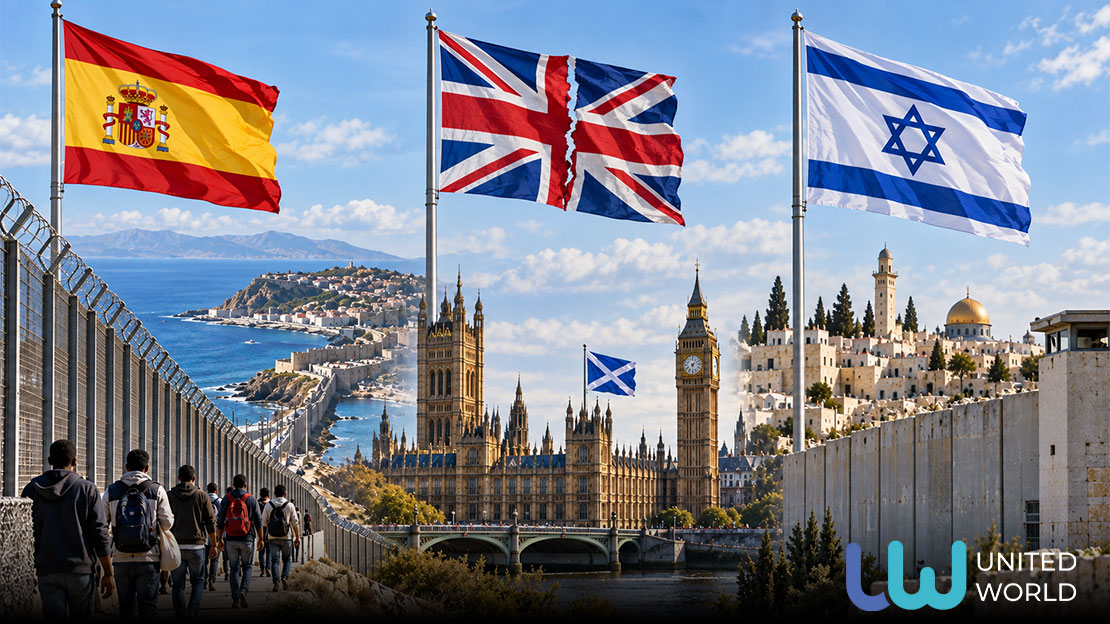
In Spain, the Sanchez government has faced one of the country’s most severe political crises in recent years following the approximately 70,000-person refugee influx into Ceuta on July 30-31.
Now, in the United Kingdom; the demands of Scotland, Wales and Northern Ireland for independence or separation from the United Kingdom have been taken to a new stage.
At first glance, these may be thought to have no connection with each other.
However, when the timing and political developments are considered together, a different picture emerges.
Because both Spain and the United Kingdom stand out as the European capitals that have responded most strongly to Israel’s policies in Gaza and the West Bank.
While Spain has been one of the pioneering European countries to recognize the State of Palestine, the United Kingdom, following its recognition of Palestine, also imposed a trade ban on products made in Israeli settlements in the West Bank.
In fact, last week, under the leadership of the United Kingdom, Spain and countries including France, Canada, Ireland and Norway announced new economic measures against Israel’s settlement policy in the West Bank.
How did the Ceuta crisis in Spain grow?
In recent weeks, the attempt by approximately 70-80 thousand people from Morocco to cross into Spain’s Ceuta region was not merely a migration problem for Spain.
Because the crisis quickly turned into an issue involving border security, intelligence, the government’s capacity and Sanchez’s political future. It even went further and caused a crisis within Europe involving calls for the borders to Spain to be closed and for it to be removed from Schengen freeness.
The fact that documents indicating that Spanish intelligence had issued warnings about the possibility of a mass crossing one day before the incident were released by media outlets such as Reuters also further escalated the crisis.
Pedro Sanchez, in a statement he made in parliament, stated that there was no concrete evidence showing that the incident had been planned by Morocco and announced that, because of this situation, they had declared the first “national security interest situation” in Spanish history.
Already facing accusations on various issues, including his wife, due to his support for Palestine, Sanchez suddenly began to be featured in numerous headlines in Europe with analyses of “success” and “legitimacy”.
Following all this, dissatisfaction with Sanchez rose significantly in the latest polls, and in the latest Vox poll I found, his vote share fell by around 8 points.
In other words, the problem facing Sanchez is no longer just Ceuta.
So how does Israel emerge here?
The truly striking point is here.
Sanchez said that there were indications of the role of Russia- and Israel-linked social media networks in the disinformation environment behind the Ceuta crisis.
Sanchez stated that Israel- and Russia-linked networks, together with far-right elements, were spreading disinformation targeting Spain’s migration policy and that this served to divide Spain and therefore Europe.
However, there is a very important detail here.
Sanchez accused Israel not only of applying political pressure against him, but directly of producing disinformation in Spain’s internal security crisis, and this accusation did not emerge out of nowhere.
Because the Sanchez government has demonstrated one of Europe’s most determined positions on Palestine in recent years, and Spain not only recognized Palestine but also conducted a diplomatic campaign in Europe for the recognition of the State of Palestine.
It took steps to limit arms and trade relations with Israel and joined restrictions on products from settlements in the West Bank.
Therefore, from Spain’s perspective, the problem with Israel is not limited to a few diplomatic statements.
It has reached the level of state policy.
The much greater rupture taking place in the United Kingdom
In the United Kingdom, another crisis erupted at the same time.
The leaders of Scotland, Wales and Northern Ireland came together and announced that the three countries would act on a new agreement emphasizing the right of the three countries to self-determination.
The importance of this development is quite significant.
Because for the first time, pro-independence political forces in three important components of the United Kingdom moved simultaneously.
In the latest poll published in the Guardian dated May 2025 that I could find, support for independence in Scotland stands at 42 percent, support for unification in Northern Ireland at 36 percent, and support for independence in Wales at 32 percent.
However, despite these figures, the country leaders suddenly decided to take this step, moreover together.
I also need to add an important point to these. On September 13, U.S. President Donald Trump, during his visit to Ireland, explicitly said that he supported the unification of Northern Ireland with the Republic of Ireland.
For all these reasons, it is clearly seen that there are other powers behind this development taking place in the United Kingdom today.
The United Kingdom had officially recognized the State of Palestine in 2025. In recent days, it has further toughened its stance towards Israel’s settlement policies in the West Bank.
What happened immediately afterwards?
Israel decided to close the United Kingdom’s consulate in East Jerusalem and banned some British politicians from entering the country.
Therefore, we are no longer talking about a theoretical connection here, but about an open chain of diplomatic retaliation and a behind-the-scenes struggle.
Where does Israel’s global influence come into play?
Here, it is clearly seen what kind of mistake those who evaluate Israel’s power only militarily are making.
Because in my opinion, Israel’s global influence consists of three different layers.
First, economic, diplomatic and military capacity of influence.
Second, its strong connections and lobbying power within the political systems of the United States and the West.
Third; the environment created especially in Europe through the transfer of the Palestinian issue into domestic politics and its influence over the United States and international institutions.
In other words, Israel is actually conducting its relations with European states not only diplomatically anymore, but also through trade, the defense industry, intelligence, security, migration, debates over antisemitism and electoral politics.
We already see the most striking example of this in Spain through Spanish Prime Minister Sanchez’s statement about “Israel-linked disinformation”.
In the case of the United Kingdom, there is a more concrete counterpart to this. Britain imposes economic sanctions on Israel, while Israel responds against Britain’s diplomatic presence.
So, what does history tell us?
When historical precedents are examined here, a more careful picture emerges.
Because Israel’s influence over European states is not a new phenomenon.
Because, since the 1950s, Israel has developed intelligence and defense relations within the European security architecture. During the Cold War, Israel’s relations with Western intelligence networks gradually strengthened. From the 1970s onward, Israel became an important actor, particularly in the fields of counterterrorism and intelligence sharing in Europe.
For example, during the 1956 Suez Crisis, Israel launched a military operation against Egypt together with Britain and France. When this operation failed, the strategic position of Britain and France in the Middle East suffered a heavy blow and the weight of the United States over Europe increased.
However, Israel did not suffer any blow.
Why are Spain and England particularly important?
The policies of both countries against Israel are not based solely on government preferences.
Because, including local and international matches, the Palestinian issue is strongly supported among the populations of both countries, that is, both among the Spanish people and in the United Kingdom.
Therefore, the decisions taken against Israel are not merely foreign policy decisions of governments. At the same time, they are also creating new fault lines against Israel in domestic politics.
The similarity between Spain and the United Kingdom emerges exactly here.
And with these data, we can comfortably say that; Western governments developing foreign policies against Israel face Israel’s diplomatic, economic and political counter-moves, and these counter-moves make the existing domestic political vulnerabilities of those countries more visible.
Look, this is not a conspiracy claim, but with all these data and realities, it emerges as a much more defensible geopolitical assessment.
The sign of the new era
I think Israel’s policy in Gaza and the West Bank has now gone far beyond the Israeli-Palestinian conflict.
Because in an environment where the United States, which Israel has dragged into war, has now lost its characteristic of being a “reliable partner” in the region, particularly for the Gulf countries, a new era is also being triggered within Europe.
This policy is turning into a factor that affects Europe’s foreign policy, the domestic politics of European governments, U.S.-European relations and even the constitutional integrity of some countries.
In an environment where the Sanchez government in Spain is facing the Ceuta crisis, where the United Kingdom is experiencing an independence move for the first time in 3 different points, and where the necessity of international institutions such as the UN, UNSC and ICC is being questioned, it is now evident that Israel’s presence has become a global threat.
The world will either read this danger properly, or it will prepare for a new global order that Israel has laid to waste.