


by Edvard Chesnokov
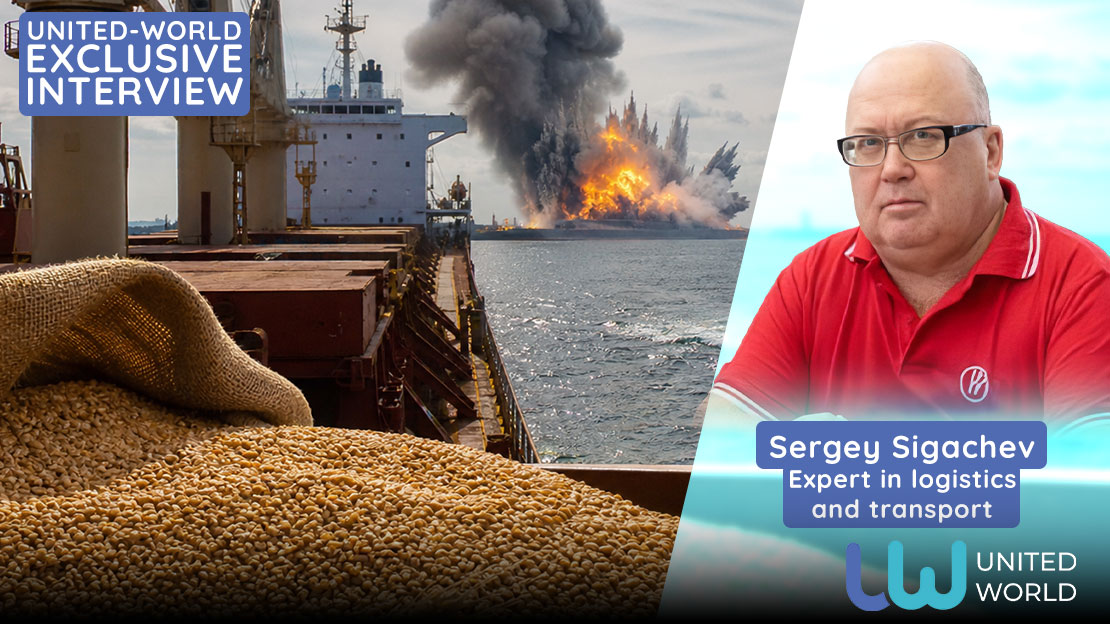
Sergey Sigachev is a member of the Russian Geographical Society, and an expert in logistics and transport. On the dawn of the Russian internet, he created the first web-guide on the famous Trans-Siberian railroad, and recently he has printed a non-fiction book about this longest land route on the Earth. Exclusively to United World, Sergei Sigachev commented on the logistic and transport dimension of the conflict between the West and countries of the world’s alternative, such as Russia and Iran.
How do you assess the recent persistent targeting of Turkish ships by the Ukrainian side in the Black Sea?
The Ukrainian side has resorted to maritime terrorism, without bothering to identify the ships’ flags, resulting in Turkish vessels being repeatedly hit. This clearly results in both direct damage and increased insurance costs. The Turkish reaction has already been made public, and it’s negative.
For their part, the Turks are trying to establish some kind of maritime truce, but this is currently failing, and it certainly doesn’t make the Turkish side more willing to militarily assist the Ukrainians. In this case, the latter are making things worse for themselves. In my opinion, there is currently no prospect of establishing a maritime truce outside the general ceasefire agreement.
How does instability in the Black Sea affect trade between Türkiye and Russia? What is Russia’s expectation regarding the security of the Black Sea?
It is clear that a naval war has a major impact on trade. Russia’s vessel turnover in the Black Sea was approximately four times greater than Ukraine’s, since we have Novorossiysk, Russia’s largest port there, with a cargo turnover of 160 million tons. And besides them are the grain and oil ports of Tuapse, Taman, Rostov-on-Don. Consequently, in terms of finances, Russia suffers more from the terror of maritime trade.
However, the Black Sea is not a single sea basin for Russia, while for Ukraine it is the only one. Russia can transport approximately a third of the Black Sea cargo turnover to other basins and partially compensate its losses. The Ukrainian side is losing cargo turnover completely, and in relative terms its losses are much heavier.
In addition, this undermines the world grain market and will affect the price and access of grain to other countries: Russia and Ukraine cover approx. 27% of the world’s grain supply. In my opinion, the Black Sea has become an unsafe basin, and the prospect of renewed attacks will always have to be taken into account as long as this armed conflict lasts.
Will Russia take a new step in the Black Sea in response to Ukrainian attacks?
I cannot predict the Russian leaders’ moves, but I believe they could impose a complete blockade of shipping to Ukrainian ports. This is entirely within Russia’s power. Ukraine won’t be able to compensate for the lost cargo turnover. Furthermore, attacks are also being launched against the Danube ports, which will be an additional damage for the Ukrainian economy. I believe it was a strategic mistake for Ukraine to start a trade war in the Black Sea basin. Kyiv has lost more than its adversary.
The U.S. is increasing its weight in the Caucasus. The ‘Trump Route’ project for the region [a proposed connection from Azerbaijan to Türkiye via Armenia—ed.] is persistently kept on the agenda. In light of these developments, can the Caucasus be considered a secure logistics route for Russia?
First of all, the ‘Trump Route’ is a virtual and media-driven concept; it currently has no tangible embodiment. To create it, not only Armenia’s consent to an extraterritorial corridor is required, but also actual construction ON THE GROUND. This is precisely why all discussions of such a route currently represent psychological pressure, not reality. As for logistical security in the Transcaucasus, it has objectively become simpler and safer since the end of the Second Karabakh War, when Azerbaijan won and reclaimed Karabakh. But at the same time, previously blocked routes between Armenia and Azerbaijan have also reopened. Such a paradox!
How do you assess the North-South energy and logistics corridor between Russia and Iran?
I’ve analyzed and written extensively about this corridor’s prospects. They were quite murky even before the U.S.-Iran Gulf War, as the critical Rasht-Astara section was missing to complete the shortest railway route between Russia and Iran through Azerbaijan. There was no rush to begin its construction, despite numerous declarations even at the presidential level.
But when the war along with the Hormuz blockade began, the possibility of completing this section was pushed into the distant future, and the corridor’s prospects are even more questionable. Don’t be fooled by the optimistic portrayal of this corridor at transport forums, as if ‘it would soon surpass the cargo flow through the Suez Canal.’ This is also a form of media pressure.
Currently, cargo turnover along this route is 21.5 million tons per year. This is certainly not insignificant, but it is much less than the Trans-Siberian Railway or the China-Western Europe International Transport Corridor via Kazakhstan. The difference is tenfold, practically an order of magnitude. The container volumes are abysmal: 11,000 TEUs in 2025 versus around 1 million via the China-Western Europe International Transport Corridor. [TEU = twenty-feet equivalent unit, a standard cargo format for international shipment — ed.]
In my opinion, this corridor will be completed and fully operational in 7-10 years, not sooner, given the pace of construction and the Gulf conflict. The more complex overland route from Russia through Kazakhstan and Turkmenistan to Iran is more stable than through Azerbaijan, which is currently a difficult and controversial partner. There’s also the direct Iran-Russia route via the Caspian Sea, but it has shallow ports, small vessels, and cannot handle large quantities of cargo.