


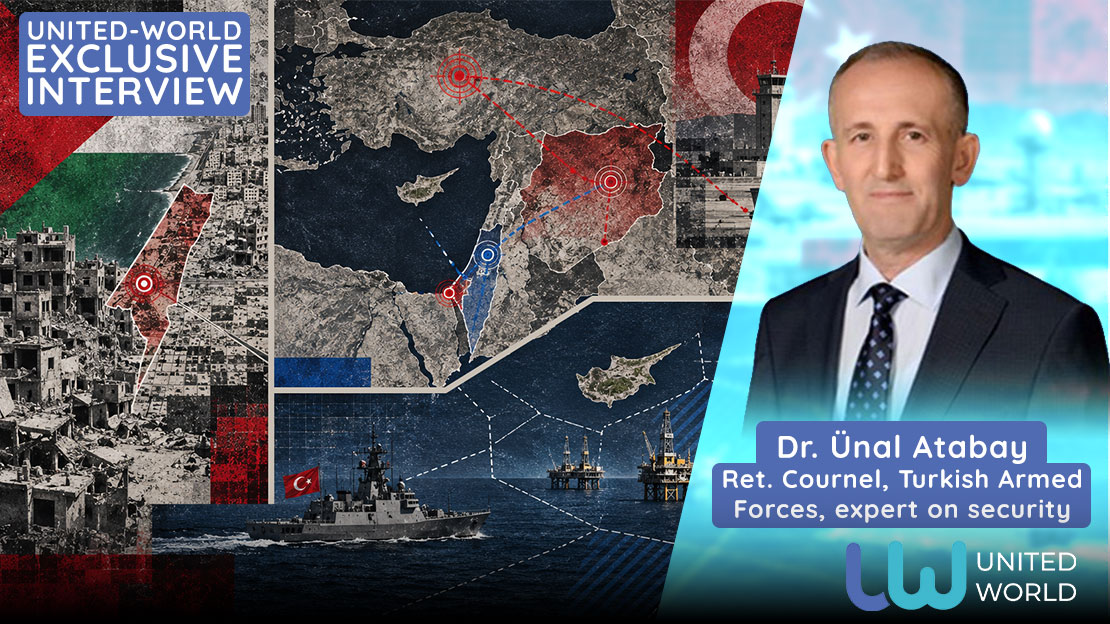
Tensions between Türkiye and Israel have expanded beyond the Gaza and Palestine issue into Syria and the Eastern Mediterranean. Israel’s military activities in Syria and Türkiye’s approach to the formation of a new security architecture in Syria have created a new area of competition between the two countries.
Although Türkiye and Israel are not direct neighbors, regional developments have generated new areas of rivalry. Israel’s cooperation with Greece and the Greek Cypriot administration in the Eastern Mediterranean has also become an important factor from Ankara’s perspective.
Atabay, a former Colonel in the Turkish Armed Forces and an expert on international politics, assessed the reasons behind the tensions between Türkiye and Israel, developments in Syria, the balance of power in the Eastern Mediterranean, and the role of Israeli Prime Minister Benjamin Netanyahu.
How has the Türkiye-Israel tension spilled over into Syria?
There has been a long-standing tension between Türkiye and Israel. Most recently, this has also had a military reflection in Syria, with Israeli attacks. How do you assess the reflection of this tension in Syria?
Actually, Türkiye and Israel, as you know, are not neighboring countries. Historically, we have not had a conflict with Israel in the distant past either. Israel is already a new state, a small state.
Therefore, although there may have been tensions between Türkiye and Israel recently because of security expectations in the Middle East, similar developments have occurred in the past as well. Let us remember that Türkiye-Israel relations were very good in the 1990s. Later, in 2005, President Erdoğan visited Israel.
After 2005, relations once again went through ups and downs, with the Mavi Marmara issue, and then, when we came to 2016, there was another recovery and ambassadors were appointed mutually. From 2022 onward, there was once again tension.
So, although there have been periods of tension between Israel and Türkiye from time to time, there have also been periods of good relations. Of course, the current tension is political as much as it is military. The tension between Türkiye and Israel is primarily a diplomatic tension centered on Palestine, but recently, Iran’s withdrawal from Syria, that is, the new developments in the Syrian field following the fall of the Assad administration, seem to have turned into a Syria-centered military rivalry. So this has been added to the equation.
On the other hand, a new security equation emerged in the Middle East as a result of the Israel-Iran war, including the Gulf region, and it affected Saudi Arabia in the same way. As such, the scope of Türkiye-Israel relations has expanded somewhat.
On the other hand, Israel has a concern of its own, a security concern. But in order to address that concern, Israel has an approach of seeking to create a security belt in the Eastern Mediterranean basin by developing cooperation with Greece and the Greek Cypriot administration.
Israel’s security search in the Eastern Mediterranean
How should this approach be interpreted from Türkiye’s perspective?
This approach also appears to be an attempt to create a security belt against Türkiye.
So, Israel has actually moved the geopolitical or political tension between Türkiye and Israel over the Gaza region into the Syrian field and, on the other hand, into the Mediterranean basin.
Of course, Greece and the Greek Cypriot administration have their own interests. These countries also want to use the situation arising from their tensions with Türkiye as an opportunity through Israel.
When all of these come together, it seems that Türkiye-Israel relations have been brought to a point of tension. But Türkiye is actually not the side creating the tension; Israel is. Because it is Israel that is making the move in the Syrian field.
After all, following the developments in Syria, Israel struck all the air bases, air defense systems and military areas, effectively eliminating its infrastructure through more than a thousand attacks.
So, Israel thinks that a possible change in the security equation through Syria could turn against it, and that Türkiye could fill this vacuum. In other words, the Iranian vacuum in the Middle East. I don’t think Israel actually needs to be concerned about this at all at the moment, nor does Iran.
Why do I say this? Because Israel alone cannot change the equation in the Middle East. Syria alone cannot change the equation in the Middle East. The United Arab Emirates cannot either. Iran cannot either.
The new equation and security architecture in the Middle East will no longer be a geography where non-state actors are the main factor — that is, actors such as Hezbollah used by Iran — but rather a geography where states, particularly Türkiye, together with global powers, can build a security architecture beyond non-state actors.
A new security architecture in the Middle East
How should Israel’s military moves in Syria be assessed within this new equation?
For this reason, the Middle East is now far from being a field or area where Israel alone can shape a security architecture as it wishes. We need to understand this.
Now, because Israel believes that the security environment in Syria will change, and because it is concerned that this security environment could pose a threat to Israel, it attacked an airport, an air base that we call Abu Zuhur. It had previously attacked several other airports last year as well.
So there is an Israeli approach seeking to shape the security equation through Syria. Or, in other words, I would like to draw another heading here. It is also possible to say that Israel is pursuing an approach of using the Syria card in order to somewhat cover up the issue in Gaza or the Palestinian conflict, to push it further into the background and move it somewhat further back on the world agenda.
In short, shifting the center of tension from the Palestinian or Lebanese arena to Syria can also be described as an effort to cover up the Palestinian issue.
Therefore, when it shifts the issue to the Syrian field, it sees Türkiye on the other side. It finds Türkiye there.
Actually, Türkiye has no intention regarding Syria. In practice, there is a misunderstanding in Türkiye’s reading of intentions, or rather in Israel’s reading of Türkiye’s intentions. Therefore, perhaps if dialogue develops in the coming period, this could be brought to a point where it is better understood.
Is the risk of direct military confrontation high?
From your assessment, I understand that you do not see the risk of a confrontation between the two countries in Syria or the Eastern Mediterranean, either through naval forces or other means, as very high.
Yes. I mean, there may be a serious diplomatic crisis and tension. But in military terms, I do not think that Türkiye and Israel will, or can, be brought to the point of a very serious confrontation.
I believe this may also be influenced by Türkiye’s cool-headed approach and Türkiye’s tendency to think in the longer term.
Because rather than creating a new environment of conflict in the region, Türkiye is a country that expects and wants the region’s new security architecture to be formed through agreements and negotiations.
We can actually point to the Türkiye-Pakistan-Saudi Arabia agreement as an example of this.
Such an agreement, on the one hand, softens the environment of conflict in the Middle East, but on the other hand creates a balancing mechanism. Because in the Middle East, rather than the dominance of a single country or a single security architecture being imposed, I see a security balance emerging through alliances in parts — that is, several countries coming together — through methods such as our Mecca Agreement.
Could the Türkiye-Israel rivalry extend to Africa and the Red Sea?
Will this security competition remain limited to Syria and the Eastern Mediterranean?
Türkiye is also trying to take steps in this direction. Israel, Greece and the Greek Cypriot administration, as you know, have concluded a defense agreement and taken it to an advanced level. Further along the chain, there is the United Arab Emirates, and at another point there is India.
There is an Israeli equation seeking to take ownership of the security of an energy corridor extending from India to the Eastern Mediterranean, and seeking to control the security of this energy corridor, with national interests expected from it.
On the other hand, the Pakistan, Saudi Arabia and Türkiye agreement — and if other countries join this, it could be Egypt, Bangladesh, Somalia — together with the Horn of Africa, If we consider the Horn of Africa and the Middle East together, a new security architecture will emerge.
Now, during this transition period, tensions between Türkiye and Israel may occur from time to time, and they will.
Because this may not remain limited to the Middle East. It may also manifest itself in the Horn of Africa, in the Ethiopia equation and likewise in the Somalia issue.
But here, of course, you cannot think of the construction of the Middle East’s security architecture separately from the Red Sea and the Horn of Africa. They complement each other and are integral. It is an entire geography that must be considered together.
Therefore, its reflection there, and the experience of mutual difficulties there, is quite natural. This also manifests itself in Sudan.
You have to consider the United Arab Emirates’ position together with the Sudan, Ethiopia and Somalia equation. Of course, Egypt is, and will be, one of the important countries in this equation.
Does Israel want to become the “orchestra conductor” of the region?
Within this picture, how do you see Israel’s main objective?
That is why I emphasized the issue of the agreement. Israel now wants to be the orchestra conductor of the Middle East. Of course, this is not possible.
Because of the geopolitical equations I outlined earlier. Israel wants to create a security belt.
It wants to create a weak Syria, like the West Bank, fragmented and divided along ethnic lines, consisting only of internal security forces but without an armed force.
Therefore, it wants a security belt both in the Syrian field, in Jordan and in Lebanon. As you know, there is also Egypt. Following the 1979 Camp David Agreement, a security belt was created there as well in the Sinai Peninsula.
In other words, it is essentially an area where Egypt’s full sovereignty cannot be ensured. It wants such a security belt.
So, what is Syria for Türkiye? Syria. For Türkiye, Syria is a cover geography. It is a cover geography. It is the geography immediately in front of us.
But for Israel, it is a geography of access. That is why the situation in the Syrian field appears to be one in which the two sides may find themselves facing each other.
But I frankly think that rather than this situation being taken to a very military level, political tension will be more prominent.
The Netanyahu factor: Is the tension personal or state policy?
Do you think this tension is dependent on the Netanyahu government? Or, given that there are elections approaching in Israel, even if his rivals win the election, is the Israeli state as a whole operating according to this approach?
Of course, the Netanyahu factor is important because Netanyahu has been an important actor in Israeli political life since he was very young, and he also has a significant base.
Therefore, although the struggle of internal opposition forces against Netanyahu manifests itself in different arenas, Israel has a security policy that it has adopted for many years.
This may continue to manifest itself in certain areas even after the election. In other words, even if there is a change of government, his more aggressive attitude, his characteristic of being more distant from dialogue, perhaps has a structure that further escalates tensions.
Perhaps it could be freed from this, it could be possible.
If Netanyahu loses the Israeli election, then the factors behind tensions between Türkiye and Israel are actually the Iran war, the activities of Kurdish armed groups in the region; secondly, the reshaping of security in Syria; the influence it wants to create in Lebanon; its desire to shape an energy basin in the Mediterranean to its own advantage through this; its close cooperation with the Greek Cypriot administration and Greece; and the attitude of Israel, which wants to be the sole actor, the orchestra conductor, in the Middle East — an approach that Netanyahu has strongly prioritized.
Therefore, perhaps if Netanyahu loses during the election process or a new equation of change emerges, relations could be carried into a new political dimension.