


Arabic Documents and Zulu Letters
Arabic Documents and Zulu Letters
In this article, which examines some of the most striking diplomatic and personal correspondences in African history, the struggle of African leaders for freedom and independence can be seen. Among the earliest of these are, respectively, the letters of King Afonso I of Kongo to the King of Portugal (1526), George Washington Williams’ open letter to King Leopold II of Belgium (1890), Patrice Lumumba’s final letter to his wife (1960), and the correspondence of Emperor Menelik II of Ethiopia concerning Italy. These documents almost serve as a summary of the last 400 years of African history. They are essential primary sources reflecting Africa’s resistance, criticism, and struggle for independence against European colonialism.
The African continent experienced intense diplomatic interactions with European powers during the period extending from the 15th century to the 20th century. Although these interactions initially began on a basis of equality, they quickly transformed into a colonial structure. The correspondences examined below document the different stages of this transformation and demonstrate the efforts of African leaders to make their voices heard in Europe.
Historical Correspondence from Africa
The Christianised ruler of the Kingdom of Kongo, Afonso I, wrote multiple letters to the King of Portugal in 1526, stating that the slave trade was destroying his kingdom. In the most famous letter dated July 1526, he wrote:
“You should know that our country is being destroyed in many ways. Your merchants and officials are kidnapping and selling our natives, the sons and relatives of our nobles. This trade is completely emptying our kingdom.”
These letters are among the first systematic criticisms of the slave trade coming from Africa and are remarkable because a Christian king accused Europe of religious and moral betrayal.
The African American historian and activist George Washington Williams directly accused Leopold in his famous open letter documenting the atrocities in the Congo Free State:
“Your Majesty, your hands are stained with blood… This is one of the most disgraceful stories of exploitation in history.”
This document is regarded as one of the earliest uses of the term “crimes against humanity” and became the beginning of international pressure.
Similarly, Emperor Menelik II of Ethiopia, after noticing the discrepancy between the Italian and Amharic versions of the 1889 Treaty of Wuchale, annulled the treaty and wrote harsh letters to Italy. These correspondences prepared the diplomatic ground for the Victory of Adwa in 1896. Menelik’s stance is one of the most successful examples of resistance against colonial treaties in Africa.
Lumumba, the first Prime Minister of independent Congo, expressed both his personal suffering and his continental hope in his final letter written in prison:
“History will one day speak; it will not be the history taught in Washington, Paris, or Brussels… Africa will write its own history, and it will be a history of glory and dignity.”
This letter was written shortly before his assassination in 1961 and is one of the most poignant personal expressions of the African struggle for independence.
Prominent Examples of Arabic/Ajami Correspondence in West Africa
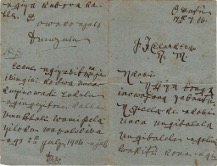
Arabic and Ajami correspondence in West Africa constitutes one of the richest and least-known parts of the continent’s intellectual history. Ajami is the adaptation of the Arabic script to local African languages such as Hausa, Fulfulde, Wolof, Mandinka, and Yoruba, and the word means “foreign.” This system developed with the spread of Islam into Sub-Saharan West Africa from the 8th–11th centuries onward and was used for both religious and secular purposes. Prayer books, talismans, poems, biographies, family records, commercial documents, political correspondence, and personal letters are among these materials.
Thousands of manuscripts have been preserved in West Africa. They were produced in centers such as Timbuktu, Kano and Katsina, and the Sokoto Caliphate. For example, Usman dan Fodio (1754–1817), the leader of the Fulani jihad and founder of the Sokoto Caliphate, wrote hundreds of works in both Arabic and Fulfulde Ajami. His daughter Nana Asma’u (1793–1864) also wrote poems, sermons, and educational texts for women in Fulfulde and Hausa Ajami. Works that encouraged jihad and mobilized the population are among the collections digitized through the Endangered Archives Programme.
On the other hand, Arabic/Ajami letters among the leaders of Kano and Katsina were important for political and administrative communication within the caliphate. These documents are rare sources documenting the establishment of the caliphate, internal politics, and Islamic reforms. More than 5,000 West African Arabic/Ajami manuscripts are preserved in the Herskovits Library at Northwestern University, among which the correspondence of the Fodio family stands out.
Ajami in the Wolof language (Wolofal) was used for commercial records, family letters, poems, and political announcements. Boston University’s African Ajami Library project digitized Wolof, Pulaar, and Mandinka Ajami documents. These include personal correspondence and public announcements. The studies of Fallou Ngom emphasize that Ajami demonstrates pre-colonial literacy. The communities whom the French called “illiterate” actually possessed a rich written culture. These correspondences demonstrate the integration of Islam with local languages and the intellectual history of Africa, while also providing evidence of pre-colonial literacy.
Letters and Correspondence of Zulu Kings
In the Zulu Kingdom, written culture was based on oral traditions. Leaders such as Shaka, Dingane, and Cetshwayo did not write letters directly, but diplomatic correspondence was conducted through interpreters.
Before and after the 1879 Anglo-Zulu War, correspondence existed with British officials such as Sir Bartle Frere and Lord Chelmsford. Cetshwayo sent messages containing peace proposals and complaints to the invaders, some of which were described with expressions such as “characters written in blood.” During his exile in London in the 1880s, he wrote letters to British politicians. The book A Zulu King Speaks (edited by C. de B. Webb & J.B. Wright) contains historical and traditional explanations dictated by Cetshwayo.
Zulu King Dingane kaSenzangakhona had agreements with the Voortrekkers between 1837 and 1838. Dingane signed an English-language land transfer document, but the dispute led to the Weenen Massacre. Although there was a written document, the Zulu side considered it a verbal agreement.
Direct handwritten letters by Zulu kings are rare, and most are diplomatic correspondences preserved in British archives such as Further Correspondence Respecting the Affairs of Zululand. The letters from these regions reflect Africa’s effort to record its own voice. While West African Ajami represents intellectual richness, Zulu correspondence is striking in terms of resistance diplomacy.
Briefly, these correspondences reveal the demands of African leaders for equality, justice, and sovereignty against Europe during different periods of African history. Afonso’s early warning, Williams’ exposure, Shaka Zulu’s efforts to protect his borders, Lumumba’s testament, and Menelik’s defiance demonstrate the continuity of anti-colonial thought.
References
Gençoğlu, H. (2025) The West’s Plunder of Africa, Kronik, Istanbul.
Thornton, John K. (translation). “Letter from the King of Kongo to King João III (July 6, 1526).” Gilder Lehrman Institute of American History.
Williams, George Washington. “An Open Letter to His Serene Majesty Leopold II…” (1890). BlackPast.org and UMass full-text PDF.
Lumumba, Patrice. “Last Letter to Pauline Lumumba” (December 1960). Friends of the Congo and AFRonline.org.
“Treaty of Wuchale” (1889). Britannica and Wikipedia (translation and context).