


Interview with Prof. Erenel from the Istinye University and Prof. Işıksal from the Near East University.
Interview with Prof. Erenel from the Istinye University and Prof. Işıksal from the Near East University.
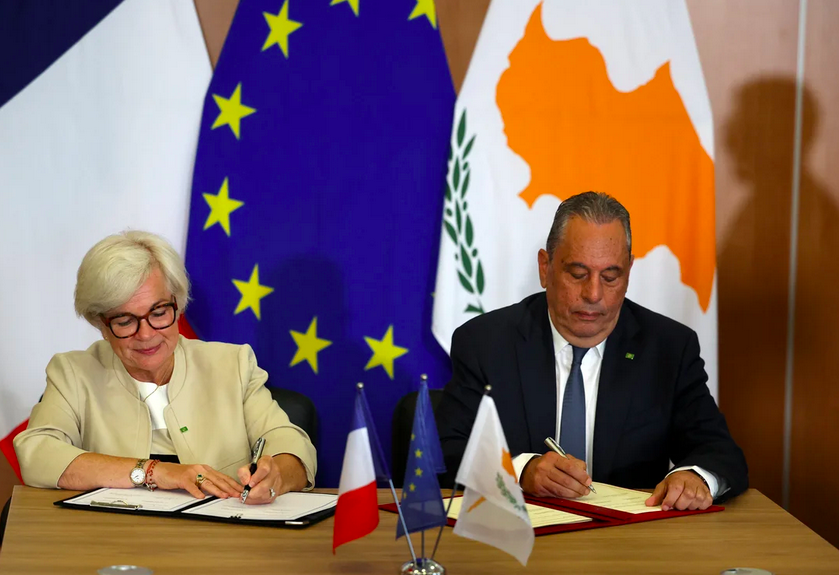
The recently signed Status of Forces Agreement (SOFA) between France and the Greek Cypriot Administration (GCA) has triggered sharp criticism from Turkish Cypriot and Turkish officials, who argue that the deal alters the military balance on the island and strengthens a growing French strategic presence in the Eastern Mediterranean.
The agreement, signed on June 8, establishes a legal framework for the deployment of French military personnel in the Greek Cypriot Administration, grants France access to military facilities and infrastructure, and expands cooperation in areas including military technology, training, joint exercises and defense industry projects. The arrangement is intended to facilitate French military activities linked to operations in the Eastern Mediterranean and the Middle East.
For supporters of the agreement, the pact represents a contribution to European strategic autonomy. For critics, however, it is another step in the militarization of the Cyprus issue and an attempt by Paris to project power far beyond the island itself.
France’s Strategic Ambitions
Hüseyin Işıksal, professor at Near East University in Northern Cyprus, argues that the agreement should be understood primarily through the lens of French geopolitical ambitions.
“This is a very important agreement,” Işıksal said. “France, as a former imperial power, has long wanted to establish itself permanently in the Eastern Mediterranean. With this agreement, a legal basis has been created for France’s military presence on the island.”
According to Işıksal, the deal is only the beginning of a broader French effort to secure a permanent military foothold comparable to the sovereign British bases already operating on the island. He noted that Cyprus occupies a unique strategic position connecting the Eastern Mediterranean, the Middle East, North Africa and the Suez Canal, making it an ideal location for military operations.
“Having military facilities on such an island is an extraordinary advantage,” he said, arguing that Paris seeks a platform from which it can intervene more effectively in developments stretching from Africa to the Levant.
Retired Turkish Major General Fahri Erenel of Istinye University sees a similar strategic rationale behind the agreement. While describing the SOFA as a technical arrangement regulating the legal status of foreign troops, military equipment and training activities, he said the broader significance lies elsewhere.
Erenel argues that the agreement demonstrates France’s ambition to position itself as the leading military and political power within the European Union. In his view, Paris is sending a message that the security concerns of Greece and the Greek Cypriot Administration are also European concerns.
“France is playing for leadership within the European Union,” Erenel said, adding that President Emmanuel Macron is attempting to capitalize on Germany’s domestic political and economic difficulties while promoting a stronger European defense identity.
He further suggested that France hopes to exploit the growing strategic importance of Eastern Mediterranean energy resources and key maritime routes linking Europe, the Middle East and Asia. According to Erenel, Paris is seeking to reassert influence in a region where it once played a major role.
What the Agreement Contains
The SOFA allows French military assets to be deployed under certain conditions in the territory controlled by the Greek Cypriot Administration. It grants French forces access to military bases and infrastructure while providing a legal framework for their presence during operations linked to the Eastern Mediterranean and the Middle East. The agreement also covers military technology sharing, strategic dialogue, joint exercises and training activities.
The Turkish Republic of Northern Cyprus (TRNC) Foreign Ministry has stated that the agreement additionally includes defense-industrial cooperation, military equipment transfers and logistical support arrangements.
The pact was negotiated following Macron’s visit to the Greek Cypriot Administration in April and entered into force immediately after its signing.
Why Critics Call It Illegal
The strongest objections concern the agreement’s legal basis.
Erenel argues that the arrangement violates the spirit of the 1960 constitutional order established by the Zurich and London agreements. He notes that the Turkish Cypriot community and the guarantor states were not consulted before the agreement was concluded.
“In the 1960 constitutional framework, the Turkish side was one of the founding partners,” he said. “No consultation was conducted with the Turkish side or the guarantor states. Therefore, from Turkey’s perspective, the agreement lacks legal validity.”
The TRNC Foreign Ministry has likewise argued that the Greek Cypriot Administration lacks the authority to conclude agreements affecting the entire island because it does not represent the Turkish Cypriot people. It described the accord as “null and void” for Turkish Cypriots and warned that it risks upsetting the security balance in Cyprus and the wider region.
Işıksal shares this assessment. He argues that the Greek Cypriot leadership continues to act on the assumption that it alone represents the island internationally and is pursuing policies aimed at extending its authority over the north. In his view, the agreement reflects a strategy of aligning Greek Cypriot interests with those of larger powers such as France, the United States, Israel and the United Kingdom.
According to Işıksal, the Greek Cypriot leadership believes that embedding itself within broader Western security structures will strengthen its position in future negotiations and regional disputes.
Security Risks and Regional Tensions
Critics warn that the agreement could increase tensions on the island.
Erenel argues that the deployment of French forces may encourage more confrontational attitudes among Greek Cypriot nationalist groups. He also believes that the agreement could further militarize an already fragile regional environment.
At the same time, he does not expect the Greek Cypriot Administration to launch any military operation against the Turkish side, citing Turkey’s military capabilities and geographic proximity.
Anadolu Agency reported similar concerns from TRNC Prime Minister Ünal Üstel, who warned that the agreement threatens the delicate balance in the Eastern Mediterranean and ignores the rights of Turkish Cypriots. He stressed that initiatives targeting Türkiye’s interests would not succeed.
How Türkiye Is Likely to Respond
Both analysts believe the agreement will reinforce Ankara’s commitment to the two-state policy it has advocated in recent years.
Erenel argues that the French move will further convince Türkiye that a federal settlement is no longer realistic and that alternative political arrangements must be pursued.
Işıksal similarly says there is little evidence that Ankara is preparing to retreat from its current position. He points to repeated statements by President Recep Tayyip Erdoğan, Foreign Minister Hakan Fidan and other senior officials supporting a two-state solution in Cyprus.
While acknowledging that diplomatic negotiations will continue under United Nations auspices, Işıksal believes Turkish policymakers remain committed to maintaining Türkiye’s military guarantee and political support for the Turkish Cypriot side.
For Ankara, therefore, the France–Greek Cypriot Administration agreement is likely to be viewed not merely as a bilateral defense arrangement but as part of a broader geopolitical contest over influence, security and sovereignty in the Eastern Mediterranean.
As France expands its military footprint on the island and the Greek Cypriot Administration deepens its partnerships with Western powers, the Cyprus question appears set to become an even more prominent arena in the wider competition shaping the future of the Eastern Mediterranean.