


By Mehmet Enes Beşer
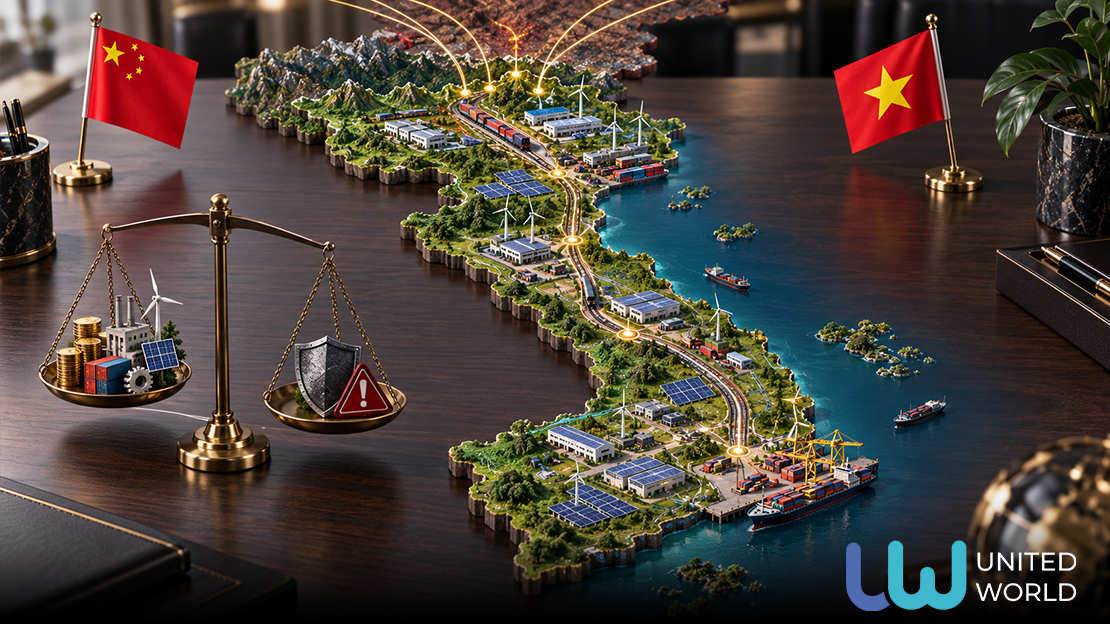
China has become the largest foreign investor in Vietnam in recent years, with money invested in industries ranging from manufacturing and infrastructure to renewables and hi-tech. As a major production center and hub node in international supply chains, Vietnamese investment – especially amid global decoupling trends – is not only necessary, but also momentum. However, a growing presence of a geopolitical competitor is not just a chance, but also potential difficulties and tensions which have to be managed by visionary policy. To ensure that Vietnam remains independent and economically resilient, the increased Chinese investment has to be carefully steered.
In itself, Chinese investment appears to be a clear complement to Vietnam’s development strategy. Due to rising costs of Chinese labor and geopolitical pressure, it becomes imperative for many firms to diversify their production capacities. In response, Vietnam has emerged as the country for “China+1” investments, which serve as a low-cost manufacturing base next door to China. Consequently, many industrial parks, logistics parks, and technology parks have sprung up all around such provinces of Việt Nam as Bắc Giang, Hải Phòng, and Bình Dương.
Clearly, this is beneficial to Vietnam, since it creates incentives for industrial modernization, job creation, and infrastructure building. Chinese capital is being invested in the country’s energy projects (solar and wind power), as well as hi-tech manufacturing (consumer electronics, textiles). Vietnam, thus, could get assistance in developing and strengthening its value chain, generating export revenue, and covering gaps which cannot be plugged using domestic funding alone. Moreover, China’s engagement in Vietnam with Chinese capital symbolizes the emergence of Vietnam as a rising economic and strategic actor in the region.
However, all this comes with notable drawbacks. The primary one is the risk of over-reliance. As Chinese investment grows, Vietnam’s susceptibility to disruptions in the supply chains or political extortion by Beijing will become greater. As there have been persistent tensions between the two sides in the past, as well as South China Sea maritime dispute and conflicting agendas in the region, Vietnam’s proximity to its giant neighbor may easily lead to political instability. Criticism of the excessive influence of Chinese enterprises and investments in energy, logistics, and telecommunications may affect national security or strategic freedom of action.
There is certainly a lot of frustration here. Disputes between Vietnamese and Chinese nationals, such as the one over Chinese laborers involved in prestigious projects, such as the Cat Linh-Ha Dong metro line, have created long-standing animosity towards them. Cost overrun, poor quality, and delays have fueled the concern over the uncontrolled nature of Chinese investments, even despite their fast-paced implementation in the region. All of this has led to the wave of criticism directed at foreign investment projects, especially those related to land acquisition, environmental issues, and workers’ conditions.
Additionally, Vietnam may become a target in the China-US competition. By increasing investments, especially the investments aimed at export-led production, Vietnam runs the risk of becoming a “backdoor” route, through which Chinese exports circumvent American tariffs. US officials have launched several inquiries about the situation, and without sensitive handling, Vietnam may face retaliatory actions. Hence, the Vietnamese government has to make sure that Chinese investments are not used for discriminatory purposes vis-à-vis such strategic partners of Vietnam as US, Japan, and the EU.
Perhaps, the greatest challenge lies in the unbalanced development. Most Chinese investments have been made in low- and mid-tech sectors, with occasional focus on eco-intensive and labor-intensive sectors. Left unchecked, this trend will destroy the dream of Vietnamese technological progress and the beginning of a “race to the bottom” in terms of wages and ecological standards. Clearly, there has to be strategic planning in place to avoid this problem.
Increased China’s investment in Vietnam carries with it equal amounts of risks and opportunities. For the latter category, there are possibilities for development, industrialization, and integration. For the former, on the other hand, there are threats of geopolitical risks, reputational risks, and opposition within Vietnam. However, what Vietnam needs to do now is to find a fine balance between managing a potentially fruitful investment while enforcing high standards of cooperation. For Vietnam, this means adopting a robust regulatory framework and implementing effective screening mechanisms.