


By Fernando Esteche*
I
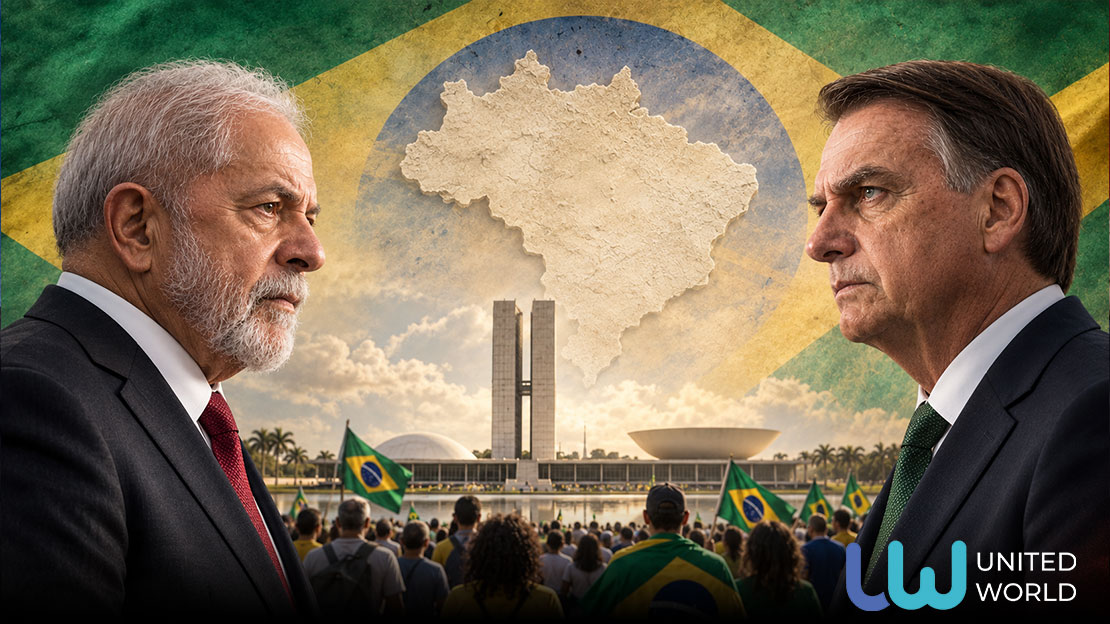
Flávio Bolsonaro finished first. With all precincts tallied, he garnered 56.1 million votes, 47.03 percent of the valid ballots, while Lula da Silva received 53.9 million, or 45.16 percent. This represents a difference of 2.2 million votes in a country of 158 million registered voters. Polls, as in previous elections, had predicted the opposite outcome until Saturday.
To interpret this result merely as another swing in the Latin American electoral pendulum would be a gross oversimplification. What shifted in Brazil on Sunday is a piece of the hemispheric realignment that Washington has been implementing since Trump returned to the White House: the reclamation of the continent as its rearguard in the dispute with China. Brazil was its biggest obstacle in this process. The first round didn’t inaugurate anything new. Instead, it accelerated the momentum of redeployment that was already underway and which now finds a Brazilian state willing, or about to be, to support it.
II
The presidential vote was the least decisive part of the night, even though it garnered the most attention. Below the presidential ticket, the right wing won almost everything that mattered. Tarcísio de Freitas retained São Paulo with over 60 percent of the vote. In Minas Gerais, Cleitinho Azevedo won in the first round. Nikolas Ferreira surpassed two million votes and is the most voted-for federal deputy in the country’s history. Bolsonaro’s Liberal Party (PL) alone secured 19 of the 54 Senate seats up for grabs, and the right wing as a whole obtained a comfortable majority of the newly elected seats.
Two names encapsulate the nature of this victory. Sergio Moro, the judge who convicted Lula in Operation Lava Jato in a trial later overturned by the Supreme Court due to bias, will be governor of Paraná. Luciano Zucco, an army lieutenant colonel, was elected governor of Rio Grande do Sul with nearly 58 percent of the vote. In 2023, Zucco chaired the parliamentary commission investigating the Landless Workers Movement (MST), a group established to criminalize the MST and its land occupations and built his career on this crusade. The fact that the most important state in the south will be in the hands of someone who has made the persecution of the continent’s largest peasant movement a central part of his government’s agenda carries weight. Deltan Dallagnol, the prosecutor in the same Lava Jato case, entered the Senate representing Paraná, his candidacy still under judicial review.
With them, the cast of lawfare returns to power, now through the ballot box, and with an explicit agenda regarding the judiciary. Only the Senate can impeach and remove Supreme Court justices, requiring 54 out of 81 votes, and the right wing prioritized that chamber with an objective it never concealed. In February, from Mar-a-Lago, Eduardo Bolsonaro publicly addressed Justice Alexandre de Moraes, telling him that he had imprisoned his father and that they would win with Flávio to remove him from the Court. Moraes already faces sanctions from the U.S. Treasury. The Senate majority adds the internal threat and also paves the way for an amnesty for Jair Bolsonaro and those convicted in the coup plot. The pincer movement against the court that tried the coup is tightening from both Washington and Brasília, and it doesn’t depend on who wins on the 25th.
III
A decisive part of that wave was supported by the evangelical vote. Evangelicals already make up more than a quarter of Brazil’s population, according to the latest census, concentrated in the outskirts of cities and among women from working-class neighborhoods. In September, Genial/Quaest polls showed Flávio with 48 percent in that segment compared to Lula’s 33 percent. Flávio skipped the first presidential debate and used that time to promise to declare that Brazil belongs to Jesus Christ. The campaign also had its Catholic front, with fake publications about Our Lady of Aparecida that forced the electoral court to intervene, and Flávio won with 58 percent in the city of Aparecida itself.
Pablo Semán has been demonstrating for years that Pentecostalism must be considered and addressed as something far more complex than an imposed church; it is a grassroots way of organizing life in neighborhoods where the state is absent and where stable employment has disappeared, and it is from this that it derives its political power. The Brazilian right wing has a permanent territorial infrastructure in the churches, one that operates between elections and that no progressive force possesses.
IV
The other infrastructure is the screen. Meta estimates 197 million WhatsApp users in Brazil, more than registered voters, with the app installed on 99 percent of phones. Most political conversations take place in closed groups—family, church, neighborhood, and work groups—beyond the reach of any oversight. Ten days before the election, Meta deactivated Lula’s ads without explanation. The Lupa Observatory documented a coordinated campaign, mostly originating from Argentine accounts, that spread the lie of a wave of Moroccan immigrants in Santa Catarina caused by the government, using photos taken in Ceuta, and which reached almost half a million views. Polymarket, blocked in Brazil since April and a partner of X, was turned into news by paid foreign accounts that announced Flávio’s rise in the betting odds as if it were a poll. On election night, it gave him a 62.9 percent probability of winning.
Meta, X, and Polymarket are based in the United States, subject to its laws and their owners, and several of those owners are close associates of Trump. Treating them as neutral platforms is a mistake that the Brazilian left already paid for in 2018.
V
The center of gravity of the operation lies in the Florida-Miami ecosystem. There, Marco Rubio’s foreign policy, the Trump family’s circle, the structures of the Cuban exile community and the Venezuelan opposition based in Doral, and a layer of Latino operatives working between them all converge. Rubio is the pivot. A son of that Cuban Miami, he transformed the State Department into the office of a hemispheric policy that until recently was the agenda of a lobby, and from there he publicly supported Flávio.
Cerimedo is the link between political power and electoral strategy. The Argentine consultant who disseminated the fraud narrative against Lula in 2022 represents in Latin America the tools of Brad Parscale, Trump’s former campaign manager, which measure voter sentiment in real time and guide messaging and budget allocation. At the Hispanic Gala at Mar-a-Lago in February, Eduardo Bolsonaro presented him with the Consultant of the Year award, and Cerimedo thanked Parscale for the technology and the Texas oilman Tim Dunn, a major financier of religious conservatism, for his work in the region. The organizer of that gala, the Spanish media entrepreneur Javier Negre, controls, along with partners, a network of websites and profiles that amplified Flávio’s candidacy, including a Florida-registered company that presents itself as being powered by Polymarket, a platform in which Donald Trump Jr.’s fund invested.
This duo had already operated in other elections across the continent. They worked on Milei’s 2023 campaign, in Chile, in Nasry Asfura’s Honduras (where Parscale and Roger Stone also appear), and in the Bolivian runoff that brought Paz to power. In Colombia, there are open investigations into their role in Abelardo de la Espriella’s campaign. Cerimedo has been imprisoned in Bolivia since August, accused of ordering the attempted murder of his ex-partner, and a bot farm was seized from one of his apartments in La Paz.
The documents available while the Federal Police are still investigating show an ecosystem with a Florida address, FARA status, its own funding, cutting-edge election technology, and direct access to the State Department, which worked openly to install the candidate.
VI
21.07 percent of registered voters did not vote, more than 33 million people. This is the highest figure since 1998, when abstention reached 21.49 percent, but it is not an anomaly of this election. Abstention in the first round was 16.75 percent in 2006 and has increased in each presidential election since then, reaching 19.4 percent in 2014, 20.33 percent in 2018, and 20.95 percent in 2022. Since 2018, it has stabilized at around one-fifth of the electorate, with slow growth. This should be considered a structural trend.
This stability undermines the interpretation of the protest vote. Those who protest choose, even if they vote against the system. What the data shows is something else entirely: a contingent that no longer feels part of the political community. The biggest difference in voter turnout is marked by education level. Absence is growing among young adults and is concentrated in lower-income sectors, in a country where voting is mandatory and missing a vote has consequences. These are largely informal workers and young people who have never entered formal employment or union life, indebted, for whom politics has no bearing on daily life. It is a process of de-citizenization, the erosion of citizenship in a society that integrates through consumption and credit and expels through precarity. They are the outcasts of a system that claims to be devoid of political legitimacy due to its structural and economic basis, but which is actually the product of ongoing poverty management policies.
For the left, this is more serious than a defeat. That segment of the population was their historical base, and today they either don’t vote or vote without any sense of belonging. Added to the 6 million blank and invalid votes, this disengagement leaves almost 40 million Brazilians out of the election—twenty times the difference between the two candidates. To try to find a way to narrow the gap between the two candidates in this situation would be a grave mistake.
VII
What’s at stake for Washington becomes clear when you look at the structure of Brazilian trade. China buys about 28 percent of all of Brazil’s exports, almost three times as much as the United States. It takes nearly three-quarters of Brazil’s soybeans and two-thirds of its mineral exports, with iron ore leading the way. On the other hand, Brazil supplies China with 73 percent of all the soybeans it imports. Meanwhile, the United States had a trade surplus of over $33 billion with Brazil in goods and services in 2025. The tariffs Trump imposed on a country from which he profits lacked commercial logic. They were instruments of political pressure.
Agribusiness and mining, which largely finance and vote for the right wing, depend on China. And yet the right wing that represents them promises to align itself with Washington. A Flávio government wouldn’t break with Beijing, because it couldn’t. What it can do is reorient the margins, which is where the future is decided. Rare earth elements and critical minerals, which Flávio offered at the CPAC in Texas as the solution to US dependence on China. Investments in infrastructure and ports. Technological cooperation. And politics within the BRICS, where Brazil could shift from promoting trade in local currencies and the bloc’s bank to hindering them from within. A BRICS with Brazil in that position retains the name but loses its South American anchor. It would be a role in the Global South like that of the UAE in the BRICS, but with a different economic scale.
In security, the agenda is even further advanced. The designation of the Primeiro Comando da Capital and the Comando Vermelho as terrorist organizations, which the State Department decided two days after Flávio requested it from Trump, makes organized crime a gateway to military and intelligence cooperation. With a willing government, Brazil can join the Shield of the Americas, and that would change the equation in the South Atlantic. Today, Argentina is already testing joint naval patrols with the United States. An aligned Brazil would empty the Zone of Peace and Cooperation that it itself promoted for decades and leave the corridor between the South American coast and Africa open to a US presence, with the Falkland Islands, under British control, already serving as an established base.
The pieces of the redeployment were all on the table before Sunday: tariff coercion, the manipulation of the security agenda, pressure on the courts, the mineral dispute, the hemispheric military alliance. What was missing was a Brazilian state that would cease resisting them. The first round didn’t deliver that yet, but it did give the right-wing control of the Senate and the main state governments. The political initiative has shifted. Even if Lula wins the runoff, he will govern against that structure and with a much smaller margin of maneuverability, both domestically and internationally.
VIII
Lula has three weeks. He needs to restore some meaning to the votes of those who no longer feel represented, and that can’t be achieved by denouncing interference, which is real but doesn’t resonate with those living in debt. Washington also has three weeks, and tariffs that Flávio asked to be postponed so as not to favor the government.
Fernando Esteche * Leader of the Patriotic Encounter. PhD in Social Communication (FPyCS-UNLP). Director of PIA Global. This article was previoyusly published on Noticias Pia here. Translation to english by UWI.