


A National State Growing Stronger and Undergoing Transformation
A National State Growing Stronger and Undergoing Transformation
By Mehmet Enes Beşer, from Tehran / Iran
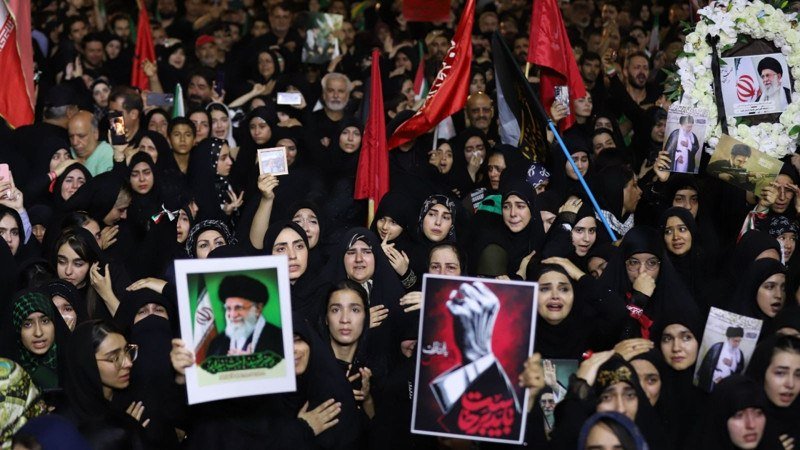
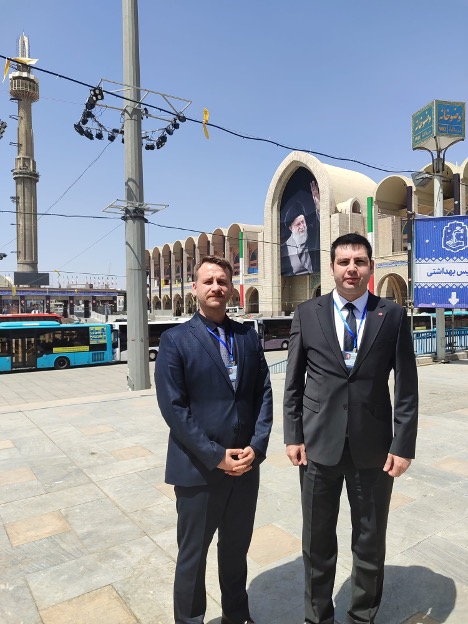
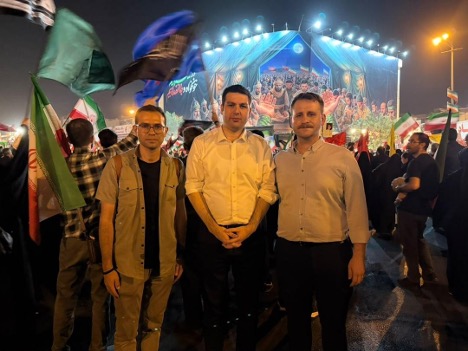
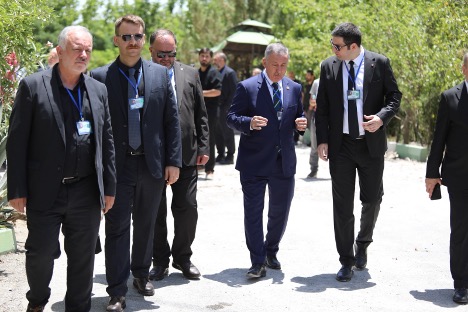
Together with Patriotic Party (Vatan Partisi) Secretary-General Özgür Bursalı, we were in Tehran, the capital of Iran, from 2 to 4 July to attend the funeral of Martyr Ali Khamenei. In addition to the Patriotic Party, the Turkish delegation included senior representatives from several political parties in Türkiye.
What we witnessed during the two days we spent there was not merely preparation for a period of mourning. It was also the process of a nation closing ranks once again.
Until this visit, what I knew about Iran consisted largely of the biased and deliberate distortions filtered through the Western media, the accounts of Iranian friends I met during my university years, art-house films and a little of Hafez’s poetry. Despite Iran being our neighbour, the channels through which we obtain information about the country pass, rather shamefully, through a Western filter. Even reports published in the Turkish press are often little more than translations of material from European and American media outlets. As a result, we have always viewed Iran from behind a curtain and have consequently misunderstood it.
Iranian Turks’ Commitment to the Revolution
Above all, what I consider most important is the commitment of Iranian Turks to the national state and the Revolution.
When we rely on American sources, we can easily be led to believe that the “30 million Iranian Turks”—including South Azerbaijanis, Qashqais and Turkmens—live under the domination of supposed Persian cultural imperialism, that children are forced to speak Persian and that the Turkish language is being deliberately erased. We are encouraged to believe that Iran is a Persian state in which Turkish and Kurdish communities merely possess minority status.
Yet both historical and contemporary realities suggest the opposite.
We heard more Turkish than Persian on the streets of Tehran. In fact, while speaking with people in the square, we never needed to switch to English. Iranian Turks aside, many of whom speak Istanbul Turkish with remarkable fluency, a significant number of Iranians of Persian origin also speak basic Turkish. There was no visible indication that Turkish was being restricted or suppressed.
Iran can be regarded as one of the most successful examples of a national state. Iranian Turks see Iran as a state they themselves established, and they embrace the Islamic Revolution.
Of course, one point should not be overlooked. Much of the anti-revolutionary population lives abroad, while those who remain inside the country may avoid expressing their true opinions on such matters. Nevertheless, I would like to emphasize that the picture being presented to the Turkish public has, at least on the streets of Iran, little visible correspondence with reality.
For the Turks living in Iran, the state is not an institution established and governed by Persians against their will, with the objective of erasing Turkish identity. Even where opposition to the Revolution exists among Iranian Turks, it appears to arise from different motives rather than from Turkish nationalism.
Perhaps the most intense moment of second-hand embarrassment I have ever experienced occurred in Tehran’s Revolution Square. A Turkish journalist asked a young man from Tabriz, “Where did you learn Turkish?”
The journalist clearly had no malicious intention, but ignorance on this scale points to a troubling problem.
Fortunately, the young man from Tabriz was understanding. He was studying history at university and proceeded to give the journalist an impromptu history lesson through a series of questions, almost in the Socratic manner.
First, he asked approximately in which century the Turks had arrived in Iran. He then asked when the Turks had settled in Anatolia. After that, he asked when Tabriz had become Turkish-speaking. He then asked the journalist where he came from. The journalist replied that he was from Manisa, whereupon the student asked when Manisa had been conquered.
The questions and answers naturally revealed the reality of the matter. Was the truly remarkable thing supposed to be that a person from Tabriz could speak Turkish?
Iranian Turks do not learn Turkish from television series. Like us, they learn it from their parents and grandparents. In ethno-genetic terms, they may even be “more Turkish” than many Anatolian Turks, although this is ultimately of little importance.
Turkish identity and consciousness remain alive and deeply embedded in everyday life. Yet this consciousness is firmly connected to Iranian identity and constitutes an inseparable part of it. Iranian Turks believe that they founded Iran, that the state belongs to them and that they have nowhere else to go.
Indeed, the martyred Khamenei, the incumbent president and numerous senior state officials come from this community.
A slogan I repeatedly heard in the square clearly summarized this outlook:
“Azerbaijan is awake; it is the pillar of the Revolution.” (Azerbaycan oyaqdı, inkılaba dayaqdı)
Here, “Azerbaijan” refers to northern Iran, including cities such as Tabriz, Urmia and Ardabil. In the original slogan, oyaq means “awake,” while dayaq means “support” or “pillar.”
The Revolution’s Young Scientists
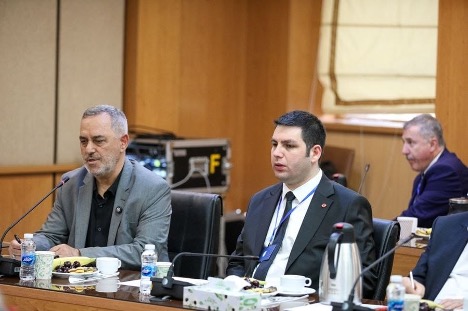
One of the institutions we visited was Shahid Beheshti University, Iran’s second-largest university. There, we had the opportunity to meet a group of highly promising young scientists.
As the Turkish saying goes, “A bad neighbor makes you a homeowner.” Decades of sanctions have forced Iranian scientists to develop domestic capabilities in fields such as physics, nanotechnology and medicine. In that sense, the sanctions may inadvertently have served a constructive purpose.
These young scientists, who can be regarded as products of the Revolution, are attracting international attention through their work in their respective fields. They briefed us on their research. Judging by the number of papers they publish in international academic journals, it can easily be said that they are not far behind universities in Türkiye.
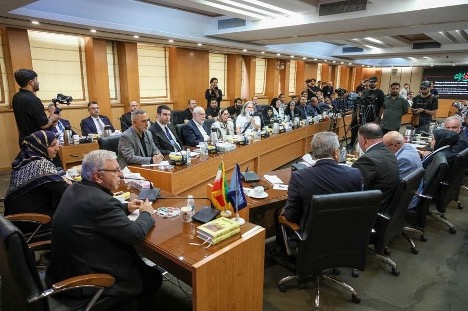
Together with the Turkish delegation, we also visited Shahid Beheshti University’s plasma research center, which had been bombed and reduced to rubble by the United States.
The deliberate targeting and destruction of this institute reveals the lawlessness of US-Israeli aggression in its starkest form. It is difficult to understand why a center conducting medical research on blood plasma would have been targeted. These reckless and brutal attacks against civilian facilities need to be brought much more forcefully to the attention of international public opinion.
Another striking feature of the university was the large number of female students. This observation is not based on scientific research but simply on what we saw during our visit. Nevertheless, the rector also emphasized that women account for nearly half of students at Iranian universities and outnumber men in certain departments.
Beyond the statistics, what particularly caught my attention was the confidence of young Iranian women.
Contrary to our preconceptions, we did not encounter women who had been pushed out of society, deprived of confidence or subjected to constant repression. Both on the streets and at the university, we saw strong, self-assured women. They interacted with men in a civil manner and expressed themselves comfortably and freely.
Officials we met told us that the compulsory wearing of the headscarf had, in practice, been lifted. Even so, women wearing Islamic dress remained highly visible both at the university and in the square.
At the same time, we did not witness any pressure being placed on women who chose not to cover their hair. In a large park near Revolution Square, whose name I unfortunately cannot remember, we saw young people enjoying themselves with a degree of freedom that would be difficult to find in many Anatolian cities.
A New Era for the Revolution
With all its achievements and shortcomings, the Iranian Islamic Revolution is approaching the end of its first half-century.
The victory achieved despite heavy losses has become one of the most important sources of inspiration in the twenty-first century, not only for Iran but also for all countries that have suffered under imperialism.
The children born on the day of the Revolution are now 47 years old. We can therefore say that the Revolution’s second generation is now taking the stage.
This generation is emerging in an environment shaped by the lessons of war, the further strengthening of the national state and the rooting of Iranian nationalism on a more rational foundation. Moreover, the confidence generated by the victory against the United States and Israel will provide a basis for future achievements.
For Iran, the Strait of Hormuz has acquired a significance comparable to that of Çanakkale for Türkiye. The profound influence that Çanakkale had on our own National Struggle can now be seen in Iran’s struggle.
The easing of the state’s formerly harsh approach towards women, the relaxation of ideological frameworks in government and the implementation of more rational policies will, in the long term, also weaken opposition to the Revolution.
I believe and hope that if the Revolution begins to reconcile with its own children—or at least takes meaningful steps in that direction—it will receive equally significant steps in return from those on the other side.
On this occasion, I congratulate the brotherly people of Iran, who have heroically constructed the first pillar of the Türkiye–Russia–China–Iran (TRCI) alliance. I hope that the days when we will all live freely and happily beneath the rising Asian sun will arrive as soon as possible.
Originally published as Turkish in Aydınlık newspaper