


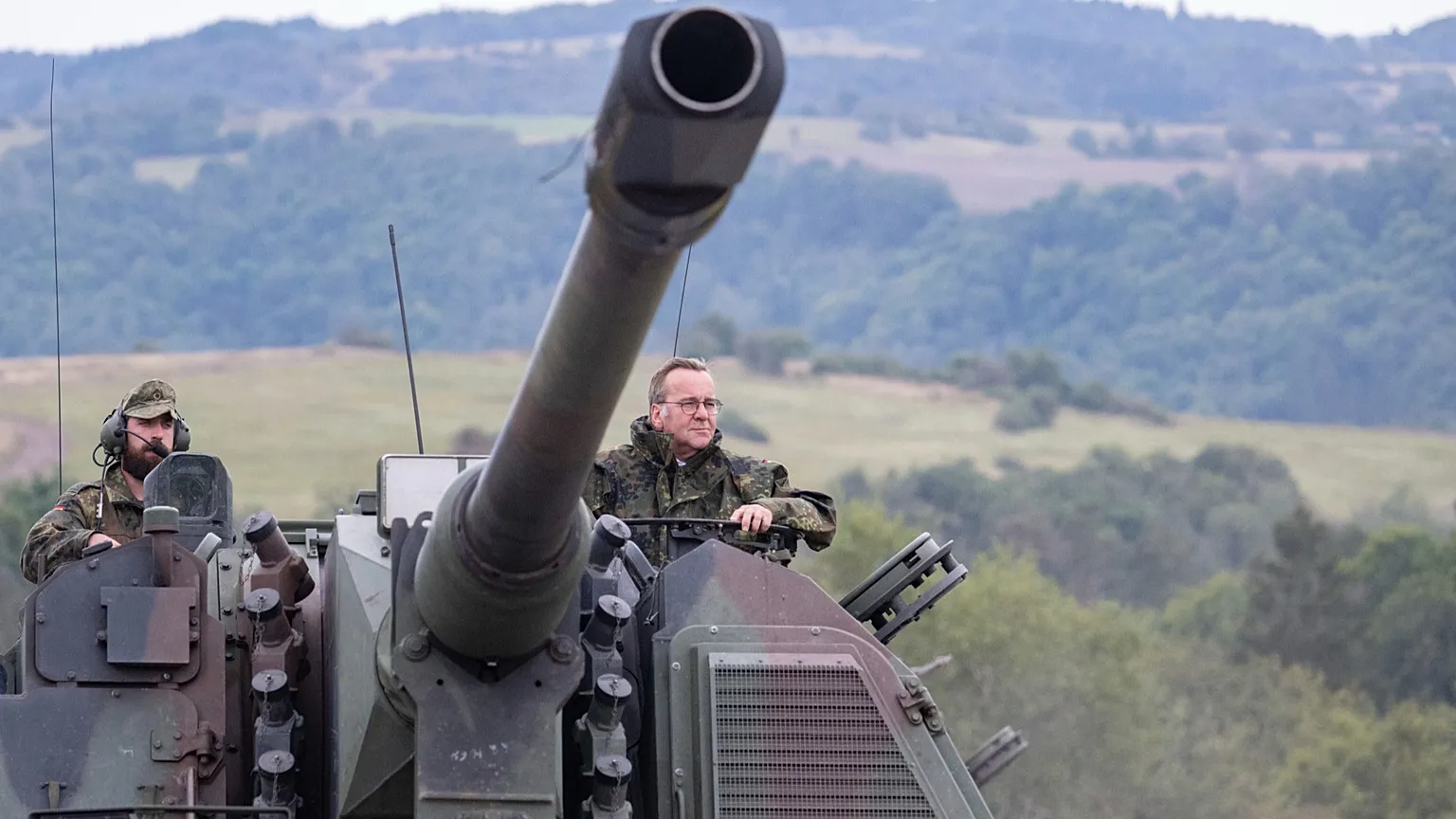
On the document titled “Overall Concept of Military Defense: Military Strategy and Plans for the Armed Forces, Responsibility for Europe” released by the German Ministry of Defense
On the document titled “Overall Concept of Military Defense: Military Strategy and Plans for the Armed Forces, Responsibility for Europe” released by the German Ministry of Defense
Europe is rearming. Countries, economies, and societies are being fundamentally reshaped to align with this new reality. The latest move has come from Germany.
The document titled “Overall Concept of Military Defense: Military Strategy and Plans for the Armed Forces, Responsibility for Europe” released by the German Ministry of Defense on April 22, 2026, lays bare Berlin’s expansive military ambitions.
This 40-page strategic blueprint has quickly become the pivotal point of the ongoing rearmament debate across the continent. The document outlines a radical transformation: steering Germany away from the model of a “peacetime military” and toward a high-intensity, “war-ready” conventional power that assumes leadership within NATO.
With the objective to transform the Bundeswehr into Europe’s most formidable conventional force, the document details a phased militarization process: bolstering defense capabilities in the short term, expanding overall capacity in the medium term, and securing a decisive technological edge over the long term.
The document identifies Russia as the biggest threat currently facing Europe, the transatlantic alliance, and Germany specifically. According to the document, Moscow aims to erode the European security architecture to expand its sphere of influence across the continent, intending to exert pressure on the Baltic and NATO members that were former Warsaw Pact members.
UWI author, historian and political scientist Associate Professor Mehmet Perinçek has shared his evaluations on the document and rearmament in Europe.
The crisis in Europe
The current militarization process across Europe can only be explained with the crisis the continent is in. By tagging along to the US, Europe became a party to the war in Ukraine. That decision has come at a high cost.
A severe economic and energy crisis has begun to ravage the continent. The sanctions on Moscow triggered a process that backfired on Europe itself. Losing access to the Russian market, coupled with the deprivation of Russian raw materials, has damaged European industry. The suspension of the Nord Stream 2 project followed by a sabotage in the pipeline directly impacted the operations of major corporations and led to factory closures.
The production crisis in Europe must also be viewed against the backdrop of the rapidly ascending China. As China emerges as a global economic hub, its rapid growth in sectors like automotive manufacturing is mirrored by the closures of car firms and factories in Europe. This picture shows that a multipolar world is emerging, the Atlantic era is coming to an end, and Europe is ceasing to be a considerable power following the American line.
Economic crises have also led to political crises. Since the beginning of the war in Ukraine, Europe had envisioned various scenarios for a change of power in Moscow. However, quite the opposite happened: We have witnessed a succession of governments in the UK, early elections in Germany, and a France unable to pull itself out of a political crisis.
“Preparing the society for war”
Europe is now attempting to get out of this crisis through “war policies”. It seeks to stall the emergence of a multipolar and its decline through rearmament. Having lost its competitiveness against China and access to the Russian market, Europe is now seeking a remedy in the defense sector. For example, Volkswagen has proposed to the German Ministry of Defense that it produce military vehicles. The French automaker Renault is starting to establish drone factories in Ukraine. They are attempting to resolve their crisis by escalating and expanding the war.
The revival of the conscription debate and the increase in defense budgets in Germany means preparing the society for war. The rise of pro-war rhetoric in leading newspapers and the emergence of leaked recordings discussing potential provocations against civilian targets in Russia are among clear signals of this. All these developments show that the West, Germany, France, and the UK, is seeking the way out where it should not seek.
An alternative path for Europe
In truth, Europe could very easily resolve this crisis: It could establish good relations with Russia and China, revive the Nord Stream 2, and buy gas via the TurkStream project. However, the prevailing policies, tensions with Moscow, China and Iran, and alignment with US interests in the Eastern Mediterranean only serves to exacerbate the crisis rather than resolve it.
In the overall global landscape, we see that the center of gravity in the world economy and military power is shifting from the Atlantic to the Pacific. We are witnessing Eurasia consolidate its strength through political and economic cooperation, unifying across military, economic, and diplomatic spheres via frameworks such as the Shanghai Cooperation Organization, BRICS, the Organization of Turkic States, and ASEAN. In contrast, the Western world is fracturing. These are not merely everyday political disagreements; rather irreparable rifts within NATO and between the US and Europe.
These fractures are also present within the countries themselves. In Germany there are strong anti-war forces AfD and BSW. Indeed, the AfD has become the first party in the polls. In France, Le Pen is breathing down Macron’s neck. In the UK, the Reform Party is on the rise. Similarly in Bulgaria, candidates who oppose current policies regarding Ukraine are becoming successful in elections.
The Turkish community in Europe
In this context, a significant responsibility falls upon the Turkish community in Europe. Turks should withdraw their support from parties and governments that exacerbate this crisis for the peace of Europe and the economic well-being and security of the Turkish community. They should back anti-war movements and parties that advocate for cooperation with Eurasia and Türkiye. It should not be forgotten that when Europe is plunged into crisis and factories shutter, it would be foreigners who will suffer most.
Therefore, both for their own economic interests and for the sake of global peace and stability, it is imperative to support the forces standing against war and to send a decisive message to the governments persisting with these policies.