


The erratic leadership of NATO
The erratic leadership of NATO
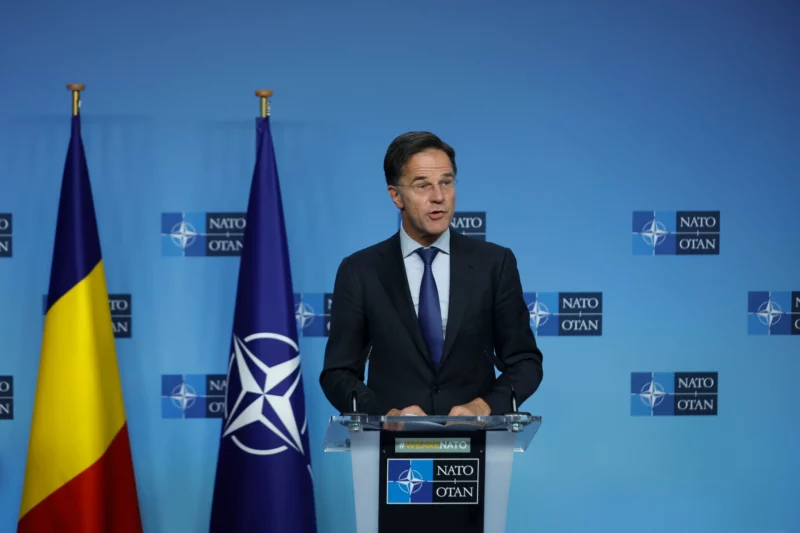
NATO Secretary General Mark Rutte said on March 22 that he is “absolutely convinced” that the alliance will be able to reopen the Strait of Hormuz. Rutte stated 22 countries, including NATO members along with allies such as South Korea and Japan, are coordinating efforts to do that.
Cem Gürdeniz, a retired Rear Admiral of the Turkish Navy and one of the coiners of the term “Blue Homeland” (Mavi Vatan) shared his views on Rutte’s statement on.
We present Gürdeniz’s analysis, translated into English.
——————————————————————————–
1. NATO Secretary General Mark Rutte’s recent statement that 22 countries are coming together to secure the Strait of Hormuz signals a highly dangerous strategic rupture that stands in stark contradiction to the alliance’s current reality.
2. To talk up a military engagement of this scale in one of the world’s most critical energy simply to appease Trump is not only a move that escalates regional tensions, but also a clear disregard for NATO’s own capacity limits.
3. Today NATO, particularly its European flank, is experiencing serious depletion in munitions and logistics due to the support to the war in Ukraine. The arsenals of many European countries have been drained to alarmingly low levels. On the US side, it is also an open reality that stockpiles are under severe strain due to the extensive military support to Israel. In these circumstances, speaking of a new military commitment in a high-risk geography like the Strait of Hormuz is detached from military realities.
4. Rutte’s claim that “22 countries are ready” doesn’t suffice to mask the political and military fragmentation on the ground. Indeed, several European countries are keeping their distance from direct military involvement, and even we read conflicting statements from the US on whether NATO’s involvement is demanded. In other words, what we are seeing is not a unified and binding NATO decision, but rather a loose and ambiguous coalition discourse.
5. Even more critical is the following point: in a military alliance of 32 members like NATO, a commitment of this scale cannot be declared without the open discussion and approval of the NAC—the North Atlantic Council. It is a big question mark as to what authority Rutte makes such statements. This undermines the alliance’s institutional functioning and bypasses decision-making mechanisms.
6. One of the greatest mistakes in military history is committing to major undertakings without accurately assessing one’s real strength and plunging into uncontrolled adventures. Today, NATO stands precisely on the brink of this very risk. The erratic, unpredictable, and at times almost childish reflexes of its political leadership further undermine an already fragile strategic balance.
7. As for Türkiye, the issue has an even more vital dimension. Under such erratic leadership, the question of how much longer its most valuable naval and air elements should be allocated to NATO’s operational command should be seriously debated. Because this is not merely a matter of alliance obligations, it also directly concerns national security and the proper utilization of its own national forces.
In conclusion, NATO does not need to be defeated militarily; NATO already gives the impression of being defeated from within. As long as it has a Secretary General like Rutte, NATO will continue to flail in like a headless rooster.