


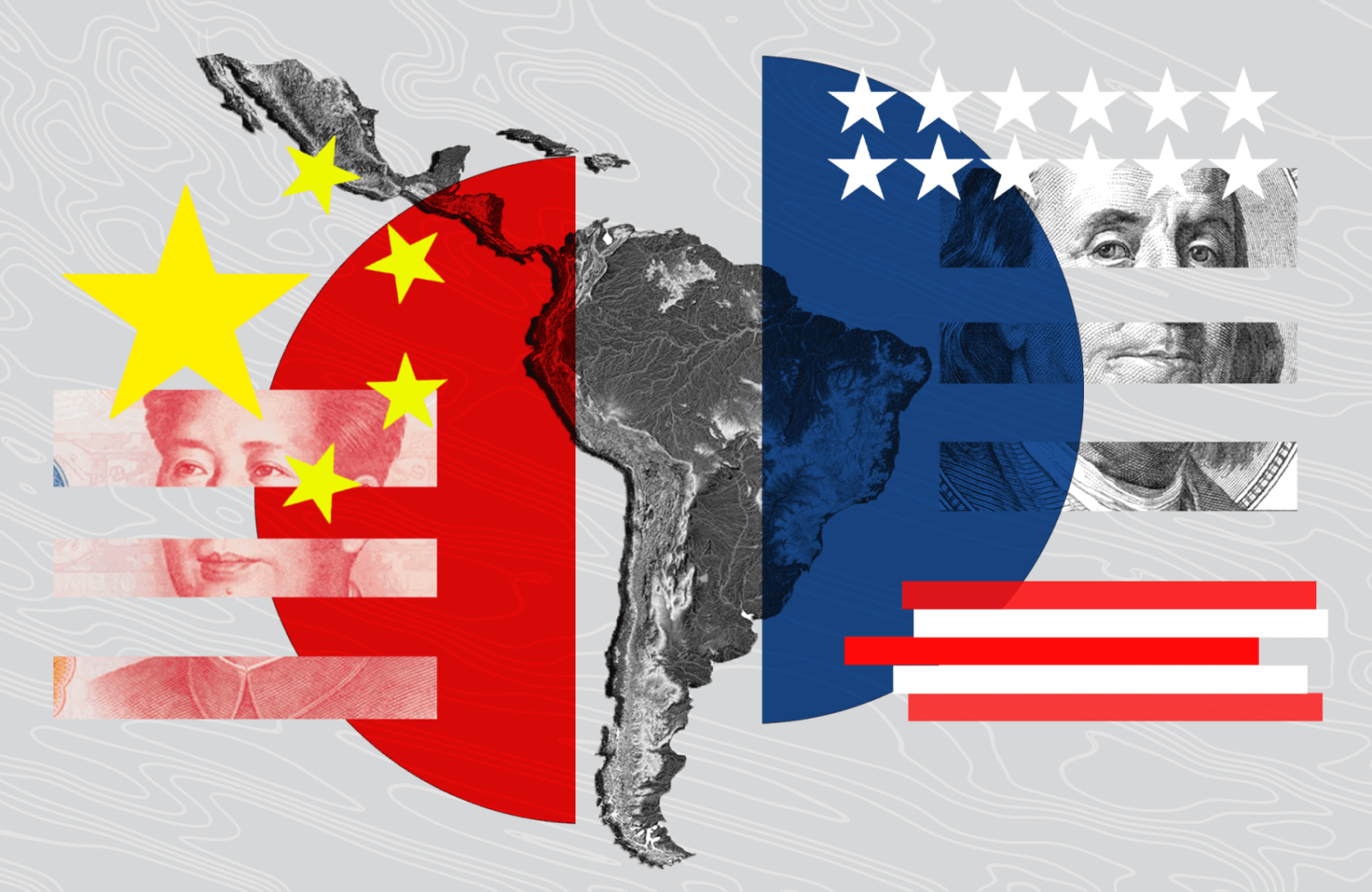
If China it thinks that by “wooing” the business sector and the right-wing governments that hate them, it will gain ground in Latin America and the Caribbean, it confirms that it understands little to nothing about what is happening in the region and what the Monroe Doctrine and the Trump Corollary mean.
If China it thinks that by “wooing” the business sector and the right-wing governments that hate them, it will gain ground in Latin America and the Caribbean, it confirms that it understands little to nothing about what is happening in the region and what the Monroe Doctrine and the Trump Corollary mean.
The process of containing China’s economic presence in Latin America and the Caribbean is already underway, both openly and more subtly. Beyond the outright rejection of Chinese companies in Venezuela following the armed incursion into that country on January 3rd, other manifestations point to a trend unfolding in the areas of trade, investment, technology, and security. While China has the capacity and is concerned with defending its interests in these spheres, the confrontation is also evident in the geopolitical arena, where Beijing has no intention whatsoever of challenging Washington. To paraphrase the old adage, China isn’t interested in having friends; its desire is to have good partners with whom to conduct—to use a redundant phrase—good business.
China’s approach remains misguided and stems from its misunderstanding of the problem, as it addresses it exclusively from a commercial, economic, and financial perspective, thereby magnifying the weight its economic power could have in the region on the one hand, and the degree of entrenchment its presence means in local economies on the other.
The analyses of Chinese academics are almost strictly quantitative; they are not interested in measuring the significant qualitative and subjective impact that their enormous economic presence has on the region. And the truth is that, to a large extent, the local population does not perceive this Chinese disposition, because it is almost exclusively limited to doing business with entrepreneurs and companies that do not generate benefits for the citizens.
Studies conducted in China on its ties with the region are based on quantitative analyses of trade flows, long-term investments, financial links, infrastructure projects, global supply chains, and others that effectively produce economic growth which is basically enjoyed by a minority of the population.
And as always, every analysis done in China overwhelms with figures: that in 2024 China’s bilateral trade with Latin America exceeded 500 billion dollars for the first time, approximately 35 times the level of 2001, and that trade in 2025 is expected to surpass that mark again, which would highlight the growing depth of China’s economic commitment to the region.
Or that in South America, China has already surpassed the United States as the main economic partner in key countries like Chile, Peru, and Uruguay. That Brazil sends around 28% of its exports to China, compared to approximately 13% to the United States.
Whether investment patterns show a similar change is as China’s cumulative investment volume in Latin America, estimated at around $650 billion, approaches the total US investment of approximately $1 trillion.
Okay, so what’s the point? If Chinese businesspeople behave just like their American counterparts and are equally hated and despised, the question is, why would we leave the United States if it’s going to be the same in China’s hands? It’s true that the Chinese government and President Xi Jinping himself are making enormous efforts to change this perception, developing policies more in line with the country’s philosophical and political principles, but this is far from being reflected in the lives of ordinary people. Beijing assumes that the United States’ efforts to block China will face resistance from Latin American governments and societies motivated by their dependence on these projects for jobs, tax revenue, and infrastructure improvements… and perhaps that’s true, but then, how are they any different from the United States?
They are mistaken. Resistance will only arise—as it has so far—from the magnitude of Washington’s pressure, blackmail, and threats, and the implications this has for the profit margins of businesses. When this happens, Latin American governments rush to Washington to explain the situation so that the US will show “reasonable flexibility” and authorize them to negotiate with China. That is the reality; everything else is wishful thinking.
In recent times, especially since Donald Trump’s second term as US president, these dynamics have gained unusual momentum. This context helps explain Panamanian President José Raúl Mulino’s rejection of the statement issued by the Chinese government’s Hong Kong and Macao Affairs Office regarding the Panamanian Supreme Court’s ruling on the contract held by the Chinese port company CK Hutchison Holdings to manage two ports in the Panama Canal. Mulino stated that Panama was a state governed by the rule of law and that judicial decisions should be respected. The Chinese government had appealed the ruling that annulled the contract.
In another part of the world , the way in which the accusation and subsequent swift removal of Peru’s former interim president, José Jerí, was carried out for alleged “semi-clandestine” ties with businessmen of Chinese descent, created, at the very least, well-founded suspicions about the fate that befell the former leader. For several weeks prior to the legislative impeachment proceedings, the US embassy in Peru made comments that can only be described as improper and unusual in the realm of diplomacy, and as interference in an internal matter unrelated to the role of the US representation in Lima.
These actions were sending a clear message to undermine the credibility of Chinese businessmen in Peru, which cannot be ruled out because the US objective of halting Chinese advance in the region is public knowledge, even since the time when General Laura Richardson, as head of the Southern Command under the Joe Biden administration, had free rein, giving orders and instructions to presidents and local authorities.
It is well known that Peru plays a strategic role in the South American region today through the mega deep-water port of Chancay and other important infrastructure. Reversing or reducing Chinese investments in Peru could have major implications for China’s future plans and its Belt and Road Initiative.
Attempting to send a signal to the United States, which had pressured in this regard, and trying to save himself from dismissal, the then-President of the Council of Ministers of Peru, Ernesto Álvarez, described as “unacceptable” the fact that the state-run Supervisory Agency for Investment in Public Transportation Infrastructure (Ositran) could not supervise the Chancay port , after the Judiciary ordered this regulatory body to refrain from inspecting this infrastructure controlled by the Chinese company Cosco Shipping Lines.
Álvarez said he was concerned that, given Chancay’s crucial importance to Peru and all Pacific trade, some aspect of its operations, or even parts of the port facilities themselves, might fall outside the scope of oversight by the regulatory body. He stated that the government would appeal the ruling, and if it did not receive a favorable response, it would consider filing a claim with the Constitutional Court.
In another action that falls within the United States’ recent anti-China offensive, Washington, through Secretary of State Marco Rubio, personally announced the revocation of visas for three Chilean government officials: Minister of Transport and Telecommunications Juan Carlos Muñoz, Undersecretary of Telecommunications Cristian Araya, and Chief of Staff of the Undersecretary of Telecommunications Guillermo Petersen. The United States stated that it revoked the visas for “compromising critical telecommunications infrastructure and undermining regional security in the hemisphere,” in relation to the proposed fiber optic cable connecting Valparaíso with Hong Kong.
This measure clearly falls within the type of political blackmail the United States routinely employs to counter China’s influence in Latin America. It is yet another arbitrary action by the US against a Latin American government that has been submissive, docile, and obedient. The most shameful aspect—characteristic of the current Chilean government’s subservient nature—has been the response from the Minister of Transport and Telecommunications himself, who indicated he was “hurt” by the decision, given his special “ties” to the United States, both familial and academic.
In another area, in the Caribbean, the United States ambassador to the Bahamas, Herschel Walker, argued that the terms of the $195 million Chinese financing for the second hospital in New Providence are not “in the best interests” of this nation and promised that the Trump administration “would help secure a better deal.”
In an official statement responding to revelations by a Bahamas newspaper that Chinese law and jurisdiction would govern the Export-Import Bank of China loan covering 72.8% or nearly three-quarters of the hospital’s $278 million financing needs, he argued that the Bahamas would be better off securing “financing options that adhere to international standards.”
Suggesting that the government should reconsider the agreement, Walker said, “It does not appear to be in the best interests of the Bahamas to submit to Chinese law and labor standards on its own territory.” He believed it was better to consider other financing options that comply with international norms, for which President Trump would impose fair agreements that benefit both nations, committing to be the preferred economic and security partner.
The New Providence hospital agreement and its financing terms threaten to be the first point of contention between the Trump administration and the Bahamian government during Walker’s presidency. It also threatens to drag the Bahamas into what Prime Minister Philip Davis’s administration has always sought to avoid: the geopolitical battle between the United States and China for economic and global dominance.
Walker’s statement also confirmed revelations by the financial services publication Tribune Business that China Railway Construction Corporation, the main contractor for the second New Providence hospital, was among a group of Chinese entities that attracted Donald Trump’s attention during his first term due to their historical origins and ties to the Chinese military. For this reason, the U.S. government issued an executive order prohibiting Americans from owning stock in these companies because of those ties.
This is just the beginning; the United States’ offensive against China will escalate, especially given Secretary Marco Rubio’s decision to expel US investments from the region. To achieve this, they are not hesitating to use blackmail, threats, and even armed attacks.
According to Professor Wang Wen, Dean and Professor at the Chongyang Institute of Financial Studies of Renmin University of China (RDCY), “… if the United States continues its policy of marginalizing Chinese interests in the region through a piecemeal and gradual approach, China is likely to respond with a combined strategy of defensive counterattack and strategic escalation.” This would include “economic integration, financial empowerment, rule restructuring, diplomatic coordination, and risk management, designed both to protect existing investments and to expand into new areas of cooperation, consolidating the community of shared economic interests between China and Latin America.”
It’s a good start, and in some respects could be considered a radical shift in Chinese policy toward the region, as it would express a different vision that moves away from unilateral trade and economic policy and toward “diplomatic coordination” on issues that go beyond the recognition of the “One China” principle, which seems to be the differentiating factor in the friend-enemy dichotomy of China’s foreign policy doctrine, which until now has actually been more of a partner-enemy dichotomy. However, it must be noted that this entire proposal only aims to consolidate “the community of shared economic interests between China and Latin America”… but it’s a start.
Of course, China has an arsenal of instruments of action that go far beyond the mere exercise of economic and financial operations, which it has not dared to use, seemingly out of respect for Latin America and the Caribbean’s status as the United States’ backyard. This can be deduced from the form and substance of China’s actions in any other region of the world, which are far more proactive, assertive, and assertive.
If China believes that this attitude will bring it closer to the United States, it is sorely mistaken. And if it thinks that by “wooing” the business sector and the right-wing governments that hate them, it will gain ground in Latin America and the Caribbean, it confirms that it understands little to nothing about what is happening in the region and what the Monroe Doctrine and the Trump Corollary mean. They should know that they have no chance of playing a role in this context unless they accept that sooner or later, they will have to confront Washington. As Hamlet would say, “That is a question.”