


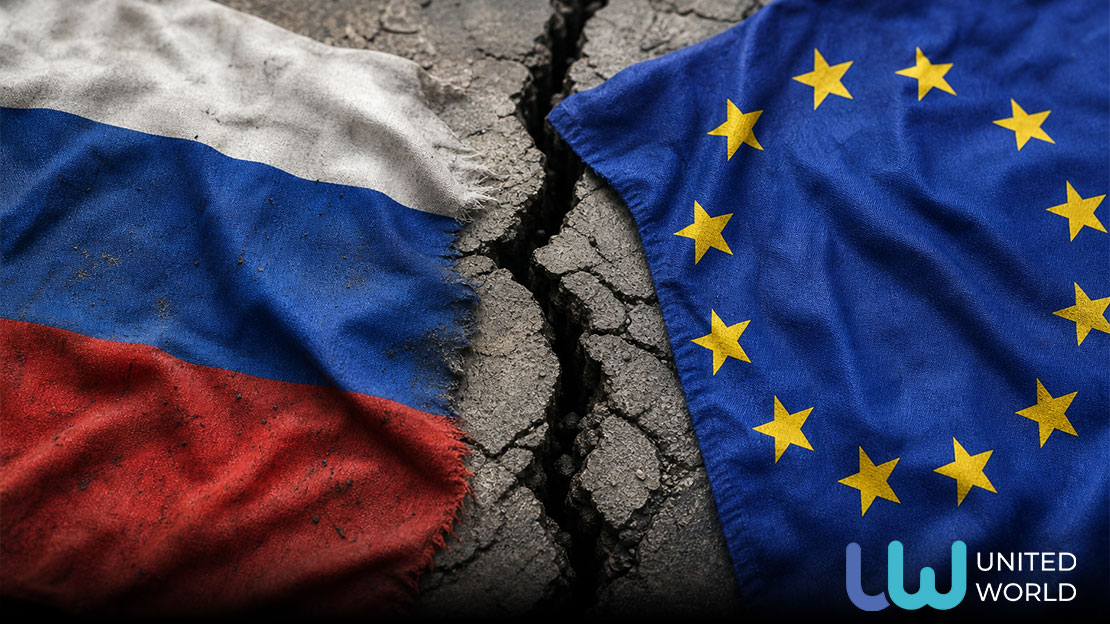
UWI author, historian and political scientist Associate Professor Mehmet Perinçek was a live guest on Türkiye’s Ulusal Kanal to discuss the rising tensions between Europe and Russia and the reasons behind them.
We are sharing the program with our readers.
—
“Russian threat” as a disguise for aggression
“Russian threat” is increasingly becoming a subject of political debate in Europe. What is happening, and what is behind it?
The talk in Europe of a “Russian threat” is not consistent with reality. Europe is inventing a supposed Russian threat in order to conceal its own aggression toward Eurasia and Russia. If we look back at Hitler and the Second World War, what did Hitler say when he moved against Czechoslovakia? The lives of Germans in Czechoslovakia were in danger, and Germany had to send in troops and occupy Czechoslovakia in order to protect them. He said communism was spreading, and that Germany had to eliminate that threat at its source. So even Hitler’s Germany tried to disguise its imperialist and aggressive ambitions and manufacture a pretext for them.
We see similar tendencies reemerging in Europe today, with Merz, Macron and a number of other leading European figures. When we look at the facts, what we actually see is not Russia advancing toward Europe, but Europe and the Atlantic bloc advancing toward Russia.
NATO’s expansion: Towards Russia and the others
In the early 1990s, when the Soviet Union was collapsing, the Soviet leadership under Gorbachev essentially said: we will dissolve the Warsaw Pact, but NATO must not expand eastward. Western leaders gave verbal assurances to that effect. But they did not keep those promises. On the contrary, NATO expanded eastward toward Russia six times and eventually reached Russia’s borders.
This attempt to encircle Russia has parallels elsewhere: in the Eastern Mediterranean and the Cyprus issue, in the Taiwan issue, in the Strait of Hormuz and in Yemen. In all these regions, we see attempts by the same forces to surround, contain and suffocate Iran, China and Türkiye.
“The possibility of a major war cannot be ruled out”
So what you are saying is that there is no substance to this claim that Russia is not actually preparing an attack. On the contrary, you argue that the Atlantic bloc is seeking to cross Russia’s red lines and expand eastward toward Russia. Then let me put the question differently. Does Russia currently have the military capacity and resources to open a second front against NATO?
The possibility of such a war or confrontation cannot be ruled out. That needs to be underlined.
Germany, Britain, France, and Poland should also be included here, we see that they are preparing for a possible war with Russia. They are rearming rapidly. They are increasing their military and defense budgets. At the same time, they are conducting propaganda campaigns and other activities aimed at preparing society for war. They are telling Europe’s young people that they need to be prepared for war. European industry is increasingly being oriented in that direction too. Major automobile manufacturers and other large Western companies are beginning to invest in the defense industry. Volkswagen, for example, has approached the German military with proposals to produce military equipment. France’s Renault has moved into drone production. We call Rheinmetall and other huge companies to this list. This clearly shows that Europe and the Atlanticist powers are preparing for war. So the possibility of such a war does exist.
War simulations by the US
If such a conflict were to occur, we would also have to say that Europe’s military strength and overall military capacity are fairly weak. Europe is not ready for a war of this kind. And this is not merely our assessment. Western military experts, Western officials and even some of the forces advocating confrontation themselves acknowledge that Europe is not really in a position to match Russia militarily. Socially, too, the European population is not prepared for war. Then, of course, there is the fact that Russia is a nuclear power. There have also been numerous war simulations conducted in the US, including simulations carried out or commissioned by the US government itself. These simulations have concluded that, in a non-nuclear, conventional war, the US would be defeated by Russia and China.
There is another factor we have to take into account. In any armed confrontation with Russia, particularly in the event of a military intervention directed against Russia, there is also the possibility that Russia’s allies and friendly countries would become involved.
A possible war spilling over from Russia and NATO
What exactly do you mean by that? Could you elaborate?
A war between Russia and NATO would, in effect, mean the beginning of a world war. It would not remain confined to Russia and NATO, but lead to a much larger conflict encompassing the entire world. In such a major confrontation, countries on the Eurasian side would also become involved. Just as there is economic solidarity among them, countries such as Iran and others would not remain indifferent in the event of a war of this magnitude. Other fronts would inevitably emerge.
As I said earlier, the war in Ukraine and the Taiwan issue cannot really be separated from one another. Nor can the Taiwan issue and the Strait of Hormuz or the Eastern Mediterranean.
That is why we can say that Europe, with its present military strength and capabilities, is not ready to match Russia. Again, Western officials themselves say as much.
Just and unjust war
There is another factor: the distinction between a just war and an unjust war. I don’t think a young European, or for example a Turkish worker living in Europe, would be particularly willing to go and die on the Russian front for Germany’s imperial interests. Russian young people, on the other hand, would fight with much stronger motivation if they believed they were defending their own homeland.
So the main problem facing Europe today is not the claim that Russia is about to attack. Rather, Europe lacks a common political approach and a common security mechanism capable of managing such a confrontation or waging a war against Russia or another country. Is that what you are saying?
Yes. And they are trying to create such a mechanism and legitimization for that. But they are facing serious opposition within their own countries. We saw that reflected in the recent elections in Germany. Referendums are being held in Switzerland over the question of neutrality. Macron is approaching the end of his political life, while Le Pen and Melenchon are gaining ground.
NATO-Russia confrontation from Türkiye’s perspective
You argued that if a war broke out between NATO and Russia, it would not remain confined to those two sides but would spill over. And you mentioned some countries. That brings us to Türkiye’s perspective.
When the Atlantic powers attempt to encircle Russia through Ukraine and the Black Sea, they are also encircling Türkiye. Their plans in the Black Sea cannot be separated from their plans in the Eastern Mediterranean or from their plans aimed at undermining the sovereignty of the Turkish Republic of Northern Cyprus (TRNC).
Likewise, the dollar-based system of domination that they seek to impose on Türkiye is similar to the system they seek to impose on Russia. So Türkiye’s objective interests clearly place it on the opposite side of the Atlantic bloc. If the Atlantic bloc becomes stronger and succeeds in implementing its plans, that would also damage the sovereignty of the TRNC. It would weaken Türkiye in the balance of forces in the Eastern Mediterranean and strengthen the opposing side.
A stronger Atlantic bloc also means greater support for Israel. It would mean an increase in the pressure and threats directed by Israel against Türkiye, Syria, Palestine, the Arab world, the Islamic world and Iran. That brings us back to what I said at the beginning: the Black Sea and the Eastern Mediterranean form part of the same strategic front. The Taiwan issue and Strait of Hormuz are likewise parts of the same broader front. From that point of view, Türkiye’s objective interests lie in opposing the Atlantic bloc.
Right position and alignment for Türkiye
But there is something to be added here: There is a way capable of preventing this escalation. The world doesn’t have to be heading toward a major war. If Türkiye adopts the right position and a strategic alignment between Türkiye, Russia, China and Iran is established, the economic power created by such a grouping, the military deterrence it could generate and the broader network of international alliances it could attract would help prevent such a war.
The Atlantic bloc is already in economic decline. It is losing legitimacy internationally with each passing day. It is also becoming increasingly divided internally. Developments such as the rise of the AfD in Germany, the growing support for Le Pen and Melenchon in France, and the contradictions between Europe and the US demonstrate this. Everyone sees their failure in Iran and Palestine.
In that sense, the primary issue of Türkiye, both in order to solve its own economic and security problems and to help prevent the world from being dragged into another major war, is to build this alliance. Such an alliance would also enable Türkiye to establish relations with the West on a more balanced and substantial basis.
Ukrainian attacks on Turkish vessels and pipelines
And I’d like to ask a last question. How will the tensions between Europe and Russia affect the battlefield in Ukraine? The winter is approaching. Will Western and European countries continue providing military support to Ukraine? In the short term, where do you see the war heading?
The Western support is going to continue. But the Ukrainian army has been unable to advance and has in fact been retreating. That’s why we are seeing more drone attacks and terrorist attacks deep inside Russia, targeting civilian targets. These attacks are putting pressure on Russia to respond more harshly, perhaps even to consider the use of nuclear weapons on a limited, tactical scale. The intensification of attacks behind the front lines is because they fail on the battlefield.
I think we can expect the intensity of the war to increase in the coming period when we consider the preparations being made by the West.
I should note one point about Türkiye. Turkish vessels and some of Türkiye’s most important energy projects, including TurkStream and Blue Stream, have also come under attack from Ukraine. We need to recognize this. Russia is not the only target here. Look at the Black Sea today: trade has effectively come to a halt. Ships are no longer travelling back and forth to the opposite shore as they once did. The tomatoes grown by Turkish farmers; the machinery produced by Turkish manufacturers can no longer reach Russia as they did before. Likewise, the raw materials and other goods Türkiye needs are no longer arriving from the other side of the Black Sea as they did before.
So we cannot regard this war as if something with no direct bearing on Türkiye. And the cost of the conflict for Türkiye is increasing with each passing day.