


By Mehmet Enes Beşer
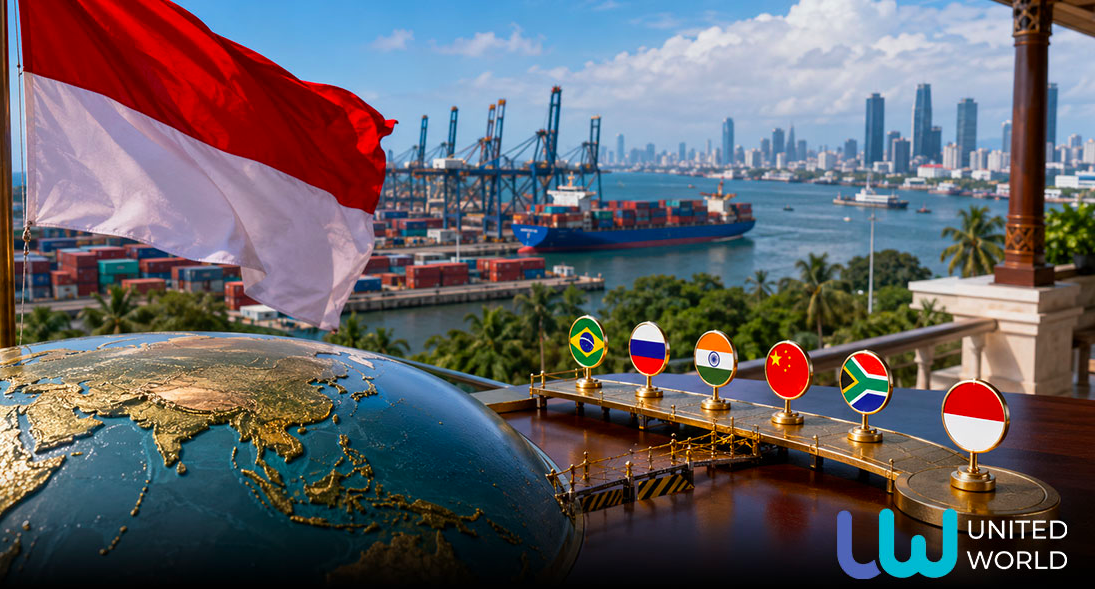
At the beginning of January 2025, Indonesia joined the BRICS group becoming its tenth member state and the first representative from the Southeast Asian region. Being among other major countries in the BRICS alliance, Indonesia strives to increase its influence at the international level, develop economic cooperation, and position itself as a leader representing the voice of emerging economies. On the other hand, this strategic decision can be considered quite complicated because of the opportunities and challenges that the country faces.
The first chance to take advantage of being a member of the BRICS group is that it gives the possibility of using the financial resources provided by the New Development Bank. In this way, Indonesia will obtain alternative financing sources and will not have to rely solely on Western countries in terms of finance needed to implement projects and develop the country economically. Additionally, Indonesia will gain the opportunity to invest in infrastructure by financing the construction of roads, railroads, and hydropower stations, and creating high-speed Internet connections.
Furthermore, by joining the BRICS alliance, Indonesia gets the chance to diversify its foreign trade partners. Cooperation with such countries as China, India, Brazil, and Russia allows the country to create new export markets and increase its resilience to economic shocks caused by global economic instabilities. Moreover, it provides an additional income for the budget, which is crucial in the current challenging situation.
By joining the BRICS alliance, Indonesia expresses the intention to adhere to the principle of multi-alignment, which means the lack of a choice to be a full-fledged ally to either one of the two major blocs in the world politics. Such a position is beneficial for the country because Indonesia gets a great number of allies with different political views and positions that enable it to pursue an independent foreign policy.
However, the adherence to multi-alignment has several difficulties. First, Western countries may regard Indonesia’s actions as favoring Russia and China, thus putting in question its neutrality. It is vital for Indonesia to handle this issue and preserve its neutral position in the global political arena.
Secondly, Indonesia will experience both domestic and international challenges related to the fact that joining BRICS can be viewed as a move that undermines the influence of the USA in this region. However, it should be said that Indonesia has long been implementing its strategy of non-alignment and promoting the interests of the Global South worldwide, which is why the country should be regarded as the leader of developing countries.
Finally, some Indonesians perceive the accession to BRICS as a measure aimed at increasing their country’s international standing, while others fear excessive dependency on certain BRICS members, mainly China. Therefore, in order to address these concerns and convince Indonesian citizens to support the government’s intentions, the government has to conduct an effective informational campaign about the benefits of joining the BRICS group.
Indonesia has become a BRICS member to maintain and develop further a neutral stance characteristic for the country. By joining the alliance, Indonesia hopes to counterbalance the confrontation between China and the USA, becoming a strong advocate for the interests of emerging economies and playing an important role as a mediator in resolving disputes between two leading world economies.
Nonetheless, Indonesia’s accession to BRICS also involves a number of difficulties because the government has to avoid entanglement in geopolitical tensions existing between other BRICS members while pursuing the goal to benefit from cooperation. In particular, it is vital for Indonesia to be able to negotiate with all member states and use their advantages without becoming involved in controversial matters.
The accession of Indonesia to the BRICS alliance in January 2025 was strategically important for the country since it gave Indonesia an access to alternative financing sources and the opportunity to use the resources of the New Development Bank in order to finance its infrastructure development projects in the transportation, energy, and information technology areas.
Joining BRICS also helped Indonesia in its goal to expand its foreign trade and reduce dependency on its main economic partners by establishing trade relationships with other major economies in the world. At the same time, Indonesia has to deal with the challenge of managing relations with other BRICS member states and Western countries and convincing the public opinion of the correctness of this decision.