


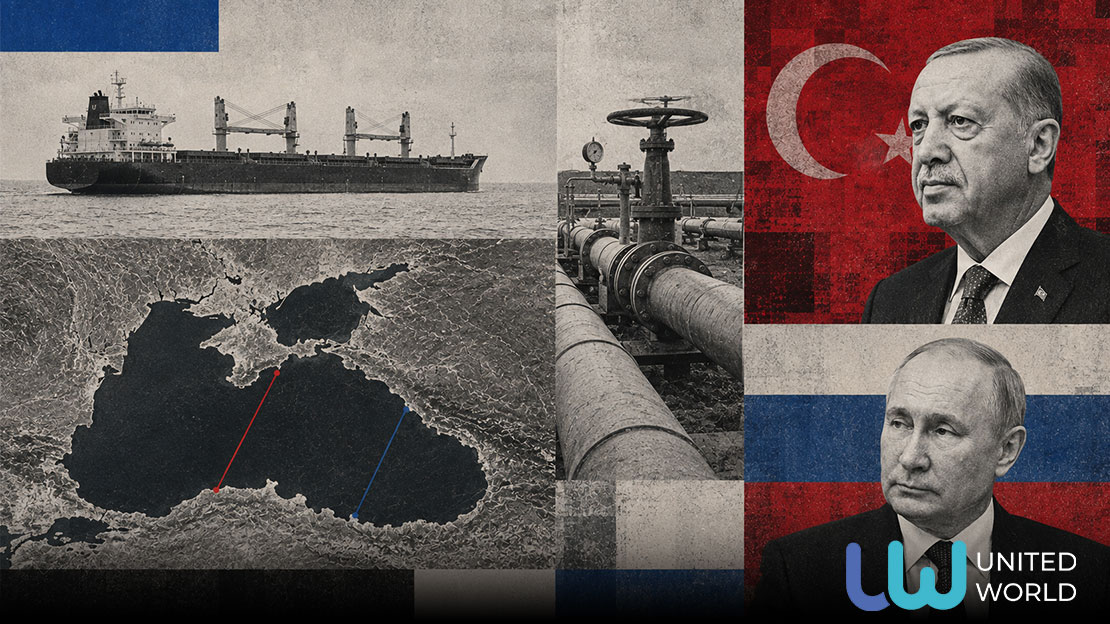
Relations between Türkiye and Russia, two major states of Eurasia, are showing signs of deterioration in connection with the ongoing war in Ukraine.
Most recently, allegations that US-made munitions in Türkiye’s inventory would be sent to Ukraine have further heightened tensions between Ankara and Moscow.
Commenting on the issue, Russian Foreign Ministry Spokesperson Maria Zakharova said that Moscow was awaiting statements from both Türkiye and the US, and if the arms transfer in question were to take place, bilateral relations would suffer a serious blow. Ankara has yet to issue an official statement on the matter.
Another source of tension between the two countries is Ukraine’s continuing attacks on commercial vessels in the Black Sea.
Russian Foreign Minister Sergey Lavrov had the following to say on the issue: “When an AFU drone strikes a Turkish bulk carrier, a tanker, or a civilian vessel, when those same drones repeatedly attack the infrastructure of the Caspian Pipeline Consortium in the Caspian Sea, directly targeting vessels associated with American companies Chevron and ExxonMobil, neither Türkiye nor the United States publicly declares that such actions by Ukrainian terrorists are unacceptable.”
Lavrov’s remarks came following Turkish Foreign Minister Hakan Fidan’s proposal for a moratorium in the Black Sea.
Another statement concerning developments in the Black Sea came from Ukraine’s ambassador to Ankara, Nariman Celal. Celal called on Türkiye to step up its efforts to bring Russia back into the peace process, and expressed his support for the moratorium (temporary ceasefire) proposed by Fidan.
The Russian side is known to have no intention of ending its military operations in Ukraine unless the conditions it has put forward are accepted.
The point we have reached today indicates that the Ukraine issue has become a source of tension in Türkiye–Russia relations, which had otherwise been developing in a broadly positive direction.
But could this tension lead to structural problems between the two countries?
The answer lies in the flexible nature of Türkiye–Russia relations.
Ankara and Moscow pursue a flexible approach both in their bilateral ties and in their handling of mutual regional issues.
To put this more concretely: Russia maintains its relations with Ankara by considering Türkiye’s role and commitments within NATO.
Perhaps the most accurate summary of Moscow’s approach to Ankara can be found in the following remarks by Foreign Minister Lavrov: “Türkiye aspires to be both a NATO member with the largest army in the bloc and to maintain relations with the European Union, though it is acutely aware that it will never be admitted to the EU. It also seeks to foster strong relations with Russia, given our many joint economic projects and shared history: the Caucasus and the Black Sea. Türkiye is genuinely committed to ensuring that the Black Sea remains stable.”
In the same interview, Lavrov made another observation that is crucial to understanding Russia’s view of Türkiye: “I believe that the ‘trails’ that persist because of its NATO membership and various engagements with the European Union are, indeed, unavoidable.”
As Lavrov’s remarks and realities on the ground both demonstrate, Moscow pursues a flexible policy toward Ankara by taking Türkiye’s engagement with the West and changing circumstances into account.
Russia has so far maintained the same flexibility in its assessment of Türkiye’s steps regarding Ukraine. Russia has met Ankara’s declarations of support for Kyiv with measured responses, again taking Türkiye’s engagement with the West into account.
However, recent developments in the Black Sea and the allegations concerning arms transfers suggest that certain limits may now have been crossed.
Türkiye, for its part, also pursues an approach aimed at preserving the structural relations with Russia while simultaneously seeking to maintain a balance in its relations with the West.
Ankara’s refusal, despite pressure, to join the sanctions on Russia, and its meticulous implementation of the Montreux Convention in matters concerning the Black Sea, are two concrete examples of this approach toward Moscow.
Underlying Ankara and Moscow’s shared preference for preserving relations is a set of fundamental structural realities:
1. Binding factors in the field of energy,
2. Russia’s strategy of not losing Türkiye, which functions as something of a lifeline against sanctions,
3. Mutual security requirements in the Black Sea;
4. The need, and in some cases the necessity, for dialogue and cooperation in the Balkans, the Caucasus, Central Asia, West Asia, and North Africa,
5. Bilateral trade.
These factors can be summarized under two headings: geopolitical and economic-energy necessities.
Yet these structural necessities do not prevent either country from testing the other’s limits in grey zones or from using such moves as leverage in their relations with other powers.
They are, of course, making these moves, leaving room for flexibility and paying attention to each other’s red lines.
Indeed, the Turkish government’s policy of balancing the West with Russia and vice versa, in essence, built on this “room for flexibility”.
Developments in Syria, the Caucasus, Central Asia and, most recently, Ukraine can all be read within this framework.
Both Ankara and Moscow will avoid, until the very last moment, taking steps that could undermine the foundations of their relationship.
Yet as Russia’s confrontation with the West intensifies and expands, and as the Turkish government’s engagement with the US–UK axis becomes increasingly binding in areas affecting Russia, the possibility of a rupture between Ankara and Moscow grows correspondingly greater.
As the risk of a global war increases, maintaining friendship and stability between two of Eurasia’s major powers is of inestimable value.
It is not possible to shield Ankara–Moscow relations from geopolitical ruptures through a model based solely on balancing, flexibility, and bargaining.
Unless the relationship becomes fully structural, it will remain vulnerable to provocations by third powers and exposed to the possibility of rupture at any moment.
The path toward a fully structural relationship lies not in policies of balancing and tactical flexibility, but it instead requires the construction of a joint and comprehensive strategy of cooperation based on equality and mutual interests, and insulated from the influence of third powers.
Beyond their bilateral relationship, Ankara and Moscow possess the potential for cooperation across a vast geography stretching from the Balkans to Central Asia and from North Africa to West Asia, capable of altering global balances.
Unlocking this potential requires the appropriate political will.