


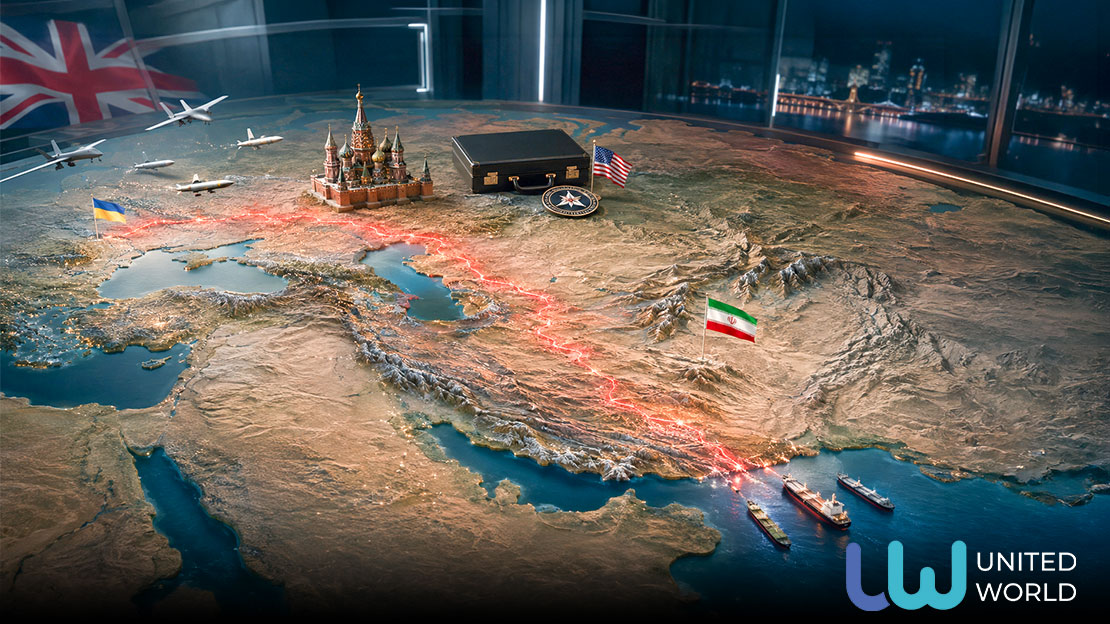
We have two important developments in the war in Ukraine. The first is CIA Director John Ratcliffe’s surprise visit to Moscow on August 26. The second is Britain’s role in the war, as witnessed by British Prime Minister Andy Burnham’s visit on August 24.
CIA Director John Ratcliffe traveled to Moscow on an unannounced visit. It was also the first visit to Moscow by a CIA director since 2021. Kremlin spokesman Dmitry Peskov confirmed that contacts between the intelligence services.
British Prime Minister Andy Burnham made his first overseas visit to Ukraine on August 24. The timing of the visit, coinciding with Ukraine’s Independence Day, was considered significant. Burnham met with Zelensky, and during the visit London approved the sharing of classified technical information concerning British-made Skal missiles with Ukraine. The two countries also announced a new partnership to develop artificial intelligence technology for military purposes.
To that, one should also add to Russia’s recent reaction to Britain over drones. Moscow strongly protested the use of British-made UAVs in Ukrainian attacks against Russia and warned London not to become further involved in the war.
UWI author, political scientist Dr. Onur Sinan Güzaltan was a guest to Filiz Atıcı from CGTN Turkish to share his evaluation on these developments.
—
Mr. Güzaltan hello and welcome.
Hello. Thank you for having me.
Let’s begin with the CIA director’s visit to Moscow. What does this visit mean?
It is a critical visit. As you mentioned, this is the first time since 2021 that a CIA director has held talks in Moscow. A few months after the CIA director’s visit in 2021, Russia launched its special military operation in Ukraine.
Also, there was another significant visitor to Moscow, Archbishop Paul Richard Gallagher, secretary for relations with states in the Holy See, the “Vatican’s foreign minister.” This was also the first high-level Vatican visit to Moscow since 2021.
Following those visits in 2021, Russia’s military operation in Ukraine began, and the entire global balance changed. Now, roughly four years later, these two representatives, the CIA director and Gallagher, have visited Moscow.
This clearly points to a major turning point. The timing of these visits is important. Zelenskyy said that Russia would be hit hard and that this would continue for approximately 40 days. And attacks on Russian cities, particularly Moscow, including drone and missile attacks, increased.
Another important point is that Russia continues to advance on the front, both in the Donetsk and Lugansk areas and toward the remaining parts of Ukraine that provide access to the Black Sea through Odessa. This has significantly weakened the Kyiv government.
We are now beginning to see, both explicitly in the news and between the lines, corruption investigations targeting Zelenskyy’s office and opposition groups increasingly raising their voices against him. These developments indicate a military unraveling in Ukraine accompanied by serious political turmoil. At this point, the CIA director and the Vatican’s foreign policy representative visited Moscow.
Another important factor in assessing these visits is what is happening in Iran. Russia’s support for Iran is well known. The two countries have very comprehensive agreements. Concrete steps are being taken regarding the North-South Corridor. The petrodollar system, on which the US has built much of its system, is facing a major threat through the Strait of Hormuz.
What kind of turning point are we talking about? Will we see a renewed negotiation process, or something else?
Militarily, this has actually been a process that advances in leaps. At certain points, it becomes bogged down, but immediately afterward, developments can begin to unfold very rapidly. What we can identify now is, first, an overall military deadlock on the Ukrainian side. The Kyiv government is in a very difficult position.
Yes, drone and missile attacks against Russia continue, particularly against Moscow, infrastructure facilities, and civilian targets. But these attacks don’t translate into advances on the front. That is the first point.
Second, Ukraine’s supply and logistics lines through Odessa and the Black Sea have been cut off. This could have very grave consequences. There are many assessments suggesting that logistical support provided solely over land won’t be sufficient for Ukraine. That is the second point.
Third, the future of the governments in Europe that have stood behind the Kyiv administration is increasingly uncertain, and there are major debates over the support being provided to Ukraine.
Fourth, since the beginning of Trump’s second term, the US has adopted a more distant position toward the Kyiv government.
Fifth, there are reports suggesting that Russia could respond very harshly to Britain’s support for Ukrainian attacks.
Another factor is Iran: the US is stuck in Hormuz.
And finally, remember that after the meeting between Trump and Putin in Alaska, there were numerous assessments suggesting that the two sides had reached understandings on certain issues.
All of these issues actually form a single package. This is a broad geographical line stretching from the center of Eurasia to West Asia, from Ukraine all the way to Iran. It has military, energy, logistics, and economic dimensions.
We can say that all these issues constituted the content of the CIA director’s talks during his visit. The very fact that he personally traveled to Russia indicates that developments have reached a turning point.
There is an increasingly intensive British support for Ukraine. What is Britain trying to achieve? Are British and American policies beginning to diverge at this point?
There are both historical and strategic reasons behind this. Relations between Russia and Britain have always been tense, and within the Western camp Britain has always been the standard-bearer of opposition to Russia, particularly since the Bolshevik Revolution of 1917. There are also more specific historical dimensions to this, such as the relationship between the British royal family and the Romanovs overthrown by the Bolsheviks.
Without going into those details, if we look at developments from the perspective of contemporary politics and geopolitics, Britain is pursuing a strategy aimed at government change in Russia. It wants a government aligned with Atlantic policies; it uses intermediary forces such as the Kyiv government for that.
In the recent period, London has been the primary force advocating the continuation of the war. Regardless of who comes to power in London, we see this strategy continuing. The first leader received by the new prime minister was Zelenskyy, and his first foreign visit was to Ukraine.
And look at the chronology of events: whenever the possibility of peace comes onto the agenda, there is a provocation or an escalation. There is a terrorist attack, or an announcement that Ukraine will be supplied with long-range missiles, and so on. Behind these developments, you consistently see Britain. That needs to be noted. That is the first point.
As for your question about whether the US and Britain diverge on Ukraine; at the beginning of his second term, the Trump administration, with the MAGA team within, advocated a more inward-looking strategy. During that period, the US pursued partially different policies both toward Russia and toward West Asia. But particularly over Gaza, as support for Israel increased and the US returned to its traditional policies toward Israel, divisions emerged within the US administration, and the MAGA faction was pushed aside.
After that, we saw British-American relations return to their old track, to what we might call the “Anglo-Saxon bloc.” So, although there were fluctuations for a certain period, my view is that Britain and the US are now playing a kind of good cop-bad cop game toward Russia. I don’t think Britain would be capable of taking such serious steps against Russia on its own without US support.
There is an argument that post-Brexit Britain is trying to redefine its influence in Europe and that the war in Ukraine provides an opportunity in this respect. Would you agree?
Britain may indeed have such an objective, but the situation in Europe itself is hardly encouraging. If you follow even a little the political, economic, and demographic situation in Germany and France, you can see that Europe is in the midst of a very serious crisis.
Secondly, political parties in these countries that advocate normalizing relations with Russia, Le Pen’s National Rally in France and the AfD in Germany, are now among the leading political forces. According to official polling, these parties are expected either to become coalition partners or to govern alone in forthcoming elections. Under these conditions, a unified European project under British leadership against Russia doesn’t seem so realistic. Also, there are many assessments suggesting that Reform UK takes positions opposed to what we might call “conventional” British politics, including relations with Russia.
What we can say is that the “establishment,” the aggressive neoliberal structure, is seeking to maintain its claim to global dominance through Britain in the north and Israel in the south. I believe this is the reason behind the UK’s audacious stance.
One final, general question. When you assess the war in Ukraine and the situation in Iran together, what does the overall trajectory tell you?
What we have before us is an intensifying, deepening war with a tendency to spread. The line stretching from the center of Eurasia all the way to West Asia and the Strait of Hormuz is, in reality, a single front. It is getting more clear with time. Relations among the countries in this war are getting closer and closer. An example outside geopolitics: A few days ago, I was in a bookstore in Moscow. Among the best-selling books, Khamenei’s memoirs ranked third. This shows the Russian people’s attention to Iran.
The US and the West continue to insist on maintaining their hegemony. In some places they use proxy forces; elsewhere they intervene directly themselves. But when we look at the overall picture, they lost in Iran; the Iranian people, the Iranian state and the Iranian military won. Iran brought the petrodollar system that sustains the US-centered entire system to a standstill and demonstrated that it has the ability to bring it down.
Israel, the US’ outpost in the region, has become isolated. It is politically and diplomatically isolated, and economically in a difficult situation. It is also facing demographic difficulties. For a country whose existence is based on inward migration, the reports suggesting that nearly 300,000 people have left Israel represent a very significant number. Ukraine, despite the support of the entire West, has lost a quarter of its territory. Russia, despite the impact of various sanctions, remains determined to continue the struggle.
So, to answer your question concretely, there are two possibilities: either the US and the West will cling onto their hegemony, or they accept the process of multipolarity at certain levels and in certain areas and adapt to it, allowing for a softer transition.
Onur Sinan Güzaltan, thank you very much for your contribution.
Thank you for inviting me.