


By Andaç Yedigüller
Military cooperation between Türkiye and the United Kingdom has accelerated significantly in recent years. The latest example came with the Security and Defense Cooperation Agreement signed during the NATO summit in Ankara. While the full contents of the agreement have not been made public, official statements outlined its broad scope. According to these statements, the agreement covers military cooperation, collaboration between defense industries, joint efforts against cyber and hybrid threats, counterterrorism, and cooperation in the space domain. The announcements also emphasized that the agreement is intended to contribute to the security environment within the NATO–Atlantic framework.
Cooperation over the past several decades
Rather than assessing this agreement in isolation, it is more useful to view it as part of the broader trajectory of military cooperation between the two countries over the past several decades.
The foundations of this relationship date back to the 1980s. During that period, British Land Rover and Otokar, a company within Türkiye’s Koç Group, cooperated in the production of military vehicles for the Turkish Armed Forces. Türkiye also purchased Rapier air defense systems from the United Kingdom during the same decade.
In 2003, Türkiye joined the A400M military transport aircraft program led by Airbus, of which the UK is one of the principal partner nations.
In 2005, Türkiye’s Nurol Group and Britain’s BAE Systems established a long-term partnership through FNSS and Nurol Defense Industries. The cooperation had begun when BAE Systems acquired the relevant defense division of Nurol’s American partner. Over time, this partnership expanded considerably. Today, FNSS represents one of the most significant areas of UK–Türkiye defense industrial cooperation, particularly in the design and manufacture of armored land vehicles.
In 2017, BAE Systems and Turkish Aerospace Industries (TUSAŞ) signed an agreement on the design and technology transfer for Türkiye’s fifth-generation fighter aircraft program, now known as KAAN. However, the partnership appears not to have met initial expectations, and TUSAŞ is now continuing the program independently.
A new phase by 2025
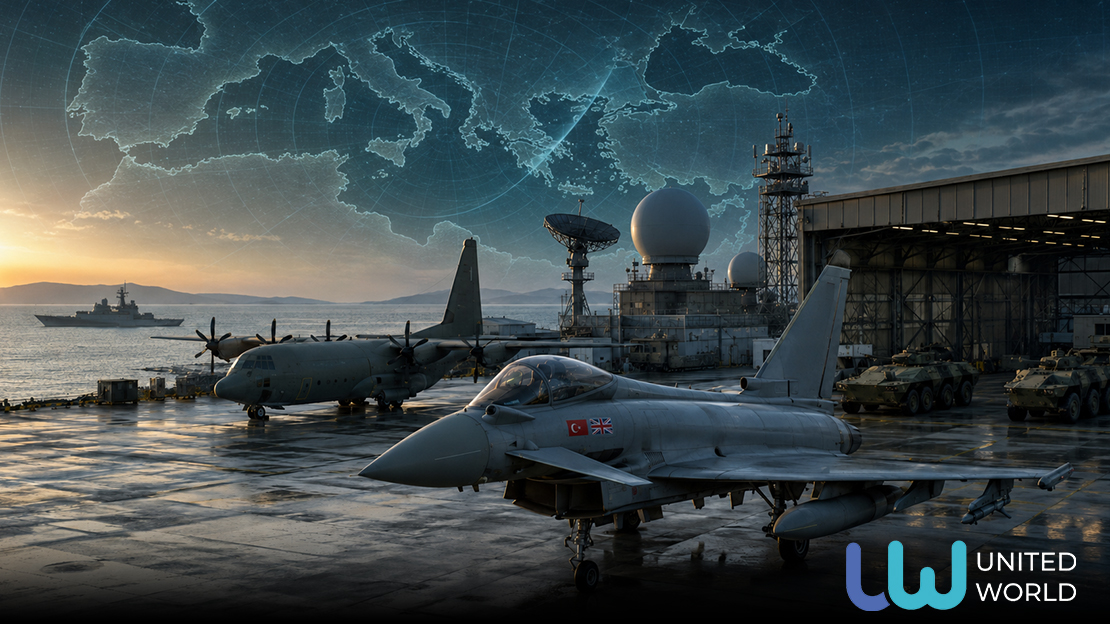
By 2025, bilateral defense cooperation had entered a new phase. One of the most significant developments was Türkiye’s agreement to purchase 20 Eurofighter Typhoon fighter aircraft from the United Kingdom and its European partners. Valued at approximately £8 billion, the deal was repeatedly presented by then Prime Minister Keir Starmer as both an economic and political success. Without this order, thousands of highly skilled jobs in the UK’s aerospace sector could have been at risk, while production lines faced the prospect of remaining idle.
Another notable initiative in 2025 was the signing of a Memorandum of Understanding between TUSAŞ and BAE Systems concerning cooperation in the development and production of unmanned aerial systems.
The same year also saw Türkiye agree to purchase 12 second-hand C-130J Super Hercules military transport aircraft from the UK. British company Marshall Aerospace was selected to modernize the aircraft under a contract estimated at around £600 million.
British engine producer Rolls-Royce has also maintained a long-standing relationship with Türkiye. The company supplies engines for several helicopter models assembled in Türkiye and will provide the engines for the Eurofighter aircraft acquired under the recent agreement. Negotiations have reportedly reached an advanced stage regarding licensed production of Rolls-Royce engines within Türkiye.
The relationship extends well beyond defense. Rolls-Royce has long been one of the principal engine suppliers for Turkish Airlines’ wide-body fleet, while the company’s decision to establish a major engine maintenance facility in Türkiye has further deepened industrial cooperation. Today, Rolls-Royce is led by Tufan Erginbilgiç, a dual British-Turkish citizen and former BP executive. Judging by the company’s share price performance in recent years, his leadership has been widely viewed as very successful.
An important distinction should be noted. The defense companies commonly described as “British” are privately owned corporations whose shares are publicly traded. None is owned by the British government. Their largest shareholders are global institutional investment funds. On the Turkish side, cooperation involves both private-sector companies which are relatively small companies and state-owned defense institutions which are relatively big corporations.
It is also striking that many of the largest defense agreements were concluded during 2025. These deals were negotiated under Prime Minister Keir Starmer and Defense Secretary John Healey. While Starmer is no longer in office, Healey has since assumed an even more influential position as Chancellor, responsible for the British economy. His record in promoting defense exports naturally raises expectations about his approach to industrial policy more broadly. At the same time, it should be remembered that the sale of the Super Hercules aircraft attracted criticism from some quarters within the UK, who argued that it reduced the operational strength of the Royal Air Force.
Qualitative shift
The growing number of agreements also demonstrates a qualitative shift in bilateral relations. Since the early 2020s, cooperation has moved beyond individual procurement projects towards broader strategic and industrial collaboration. From this perspective, the NATO summit agreement signed in Ankara appears to represent the most comprehensive strategic framework yet, encompassing defense industry, cybersecurity, counterterrorism, and space cooperation.
When interpreting military cooperation agreements between states, one important point deserves emphasis. In the United Kingdom, virtually all defense, aerospace, cyber, and related capabilities are provided by private companies. Consequently, when the British government signs defense cooperation agreements with Türkiye, it is effectively signaling that it does not intend to impose political restrictions on its private sector’s ability to supply goods and services to Türkiye.
Issues complicating the relations
Nevertheless, several issues continue to complicate the relationship.
In 2019, following Turkish military operations in northern Syria, the UK imposed restrictions on certain military exports and defense cooperation with Türkiye. This episode created a degree of mistrust between the two countries.
Britain’s indirect support for Israel during the conflict in Gaza has also generated concern within Türkiye. Reports that intelligence-gathering flights have operated from British military bases in Cyprus over Palestinian territory—and that such intelligence may have been shared with Israel—have contributed to public skepticism regarding British regional policy.
The UK’s strong support for Ukraine and its increasingly confrontational stance towards Russia also presents strategic challenges for Türkiye. From Moscow’s perspective, expanding military cooperation between Ankara and London may create additional distrust. For Türkiye, however, Russia remains an indispensable partner with extensive economic, touristic, energy, and social ties. Ukraine is likewise regarded as a friendly nation, and a prolonged Russia–Ukraine war runs counter to Türkiye’s broader regional interests.
Another unresolved issue concerns members of the FETÖ movement who fled to the United Kingdom following the failed coup attempt of 2016. From Ankara’s perspective, this remains one of the outstanding bilateral disputes.
Why, then, has UK–Türkiye military cooperation developed so rapidly in recent years?
Defense cooperation has followed economic integration
The answer cannot be understood without considering the broader evolution of economic and social relations. In many respects, defense cooperation has followed economic integration rather than leading it.
Over the past two decades, large numbers of Turkish citizens have migrated to the United Kingdom, particularly under the Ankara Agreement and other legal migration routes. Many established businesses by importing Turkish goods and services into the British market. As a result, Türkiye’s trade surplus with the UK has grown substantially. This expansion was accompanied by new free trade arrangements and the broadening of existing agreements.
During the past twenty years, bilateral trade has tripled, increasing from approximately £10 billion to around £30 billion annually. Türkiye’s trade surplus has quadrupled, reaching approximately £8 billion. Few countries generate such a substantial and sustained trade surplus for Türkiye.
Britain’s decision to leave the European Union following the 2016 Brexit referendum also accelerated its search for new commercial and strategic partnerships beyond Europe. The rapid expansion of UK–Türkiye relations can therefore be understood, at least in part, as a consequence of Britain’s post-Brexit strategy of strengthening bilateral relationships.
A trajectory for the cooperation
Looking ahead, the agreements signed in recent years suggest that cooperation between British and Turkish defense companies is likely to continue expanding, particularly in advanced military technologies. At the same time, significant geopolitical risks remain capable of disrupting this trajectory.
Britain’s close alignment with Israel in its Middle East policy is one such risk. Any future conflict between India and Pakistan would almost certainly see the UK align more closely with India, while Türkiye would be expected to support Pakistan. Developments concerning Northern Cyprus or relations with Russia also have the potential to place considerable strain on UK–Türkiye relations.
The future of military cooperation between the two countries will therefore depend not only on industrial and commercial interests but also on how successfully both governments manage the broader geopolitical differences that continue to shape their relationship.