


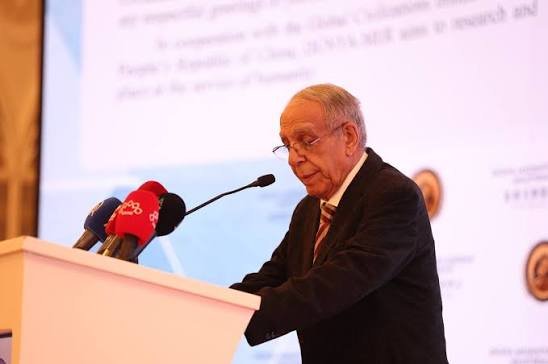
Professor Semih Koray’s speech at the conference on Global Security and NATO in Istanbul.
Professor Semih Koray’s speech at the conference on Global Security and NATO in Istanbul.
The World Civilizations Initiative Research Center organized an international conference on Global Security and NATO on June 26-27, 2026, in Istanbul, Türkiye, ahead of the NATO summit scheduled for 7 and 8th of July in Ankara. One of the speeches was held by Prof. Semih Koray, President of the World Civilizations Initiative Research Center and Deputy Chairman of the Vatan Party. Below we document Koray’s speech. The title was set by UWI.
Distinguished Guests,
Dear Participants,
Ladies and Gentlemen,
On behalf of the Global Civilization Initiative Research Center, I would like to warmly welcome you to our conference on “World Security and NATO.” It is my great pleasure to greet you all with my sincerest respect.
Our conference is taking place at a time when the Atlantic system is undergoing an exceptionally rapid process of transformation. The centrifugal forces within NATO have reached their highest level since the Alliance was founded. We are witnessing almost daily changes in the long-established relationships between the United States and Europe, the United States and Israel, as well as the United States and the Gulf countries. At the same time, both the United States and the European countries are experiencing the deepest internal divisions they have faced since the end of the Second World War. On the international stage, not only NATO but also virtually all the institutions that have shaped the functioning of the Atlantic system have lost much of their influence. Twenty years ago, the International Monetary Fund and the World Bank occupied a prominent and decisive place on Türkiye’s agenda. Yet for more than a decade these institutions have virtually disappeared from our national discourse. The United Nations, meanwhile, has been reduced to one of the least effective actors in the management of international conflicts. In an effort to preserve and consolidate the so-called New World Order proclaimed in the 1990s, the United States has imposed sanctions on more than forty countries. Since the effectiveness of a threat is measured by its ability to achieve results without having to be carried out, the widespread use of sanctions demonstrates not America’s power to compel, but rather its growing inability to make others comply with its will.
These transformations have also been reflected on the ideological level. Liberalism—and its adaptation to the needs of the system in the form of neoliberalism—served for a long time as the ideological foundation that held the Atlantic system together. Today, however, neither the so-called rules-based international order, nor the global free-market system built on the principle of laissez-faire/ let do, nor even the rhetoric of freedom and human rights can be defended convincingly, even at the level of discourse. Instead, approaches that seek to redefine Western civilization primarily on the basis of religious identity and naked national interests are gaining increasing prominence.
The center of gravity of global productive power has shifted from the West to the East and from the North to the South, and this process continues. More importantly, the profound fractures and upheavals that characterize our era are taking place not in the East but in the West, not in the South but in the North. It is under these circumstances that the NATO Summit will convene in Ankara on 7–8 July. There is little doubt that this summit will represent yet another turning point within the Atlantic system.
World security is of vital importance for building humanity’s shared future. The primary purpose of this conference is therefore to examine the underlying causes of NATO’s ongoing process of disintegration and, through an objective and unbiased approach, to draw conclusions that may contribute to the establishment of a more secure international order. Our distinguished speakers will undoubtedly address this issue from a variety of perspectives, broadening our horizons and enriching our understanding. In my opening remarks, I would also like to present several observations that I hope will serve as a basis for discussion throughout our conference.
- From its establishment until the 1990s, NATO was positioned against the Soviet Union and the Warsaw Pact. Following the dissolution of the Soviet Union, however, NATO—under the leadership of the United States—began to expand rapidly. This clearly demonstrated that NATO had not lost its purpose; on the contrary, the scope of its mission had widened. What emerged in the 1990s was the attempt to extend American hegemony on a global scale.
- NATO’s current process of disintegration began with the emergence of a multipolar world, which gradually limited the ability of the United States to maintain its global hegemony. As multipolarity gained strength, some members of the Alliance became increasingly reluctant to continue bearing the costs of sustaining American dominance. Since the collapse of the Soviet Union, NATO as an organization has openly participated in only two major U.S.-led military operations: the dismemberment of Yugoslavia and the occupation of Afghanistan. Today, although Russia’s military operation in Ukraine is effectively being conducted against NATO forces, the Alliance has chosen to rely on proxy forces rather than formally acknowledge its direct involvement. Likewise, NATO as an organization did not participate in the U.S. and Israeli attacks against Iran.
- Since its foundation, NATO has presented itself as the political and ideological defender of Western civilization and its values. Israel, for its part, has portrayed the war in Gaza, along with its attacks on Iran and Lebanon, as a defense of Western civilization on the battlefield. Yet recent developments have made it increasingly difficult to defend these so-called Western values even at the level of rhetoric.
- NATO has also served, since its inception, as the principal instrument through which the United States established and consolidated its hegemony within the Atlantic system. As multipolarity has advanced, that hegemony has weakened, strengthening the centrifugal forces within the Alliance itself.
- The upcoming summit in Ankara will undoubtedly seek ways to breathe new life into NATO. However, under objective conditions in which NATO can no longer fulfill its hegemonic mission, such efforts are bound to prove futile and are unlikely to produce any meaningful outcome.
- It is a profound misconception to believe that NATO’s weakening and fragmentation create new opportunities for Türkiye by strengthening its position within the Alliance. Gaining a larger share in a declining organization ultimately means assuming a larger share of its burdens. From the perspective of the Atlantic system, using NATO as a means of binding Türkiye even more tightly to itself may well be the final mission assigned to this organization as it continues its decline.
Humanity today is in urgent need of a new civilization and is experiencing the birth pangs of such a civilization. The most important form of energy is human energy. A civilization comes to life and flourishes through its ability to unleash human potential. Throughout history, the true measure of progress has never been the capacity for destruction, but the capacity for creation. As the Global Civilization Initiative Research Center, we believe that humanity should draw upon all the achievements that past civilizations have contributed during their periods of ascent. Western civilization, too, has bestowed upon humanity many values of universal significance. We attach great importance to restoring these values to the service of humanity’s future development.
Today, the capacity to create and build has shifted from the West to the East and from the North to the South. It is both natural and inevitable that the emerging civilization will be shaped by those who possess this creative capacity. Accordingly, the forefront of the struggle against hegemony and for world security is now represented by the East and the South, particularly by the leading countries of these regions. Yet the future of humanity is of vital importance not only for the East but also for the West; not only for the South but also for the North. In order to build this shared future and safeguard world security, it is essential to prevent hegemonic ambitions from triggering either a new world war or regional conflicts. This makes the establishment of a Front of Humanity an urgent necessity. In building such a front, one of the greatest principles that Western civilization has contributed to humanity—the guiding role of science—must remain indispensable.
With participants from ten countries in addition to Türkiye, this conference brings together twenty distinguished speakers who will examine these issues from a wide range of perspectives, broadening our horizons and deepening our understanding. Allow me, therefore, to conclude by once again expressing, on behalf of the Global Civilization Initiative Research Center, our heartfelt gratitude to all our speakers for their valuable contributions.
Thank you very much.