


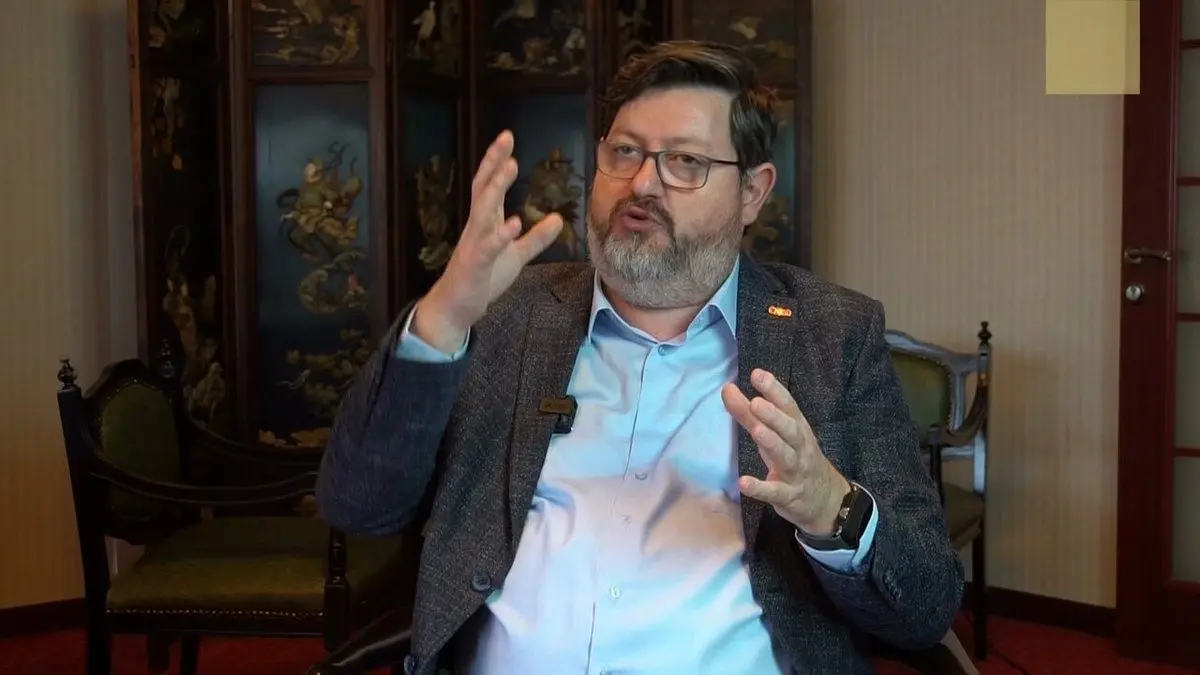
Interview with Dr. Barış Adıbelli, faculty member in the Department of Political Science and International Relations at Kütahya Dumlupınar University in Türkiye.
Interview with Dr. Barış Adıbelli, faculty member in the Department of Political Science and International Relations at Kütahya Dumlupınar University in Türkiye.
Routes and corridors are taking up more and more space on the global agenda, shaping countries’ foreign policies and even their domestic politics.
The war that began with the US and Israeli attack on Iran, and Iran’s subsequent closure of the Strait of Hormuz, brought the issue into sharp focus with renewed urgency.
Why are routes and corridors being discussed more and more?
What is the relationship among China, the US and Russia over major routes and corridors such as the Polar Silk Road, Hormuz and the Middle Corridor?
And what is Türkiye’s Middle Corridor? What is its purpose? And what are its chances of success?
We asked these questions to Dr. Barış Adıbelli.
Adıbelli is a faculty member in the Department of Political Science and International Relations at Kütahya Dumlupınar University in Türkiye. His academic work focuses on the Asia-Pacific region, and especially on Chinese foreign policy.
Why are routes and corridors, whether the Polar Silk Road, Hormuz or the Middle Corridor, increasingly gaining prominence on the agenda? And why has Türkiye begun to discuss this issue more intensely?
The most important strategic assets of the 21st century
The 21st century will be the century of routes and corridors. I said this years ago. Corridors, or routes – the two can be used interchangeably here – through which goods, services, people and energy move from one place to another will become the most important strategic assets of the 21st century. So much so that countries that don’t produce energy but transport it, that connect energy to the world market, will become more valuable and more strategic than the countries that actually produce energy, oil and natural gas.
Feasibility matters
Let me give an example. According to the EastMed project, Israel, Greece, the Greek Cypriot Administration of Southern Cyprus and the US were going to extract natural gas from the Eastern Mediterranean off Cyprus, bring it ashore in Greece and then carry it to Europe. But it didn’t happen. Why? Because it was not feasible. The US eventually gave up on it and concluded that there was only one feasible route for the region’s energy to reach Europe: Türkiye.
During a visit to Türkiye, then-US Secretary of State Antony Blinken said in an interview something to the effect of: “If you resolve your problems with Greece, we can turn Türkiye into an energy hub.”
The IMEC project was also discussed for a long time, but no concrete step has been taken. Because it’s not feasible either. We could multiply the examples.
The route between Asia and Europe
As for Türkiye, everything that is to move from Asia to Europe has to pass through Türkiye. What about Russia? Is Russia not also a route between Asia and Europe, like Türkiye? That chapter is over now. I do not think relations between Europe and Russia will recover easily. Especially in the field of energy, Europe will use an alternative route such as Türkiye in order not to become dependent on Russia again.
One of the most talked-about routes recently is the Polar Silk Road. What would you say about the relations among the US-China- Russia regarding the Polar Silk Road?
With the melting of the northern ice caps, navigation in these areas has become easier. There is also a new generation of nuclear-powered icebreakers; China in particular has recently invested heavily in this sector.
For China, the north is safe, the south is the US Navy
Now that these new routes are opening up, China can reach Europe from the north much more easily. China is pleased with this. But Russia says, “Sovereignty over these ice-covered areas belongs to me.” And the US says, “These places used to be frozen, so we never really discussed territorial sovereignty here; but handing them over to Russia would mean granting Russia sovereignty over an unlimited geography.” What the US is saying is that these routes should be operated jointly, that somehow, they should be placed under a commission, and so on.
China prefers this northern route. If China wants to use routes farther south, it has to pass through chokepoints such as the Strait of Malacca, Bab el-Mandeb and the Suez Canal, where the US Navy and aircraft carrier groups are present. China therefore doesn’t see these as very secure. On the northern route, however, there is only Russia.
The Strait of Hormuz and the US
As for the Strait of Hormuz, it is the main artery for energy flowing from West Asia and the Gulf to Europe and East Asia. It is also the route used by countries such as China and India, which sell large volumes of goods to the Gulf. In these respects, Hormuz is important.
But for the US itself, Hormuz has no importance at all. The same is true of Suez. The US does not need oil from this route. Beyond that, a closed Hormuz actually serves US interests: when it is closed, the US sells its own LNG, as well as its own oil and that of other countries. If you noticed, Trump said, “Hormuz does not concern me; come and take care of your own oil business yourselves.”
When evaluating the crisis in Hormuz, we need to look at what kind of leader Trump is. Trump is someone who creates crises out of thin air at the negotiating table and then says, “I solved the crisis.” He is a man who marks time.
Let’s move on to the Middle Corridor. It has been the most discussed corridor in Türkiye in recent months. What is this corridor? What is Türkiye’s aim?
Let me first make this clear: the Middle Corridor is not a Chinese project. It has nothing to do with the Belt and Road Initiative. The Middle Corridor is a route proposed entirely by Türkiye, and it is shorter than the existing corridors.
The Middle Corridor’s access to the Black Sea
The Middle Corridor proposed by Türkiye would include Azerbaijan, Armenia and Georgia. The main reason this corridor attracts China’s attention is not that it passes through Türkiye, but that it provides access to the Black Sea through Georgia. China currently has major port projects in Georgia and is establishing free trade zones there. It has already made significant investments. China is making similarly important investments in Azerbaijan.
China was waiting for one thing: the resolution of the dispute between Azerbaijan and Armenia over occupied Karabakh. The Chinese have this habit: if there is a problem somewhere, they do not go near it.
In China’s eyes, the advantage of the Middle Corridor’s opening to the Black Sea is that it can connect to Europe, right?
Exactly. Indeed, China is currently building a major port in Romania, on the other side of the Black Sea. BYD is now involved in a railway project between Hungary, Serbia and Romania. So, goods loaded at the port in Georgia will be transported to Europe through this route. Russia, meanwhile, is planning to move its naval base in Crimea to Sevastopol.
No US Navy presence in the Black Sea
Since there is no US Navy presence in the Black Sea, this appears to be the route with which China would feel most comfortable. As I mentioned earlier, China’s greatest concern on maritime trade routes is the American presence.
China does not seem to be thinking of the Middle Corridor in the context of Türkiye. In fact, it is conducting negotiations on the Corridor not with Türkiye, but with Azerbaijan.
Türkiye’s several obstacles in the Middle Corridor
When it comes to Türkiye, we can speak of several obstacles. Trump’s role was frequently mentioned regarding the Zangezur Corridor, one of the points through which the Middle Corridor would pass. But then Nationalist Movement Party (MHP) leader Devlet Bahçeli said this area would be called “Turan”. These mutually incompatible statements seem to suggest that there is not much hope in the Middle Corridor.
The Turkish government has recently been trying to align with Trump. On the other hand, the US does not support the Middle Corridor. Nor does it support Türkiye’s Development Road in Iraq, which is planned to be connected to the Middle Corridor.
There are also small and medium-sized business circles in Türkiye that oppose the Middle Corridor. In meetings I have attended with them, they say: “We already bring materials from China, produce here and sell here. If China can bring its goods to this region very quickly, our small-scale production facilities here will be finished.”
Indeed, China has a certain pattern of behavior: wherever it goes, it establishes its own factory, uses its own input goods, employs workers brought from China and does its own sales. We saw this in the Port of Piraeus and in all of China’s infrastructure facilities in Africa. Africans are uncomfortable with this, and they say this in meetings.
Also, how China sees the Middle Corridor feasible, and how much weight it will give to it, remains an open question. Because China already has the New Eurasian Land Bridge route, which reaches Europe through Iran and Türkiye without requiring access to the sea at all.
The Middle Corridor is being discussed very intensely in Türkiye, but according to what you are saying, there is not much hope for it. From what you said Türkiye seems to be bypassed.
Yes. I don’t hear very positive things about the Middle Corridor. In any case, Türkiye has not recently been attending Belt and Road Initiative summits at the leadership level.
The strategic point Türkiye is missing
The strategic point Türkiye is missing here is this: Türkiye has long suffered from a certain habit, a disease almost. That is the belief that “if I turn my back on this, if I ignore it, then the whole thing will stall.” But no, it doesn’t stall. The only country that stalls is Türkiye. And when Türkiye stops, the process continues with other countries.
No BRICS, no SCO: “Anchored in the West”
Of course, there is another reason for this. Remember: in Beijing, when Turkish Foreign Minister Hakan Fidan was there with the Chinese foreign minister in June 2024, he announced, “We are planning to join BRICS.” Immediately afterwards, former US Ambassador to Türkiye Jeff Flake stated that “the US hopes Ankara would not join BRICS.” He added that Türkiye is “firmly anchored in the West.” This was the first time we heard Americans use the word “anchored” in this context; usually they say things like “strategic partner.”
And after our foreign minister went from Beijing to Moscow, having heard that Jeff Flake made these remarks, he suddenly changed his tone. He made a statement like “I only came here casually”. And as you know, Türkiye did not apply for BRICS membership.
The same thing happened with the Shanghai Cooperation Organization. Türkiye said, “We are joining, we will apply next year.” This didn’t happen either. We do not know what happened or how it ended, no one explained what happened.
A tough geography between the Atlantic bloc and the Eurasian bloc
Türkiye, of course, is located in a very tough geography, squeezed between West and East, between the Atlantic bloc and the Eurasian bloc.
Recently, we have seen Türkiye moving closer to the West again. We are dreaming of joining a European Union that is falling apart. In response to this dream, the EU tells Türkiye: “Stand on the front line and protect me against Russia.” Türkiye is trying to take its place within the “new security architecture” in Europe.
“Never allow the Black Sea to become a Russian or Chinese sea”
When China’s plans regarding the Black Sea, which I mentioned earlier, came onto the agenda, the European Union prepared a Black Sea plan. According to the plan, the EU will defend the Black Sea together with countries including Türkiye and will never allow the Black Sea to become “a Russian or Chinese sea.” At that point, Türkiye should have made a statement. The Chinese were expecting this as well.
Do you know what the main reason behind all this is? It is the economy, an economy built on dependence since 1950. Because Türkiye needs to find money and credit, it is forced to step back from the things it should be doing. We cannot move forward with an economic model not based on production.