


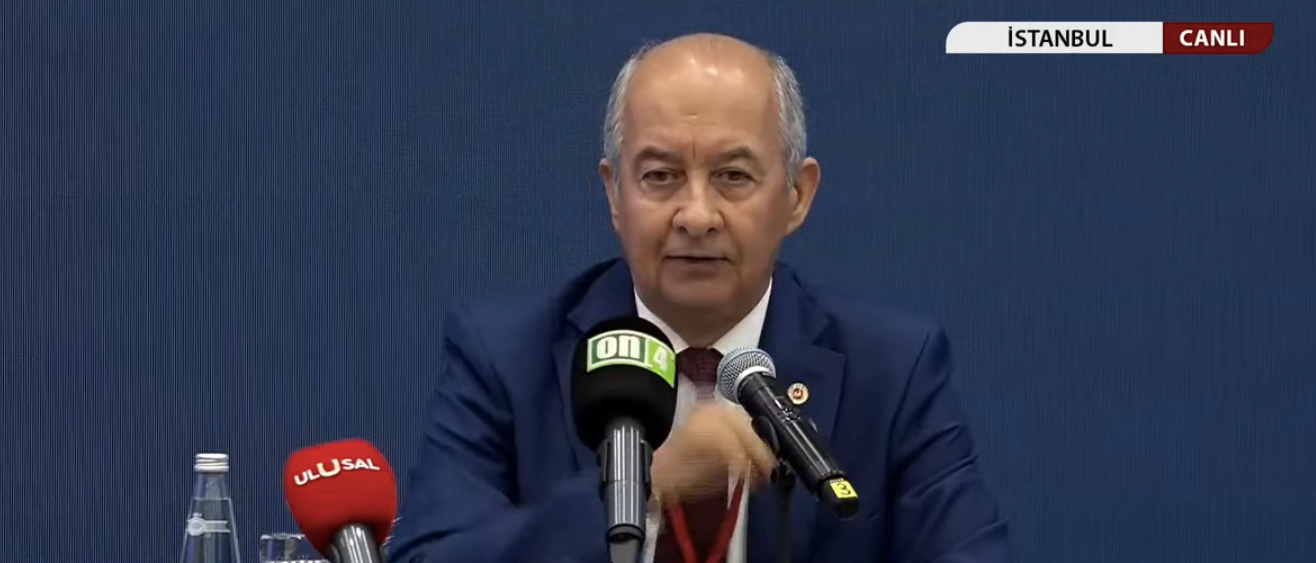
Speech of Haldun Solmaztürk, ret. Brig. Gen. Haldun Solmaztürk of the Turkish Armed Forces, at the Conference on NATO and Global Security.
Speech of Haldun Solmaztürk, ret. Brig. Gen. Haldun Solmaztürk of the Turkish Armed Forces, at the Conference on NATO and Global Security.
The World Civilizations Initiative Research Center organized an international conference on Global Security and NATO on June 26-27, 2026, in Istanbul, Türkiye, ahead of the NATO summit scheduled for 7 and 8th of July in Ankara. One of the speakers was Haldun Solmaztürk, ret. Brig. Gen. Haldun Solmaztürk of the Turkish Armed Forces. Below we present his speech, for which the title was set by UWI.
Good morning, everyone.
It is a pleasure to see you all here this morning, especially considering that it is Saturday, and we are meeting early on a weekend. I sincerely appreciate the time you have taken to be here with us today. You could have chosen to spend your weekend elsewhere, so thank you for joining us. Since our time is limited and the issues we will discuss are of great importance, I would like to move directly to the substance of my presentation.
Before I begin, however, I would like to express my sincere gratitude to Professor Semih Koray, Director of the World Civilizations Initiative Research Center, and to Vice President Ms. Şule Perinçek for organizing this excellent meeting and providing us with this valuable opportunity. Thanks to their efforts, we are able to exchange ideas and present our perspectives here today.
My presentation will focus on NATO. This should not come as a surprise, since I personally served within NATO for four years, and therefore I wanted to share my own observations. NATO has changed dramatically over the years. Today, we are witnessing a fundamentally different organization. I refer to the current structure as “NATO 2.0,” and I believe it is gradually evolving toward what could be called “NATO 3.0.” My presentation will therefore examine this transformation and explain why it has taken place.
NATO was founded in 1949 with twelve member states. At that time, Türkiye also wished to join the Alliance, but its application was rejected. Only after Turkish troops participated in the Korean War was Türkiye admitted, becoming a member in 1952 together with Greece, bringing total membership to fourteen. West Germany joined in 1955, at a time when Germany was still divided into East and West. Spain later entered the Alliance, increasing membership to sixteen. Today NATO has thirty-two members. During this long period, the Alliance has undergone profound changes.
Originally, NATO was established as a military alliance against the Soviet Union. By 1989, however, it had become evident that even if the Soviet Union continued to exist, it intended to withdraw from Central and Eastern Europe. Moscow had also accepted the reunification of Germany. These developments effectively eliminated NATO’s original strategic rationale.
The 1990s witnessed broader historic transformations across Eurasia. This period is commonly described as the era of confidence-building and arms control. The agreements and mechanisms established during those years represented some of the most significant achievements in modern international relations.
Within the framework of the Organization for Security and Co-operation in Europe (OSCE), numerous security dialogues were held. One of the major accomplishments was the Vienna Document. Under its provisions, military transparency reached an unprecedented level. If the Turkish Armed Forces moved even a single tank from Ankara to Istanbul, such activity could be reported. Mutual inspections, reciprocal visits, and joint military exercises became routine.
In 2002, under the Open Skies Treaty, the Turkish Air Force conducted observation flights using specially equipped aircraft capable of taking photographs and video recordings. Before these flights, we would notify our Russian counterparts, explaining our intended routes. Once in Moscow, the aircraft often carried multinational teams including Russians, Americans, Germans, French, Greeks, and Turks. Together they flew over Russian territory, collected imagery, and shared all the data after landing. These practices were designed to build mutual trust.
Another landmark agreement was the Treaty on Conventional Armed Forces in Europe (CFE), signed in 1990 and subsequently revised. The treaty placed strict limitations on conventional weapons, including tanks, aircraft, attack helicopters, and other major military equipment. It was revolutionary in scope. I emphasize these developments because today the concepts of confidence-building and arms control have almost disappeared from international discourse. This is neither wise nor beneficial.
It is important to remember that during the 1990s military confrontation was not regarded as the only available instrument of international politics. Therefore, when considering NATO’s future or international relations more broadly, we should keep in mind that a very different international environment once existed.
What happened afterward?
Once NATO’s original mission disappeared in 1989, discussions began about whether the Alliance should conduct “out-of-area operations”. Until then, a fundamental principle had existed: NATO was established to defend member states within its own geographical area. Operations beyond that territory were considered outside NATO’s mandate.
In 1989, however, the United States initiated a debate on this issue. A new concept—”crisis management”—was introduced. In practice, this concept served as a means of eliminating the traditional restriction against out-of-area operations. It became one of the most significant transformations in NATO’s history. Beginning with the Balkans, “crisis management” evolved into the justification for military interventions almost anywhere in the world.
Another important transformation accompanied NATO’s gradual evolution from NATO 1.0 to NATO 2.0.
People often overlook the fact that the Washington Treaty establishing NATO is fundamentally based upon Article 51 of the United Nations Charter, which recognizes the inherent right of self-defense. Article 51 also clearly states that any military action undertaken in self-defense must immediately be reported to the United Nations Security Council.
In other words, NATO’s founding treaty requires that military operations ultimately derive their legitimacy from the UN Charter. Without Security Council authorization or a legal basis under the Charter, military operations lack international legitimacy.
Over time, however, this principle was increasingly ignored. NATO and several of its members gradually set aside the legal framework established by both the UN Charter and NATO’s own founding treaty.
This issue became particularly visible during the debate preceding the Iraq War. Senator John McCain argued that while obtaining UN Security Council approval would strengthen American policy, the United States should not allow its national security decisions to depend upon the Security Council. This reflected a deliberate shift away from the legal foundations of both the UN Charter and the Washington Treaty.
The first NATO military intervention conducted without explicit UN Security Council authorization took place in Kosovo. From that point onward, similar precedents followed.
Another turning point occurred in 2001, when the United States unilaterally withdrew from the Anti-Ballistic Missile (ABM) Treaty. No convincing strategic explanation was ever offered for abandoning such a fundamental arms control agreement instead of updating or modernizing it.
There is also an important distinction within the NATO Treaty itself. Public discussion usually focuses on Article 5, concerning collective defense. In my view, however, Article 4, which requires consultation among allies, is even more significant.
Following the terrorist attacks of September 11, the United States immediately invoked Article 5, and all NATO members expressed solidarity. This opened the way for subsequent military operations in Afghanistan, Libya, Iraq, and Syria.
Afghanistan illustrates the problem clearly. NATO allies supported American policy there for more than twenty years. Yet when Washington decided to negotiate directly with the Taliban and eventually withdraw, it did so without meaningful consultation with its allies. After making its own decisions, the United States simply informed the Alliance, leaving all NATO members with no alternative but to withdraw.
Today, when some allies show reluctance regarding interventions in the Middle East—particularly concerning Israel’s actions or tensions involving Iran—the United States openly criticizes them.
Allow me to draw your attention to another issue.
In 2014, NATO inaugurated its new headquarters in Brussels, a massive complex that reportedly cost approximately 1.5 billion dollars.
Contrary to common belief, Article 5 does not create an automatic obligation for every ally to deploy troops or military assets whenever another member is attacked. Each government retains sovereign authority to determine its own response. In fact, previous crises have demonstrated that allies may choose not to participate militarily.
President Donald Trump himself illustrated this ambiguity during his first NATO Summit by deliberately omitting any explicit reference to Article 5, despite the fact that it appeared in his prepared remarks.
Today, several American officials argue that many NATO members have become overly cautious, describing the Alliance as a “paper tiger.” During recent NATO defense meetings, senior U.S. officials have argued that NATO should evolve into a force possessing genuine military capabilities and prepared for direct intervention—what I describe as “NATO 3.0”.
If this vision materializes under current American leadership, NATO 3.0 risks becoming an organization with diminishing respect for legal rules, weakened consultation mechanisms, and increasingly centralized military decision-making under U.S. leadership. Such a development would offer little hope for peace and stability across Eurasia or the North Atlantic region.
In conclusion, NATO’s new headquarters will likely remain its operational center for many years to come. Nevertheless, member states—including Türkiye—retain important responsibilities.
It should never be forgotten that NATO is not an entity separate from its members. Every NATO decision requires unanimous approval. Without the consent of the Turkish government, the Turkish Armed Forces, and Türkiye’s representatives, NATO cannot adopt any decision or take any action. The same principle applies equally to the United States, France, Germany, and every other member.
Naturally, every nation prioritizes its own national interests. Ultimately, the future direction of the Alliance depends on the sovereign decisions made by its member states.