


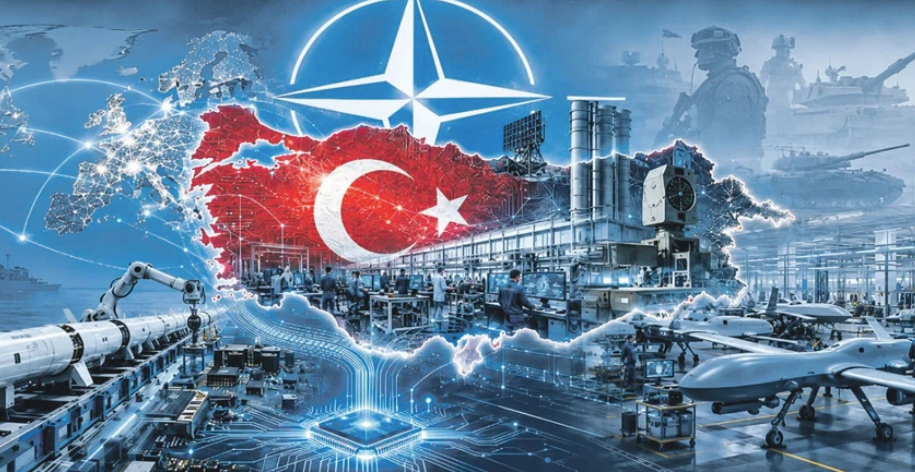
What are the expectations for the NATO summit to be held in Türkiye?
What are the expectations for the NATO summit to be held in Türkiye?
By Adem Kılıç, Political Scientist
The fact that Türkiye will host the 36th NATO Summit should not be viewed merely as a diplomatic organizational success.
This summit will serve as one of the strongest indicators of Türkiye’s rising strategic weight within the evolving international system, its central position in the security architecture, and its multidimensional foreign policy capabilities.
Indeed, in recent years, the international system has evolved beyond the unipolar structure that emerged after the Cold War into a multipolar and competitive order, and Türkiye has become one of the few countries that recognized these developments early on and was able to shape its entire strategy in accordance with this new world order.
The Russia-Ukraine War, crises in the Middle East, energy security, migration flows, the threat of terrorism, cyberattacks, and AI-based security risks have fundamentally altered NATO’s threat perception; and in such a complex period, the fact that this summit is being held in Türkiye demonstrates that NATO now views Ankara not only as a geographical neighbor but also as an indispensable actor in strategic decision-making processes.
Today, Türkiye is situated at the center of a broad geopolitical belt stretching from the Black Sea to the Mediterranean, the Caucasus, the Balkans, the Middle East, and Africa, while also standing out as one of the few NATO countries capable of engaging directly with numerous crisis zones.
For this reason, the summit will serve not only as a platform for discussing NATO’s future but also as a key showcase for projecting Türkiye’s global power to the international community.
A New Security Paradigm with “NATO 3.0”
The term “NATO 3.0,” increasingly used in international security circles, refers to the Alliance’s transformation into a more integrated, technologically advanced, and global security structure—one that adapts to new-generation threats—moving beyond its role as merely a collective defense organization.
When we speak of “NATO 3.0,” we are referring to a security framework divided into three distinct periods.
To summarize briefly: The Alliance’s structure and objectives during the Cold War era, spanning 1949 to 1991, are defined as NATO 1.0.
The main objective of this period was to deter the Soviet Union and protect Europe under the U.S. nuclear umbrella, with the alliance’s focus centered on large-scale conventional warfare and nuclear deterrence.
The period from 1991 to 2022, meanwhile, is referred to as NATO 2.0.
In other words, with the end of the Cold War, NATO’s agenda shifted; instead of the Soviet threat, the alliance began focusing on activities in areas such as the global “war on terror,” crisis management, the Balkans, the Middle East, and global maritime security—a shift that marks a new era for the alliance.
Now, the period following the Russia-Ukraine war that began in 2022—along with China’s rise, the Iran conflict, the global increase in hybrid threats, and the U.S.’s demand for greater burden-sharing from Europe—and the resulting changes in battlefield conditions is defined as “NATO 3.0.”
After all, when we look at historical reality, NATO’s first phase was shaped by a classic concept of deterrence based on containing the Soviet Union. The second phase, following the Cold War, established a structure in which crisis management, counterterrorism, and peace-support operations took center stage.
Under NATO 3.0, in addition to new threats, areas such as artificial intelligence, space technologies, hypersonic weapons, unmanned systems, cybersecurity, the protection of critical infrastructure, energy supply security, and economic security have also become integral parts of collective defense.
This transformation requires not only the integration of military forces but also defense industries, technological production capacities, and strategic supply chains into NATO’s security architecture.
Türkiye, however, stands out as one of the countries with unique advantages within the alliance precisely at this juncture.
The Importance of the Rise of the Turkish Defense Industry for NATO
In recent years, Türkiye has undergone a comprehensive transformation that has reduced its dependence on foreign defense industries to nearly zero.
Today, Türkiye has become a globally competitive manufacturer with a wide range of products, from unmanned aerial vehicles to smart munitions, from electronic warfare systems to radar technologies, and from naval platforms to armored vehicles.
In fact, the platforms developed by Turkish defense industry companies not only meet Türkiye’s security needs but are also preferred by many countries in Europe, the Gulf, Africa, Central Asia, and the Asia-Pacific region, particularly NATO member states.
In particular, unmanned aerial vehicles, electronic warfare systems, munitions solutions, and naval platforms are significantly increasing Türkiye’s influence in global defense exports day by day.
At this stage, considering NATO’s goal of increasing its defense production capacity in the new era, Türkiye is emerging not only as an ally that provides military power but also as one of the key countries that could serve as the alliance’s production hub.
Türkiye’s Mediation Capacity and Confidence-Building Diplomacy
In modern international relations, diplomatic capacity—which can build trust—is gaining importance alongside military power.
In this context, the mediation initiatives Türkiye has undertaken in recent years demonstrate that the country is increasing its influence not only in regional but also in global diplomacy.
Türkiye’s initiatives in areas such as Black Sea security, energy supply, prisoner exchanges, humanitarian aid corridors, and crisis management highlight the fact that it is one of the few countries capable of communicating with different parties simultaneously.
The hosting of the NATO Summit in Türkiye can also be viewed as a significant development that strengthens this element of trust.
Because at this critical juncture, when the alliance’s future is being debated, Türkiye is viewed not only as the host country but also as one of the reliable diplomatic platforms where differing viewpoints can be reconciled.
What Will the NATO Summit Bring to Türkiye?
The summit holds great potential to yield multifaceted strategic gains for Türkiye.
First, Türkiye is demonstrating that it is the partner playing the most active role in shaping NATO’s new security architecture.
Indeed, Türkiye is preparing to host a summit where it will implement significant agreements regarding the defense industry, technological collaborations, joint production projects, and new investment decisions.
Second, the summit holds the potential to further enhance the global visibility of the Turkish defense industry. Particularly as U.S. and EU-based defense industry manufacturers face a major crisis in their production capacity, Türkiye’s presence and capabilities are becoming indispensable.
Third, Türkiye’s diplomatic influence is becoming increasingly visible.
This is because the bilateral meetings to be held during the summit will not be limited to the NATO agenda; they could open new avenues in many areas, including energy security, trade, regional crises, counterterrorism, and defense industry cooperation.
In summary, the NATO Summit is not merely an international meeting for Türkiye; it will emerge as a strategic turning point where the defense industry capabilities built in recent years, its independent foreign policy vision, and its multifaceted diplomatic engagement will be recognized on an international scale.
In short, the 36th NATO Summit will take its place in history as one of the most visible symbols of Türkiye’s transformation from a regional power into a decisive actor in the global security equation.