


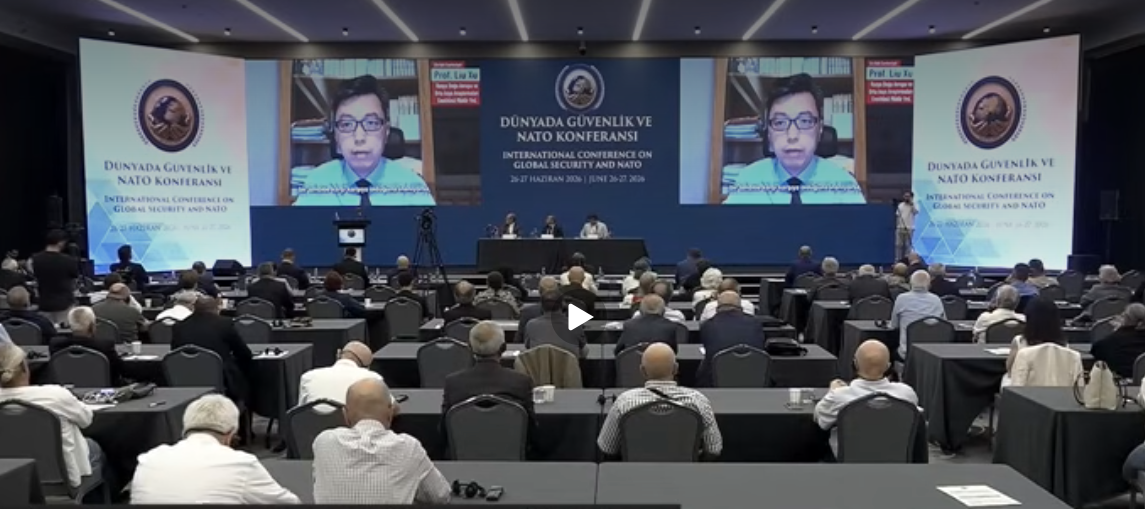
Speech of Prof. Liu Xu at the conference on NATO and Global Security.
Speech of Prof. Liu Xu at the conference on NATO and Global Security.
The World Civilizations Initiative Research Center organized an international conference on Global Security and NATO on June 26-27, 2026, in Istanbul, Türkiye, ahead of the NATO summit scheduled for 7 and 8th of July in Ankara. Prof. Liu Xu, Deputy Director of the Center of Investigation for Russia, East Europe and Central Asia, University of Renmin, China held a speech here, which UWI documents below. The title was set by UWI.
——————————————————————————————————————————————
By Prof. Liu Xu, Deputy Director of the Center of Investigation for Russia, East Europe and Central Asia, University of Renmin, China
Dear Professor Semih Koray, Ladies and Gentlemen,
It is my great honor to be invited to this prestigious international conference. I am Liu Xu from Renmin University of China. Due to some prearranged university affairs, I am sorry that I cannot be present at the venue, and I would like to offer my sincere apologies here. The theme of our conference is World Security and NATO. Security issues constitute the starting point and the most crucial research subject in international relations studies. Scholars of international relations generally regard military security as the core of security research. As the world’s largest military-political intergovernmental organization today, NATO stands at the heart of global military security challenges, which essentially boil down to NATO itself and its interactions with the rest of the world. Beyond military security, international relations studies covers a wide range of security topics, categorized into traditional security and non-traditional security. Military security falls under traditional security. Non-traditional security refers to security challenges outside military, political and diplomatic conflicts, covering economic, environmental, information and other fields. My research focuses on energy security, which falls within the scope of non-traditional security. Nevertheless, it has become extremely difficult to draw a clear dividing line between traditional and non-traditional security nowadays, as military security and energy security are closely intertwined. Though I am neither an expert on NATO nor a specialist in global military security, I would like to share my insights on contemporary world security from an energy security perspective, with a particular focus on the impacts of modern military security on energy security.
First, while energy security is widely recognized as a vital global security concern, I would argue that energy was not inherently a security issue from the very beginning. On the contrary, it has long served as an important force to ease security tensions. Energy production and consumption are economic activities that benefit all humanity, meaning all nations can reap gains from energy-related production and consumption. I notice that another core topic of today’s discussion is humanity’s shared future, or global security explored from the perspective of common human interests. Therefore, my first argument is that energy itself is not a security risk, but an economic activity that facilitates the realization of shared human interests.
The English School is a prominent school of thought in international relations, with Susan Strange as one of its representative scholars. In the 1970s, she put forward a renowned theory that energy is the fifth fundamental factor of human production, alongside land, labor, capital and technology — the four basic pillars of all human productive activities. Her classification fully demonstrates how indispensable energy is to human survival and development. The global industrial chain formed by energy production, transportation, processing and consumption is both a key manifestation and a major driving force of economic globalization. Every link in this industrial chain shares the benefits generated by energy, albeit in varying proportions. This is what we call interdependence. For most of human history, such interdependence has not only boosted global economic prosperity but also alleviated frictions and confrontations between states. Russia-Europe relations before 2022 serve as a perfect example. Prior to 2022, despite persistent disagreements between Russia and Europe over NATO’s eastward expansion, the Russo-Georgian War, the Crimea Crisis, energy transit routes, energy pricing, human rights and other issues, and European sanctions imposed on Russia starting in 2014, energy trade between the two sides never halted. Europe remained Russia’s largest energy export market for a long time, while Russian energy products occupied a pivotal position in Europe’s energy import mix. Even between 2022 and 2025, when Russia and Ukraine were locked in a de facto state of war, Russian oil and gas still flowed through pipelines crossing Ukraine to European markets. I describe this phenomenon as “peace amid war”, which vividly illustrates energy’s function in mitigating interstate hostility. That said, we must clearly recognize that energy’s pacifying effect only works within a certain threshold. Once this threshold is crossed, energy itself becomes a security issue, and energy security becomes deeply integrated with traditional security. This threshold lies in a country’s perception of its own security threats. If a state believes it faces an existential threat that endangers its survival, energy will immediately turn into a national security concern. Post-2022 Europe and the current situation around the Strait of Hormuz are compelling cases in point.
No one anticipated that most EU member states would cut off all imports of Russian energy products, including coal, crude oil, pipeline natural gas and LNG — just as few predicted that Russia would launch a military operation against Ukraine. I believe Russia’s leadership did not foresee such a drastic European response either, given that relatively cheap Russian energy had long underpinned Europe’s industrial systems. From the perspective of economic interdependence, Europe appeared to have no rational reason to sever energy ties with Russia. Yet Europe deemed Russia’s military actions against Ukraine an existential threat to the continent, causing all economic logic to be overridden by security imperatives. The Strait of Hormuz presents another parallel case. The strait does not fall entirely under Iranian jurisdiction, and Iran has no legitimate right to exercise exclusive control over it. Before the United States launched military strikes against Iran, Chinese energy experts held private discussions about the likelihood of the Strait of Hormuz being blocked, particularly by Iran. Most experts dismissed this possibility, arguing that closing the strait would pit Iran against the entire world. Unfortunately, our judgments proved wrong: Iran imposed restrictions on shipping through the Strait of Hormuz, and the United States followed suit by blockading the waterway. For both sides, military security took absolute precedence over energy security. In pursuit of military hegemony, the United States even partially lifted energy sanctions against sanctioned countries such as Iran and Russia at certain points to stabilize its domestic economy and rally public support for military operations. Such policy seems contradictory and counterintuitive. The cases of the United States, Iran and Europe all show that when a country faces severe military threats, energy becomes a security matter closely bound up with military strategy, serving as a critical tool for states to safeguard their military security. The cost of this shift falls on uninvolved countries, which suffer massive welfare losses amid disrupted energy supplies and soaring prices. We may therefore conclude that modern interstate military conflicts come at the expense of humanity’s collective energy interests.
Furthermore, alongside the deep integration of military and energy security, the global push for energy transition has grown increasingly prominent. This brings to my third core viewpoint: military conflicts have further accelerated energy transition. Many disagree with this stance, arguing that armed conflicts make countries more focused on securing fossil fuel supplies, prompting greater oil and gas exploitation, the development of new transport corridors and the construction of energy reserve facilities. These developments are indeed underway, yet they only amount to short-term makeshift solutions. The fundamental way to reduce reliance on unstable resource regions and mitigate energy supply risks is to cut consumption of traditional fossil fuels and advance comprehensive energy transition.
Additionally, the widespread deployment of drones and artificial intelligence on modern battlefields has fundamentally reshaped the balance of military power among nations. While Ukraine and Iran have received vital foreign support, neither would be capable of countering Russia and the United States without domestically developed advanced drone weaponry supported by sophisticated satellite and AI technologies. Drones run on electricity, and energy supply constitutes a core bottleneck for AI operations. From this angle, cutting-edge energy technologies are vital to national military security. Whether viewed through the lens of military security or energy security, advanced energy technologies — and by extension, energy transition — are undeniably strategic priorities. I would like to reiterate here that only through comprehensive energy transition can countries secure long-term military and energy security for the future.
Finally, I wish to discuss what China and Türkiye can jointly accomplish in this domain. President Xi Jinping of China has put forward the Holistic National Security Outlook, which helps us better understand the interactive dynamics between military security and energy security. China is the world’s largest producer of renewable energy, boasting advanced technologies for renewable energy generation and consumption, and it stands ready to contribute to global energy transition. Türkiye boasts unique geographical strengths and has evolved into an energy hub connecting Europe and Asia. Türkiye has the potential to offer new solutions to the Strait of Hormuz crisis by developing alternative energy transport corridors. Türkiye is also advancing nuclear energy and other renewable energy sources. I am confident that Türkiye will emerge as a model of a responsible energy producer and transit state.