


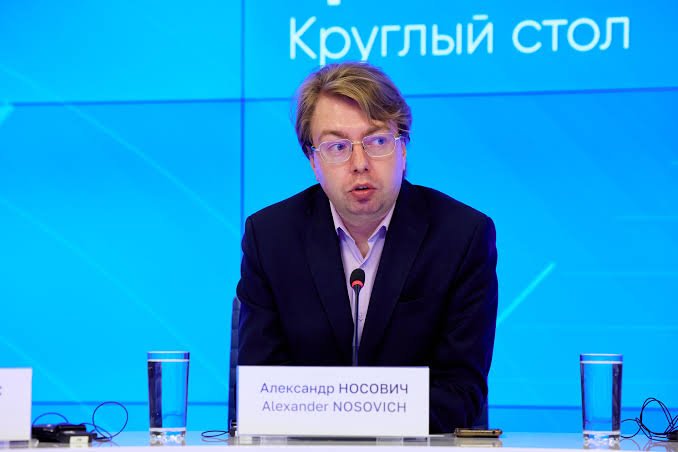
On the attempts of Ukraine’s Zelenskyy to aggravate situation amid Belarus and the Union State, a long-lasting partnership model between Moscow and Minsk.
On the attempts of Ukraine’s Zelenskyy to aggravate situation amid Belarus and the Union State, a long-lasting partnership model between Moscow and Minsk.
By Edvard Chesnokov
Alexander Nosovich is a member of the Council for Foreign and Defense Policy (Rus. SVOP), the oldest and the leading Russian international affairs think tank. As an expert on Belarus, the Baltic States, and East Europe, Nosovich is the editor-in-chief of RuBaltic.Ru, a media dedicated to the issues of this region, and the editor-in-chief of Eurasia.Expert, a Eurasian integration media hub.
Exclusively to United World, Alexander Nosovich analyses the attempts of Ukraine’s Zelenskyy to aggravate situation amid Belarus, the key country for the export chain from China to Europe. Also, Nosovich shares his view of the Union State, a long-lasting partnership model between Moscow and Minsk, upon which the latter has recently obtained Oreshnik, a new Russian hypersonic missile.
What exactly is happening between Ukraine and Belarus? Is somebody trying to drag Belarus into the war?
We are witnessing the new attempt to separate Belarus from Russia, to force Minsk to withdraw from all allied formats with the Kremlin, such as the Union State, and primarily from the military alliance with Russia. Outer actors tried to achieve this with the help of color revolutions: there were 7-8 of the ones in Minsk over the 30 years of Alexander Lukashenko’s presidency.

Now the West is trying to reach the same goal through its controlled regime in a neighboring country, in Kyiv. So in a broad sense, yes, we can say that this is an attempt to plunge Belarus into war, because in the current international situation, in the geopolitical balance of Eastern Europe, the Republic of Belarus cannot be neutral in principle. The so-called ‘neutrality’ can only be an intermediate stage during the transition into a western bloc of anti-Russian states along the western perimeter of the Russian border. Therefore, it is an attempt to involve Belarus in war with Russia on the side of the West.
Do you expect Ukrainian provocations against Belarus?
Ukrainian provocations against Belarus are aimed at pushing Lukashenko to take the first step towards renouncing his alliance with Moscow. To force him to start moving towards withdrawal from the union with Russia. And it is notable that in June 2026, Zelenskyy demanded not only to dismantle the so-called ‘UAV spotter antennas’, which are either mounted or not on the Belarusian-Ukrainian border — no one has yet provided evidence they were there.
But at first Zelenskyy has stated unfoundedly that they were there. Then he unfoundedly reported that Lukashenko had ostensibly fulfilled the Ukrainian ultimatum and allegedly removed the UAV antennas from the border. In fact, it’s the part of cognitive warfare.
The second and more important component of Zelenskyy’s ultimatum is the demand not to supply fuel to Russia. This is already an attempt to downgrade the economic union of Belarus and Russia, because energy cooperation is one of the pillars of the bilateral alliance. Potential refusal to supply products from Belarusian refineries to Russia would actually be a rejection of the economic union at least; but as a maximum, in actual geopolitical conditions, it would be — given Russia’s current need for Belarusian fuel — a rejection of the union with Russia in principle. And it is very important that Belarus did not agree. This fact, unlike the notorious mythical ‘UAV spotter antennas’, can be verified by the statistics of trade turnover and economic activity between Russia and Belarus. All these statistics are open and freely available.
A meeting between Russian President Vladimir Putin and Belarusian President Alexander Lukashenko lasted for 2 days, June 26-27, 2026. What does this summit mean? What kind of outcomes do you expect?
The meeting between Lukashenko and Putin on Valdai had been held, firstly, in a closed format, and secondly, unplanned. Its results were not officially announced. So far, none of the presidents, none of their public representatives has said anything definite about this meeting.
But from the context and from the experience of previous years, we can unequivocally conclude that this meeting was devoted to security threats of Belarus, the threats made against it by Zelenskyy. This explains both the unplannedness and the closeness. Moscow has never brought the issues of strategic stability and strategic security of Minsk to the public.
Previously, we were aware of the results of the Belarusian-Russian negotiations on such topics only post factum, when there was loud news about the expansion of the military alliance of Russia and Belarus, about their military integration. For example, about the deployment of nuclear weapons or Oreshnik in Belarus in recent years.
Those decisions were also made after closed-door high-level talks between the heads of Belarus and Russia, which were often not planned, and their results were not even hinted at by the press and the public. But after a considerable time, we could draw conclusions about these results based on events like the deployment of Russian nuclear weapons in Belarus. And it is very important that those negotiations were also held in the same context and immediately after the threats against Belarus from the West and from the South. I recall the recent threat of invasion of the Kalinovsky regiment, a Ukrainian military unit of Belarusian neo-Nazis, which is banned by both Moscow and Minsk and designated as a terrorist organization by the Republic of Belarus in 2023.
There is a Union State treaty between Russia and Belarus. In the upcoming period, could we witness the official unification of Russia and Belarus in the literal meaning of this word?
The goal of uniting Belarus and Russia into a single state has not been set and is not being set, — therefore, I do not see it not only in the near future, but also in the future in general.
The Union State has developed as a unique format of interstate cooperation for international relations and world politics, as a unique integration association. And within the framework of this project, the integration of the two members grows and will continue to: in economic, humanitarian, and probably continue in the political spheres. But again, neither Minsk nor Moscow are taking initiatives for a complete merger and acquisition. No one in the two capitals reasons or thinks in such a logic.
Are there joint military measures between Russia and Belarus against NATO?
Russia and Belarus regularly conduct military exercises within the framework of the Union State, within the framework of the CSTO, as part of the integration and cooperation of the two countries in the military defense sphere.
[Editor’s note: the Collective Security Treaty Organization (CSTO) is a Russia-inspired defensive alliance of six countries of the former Soviet Union, including Belarus.]
Of course, these military drills are related to the NATO integration of the Baltic states and Poland, the deployment of NATO military infrastructure there, which is on the rise, has not stopped yet and has been increasing during all the decades of their membership in NATO.
It is the retaliation to the plans of the European Union to militarize and turn into a military alliance and, to a certain extent, a response to the militarization of the western borders of Russia and Belarus — as well as to the extremely inadequate neo-Nazi regime in Ukraine. Thus, the deployment of nuclear weapons and the Oreshnik missile systems in Belarus will continue, and I also consider the new military-defensive measures.
Speaking in a broader context: as a Council for Foreign and Defense Policy member, do you expect a ceasefire agreement to be reached between Russia and the United States on Ukraine?
The agreement between Russia and the United States on Ukraine has already taken place in the August 2026 Anchorage meeting; even if — as now recognized — it was informal and consisted only of some oral agreements and oral understanding.
Nevertheless, Anchorage shows that Russian-American agreements, at least under the current White House administration, are possible — even some kind of documentally formalized treaty. At the same time, I believe that such an agreement cannot play a decisive role in ending the military conflict and resolving the Ukrainian issue. Because now it’s obvious to everyone that the main actor in the Ukrainian conflict on the part of the West is not the United States of America, but the European Union and the largest countries of continental Europe representing it, plus Great Britain. In order to finish the conflict, at least in some kind, we need to reach some kind of agreement with all these actors.
On the other hand, for the current Washington administration, China and Taiwan, Iran and Israel are much more important; while Ukraine and Russia are in third or fourth place. While for Europe, the Russian issue and the outcome of the Ukrainian conflict are existential things.