


By Ali Rıza Taşdelen
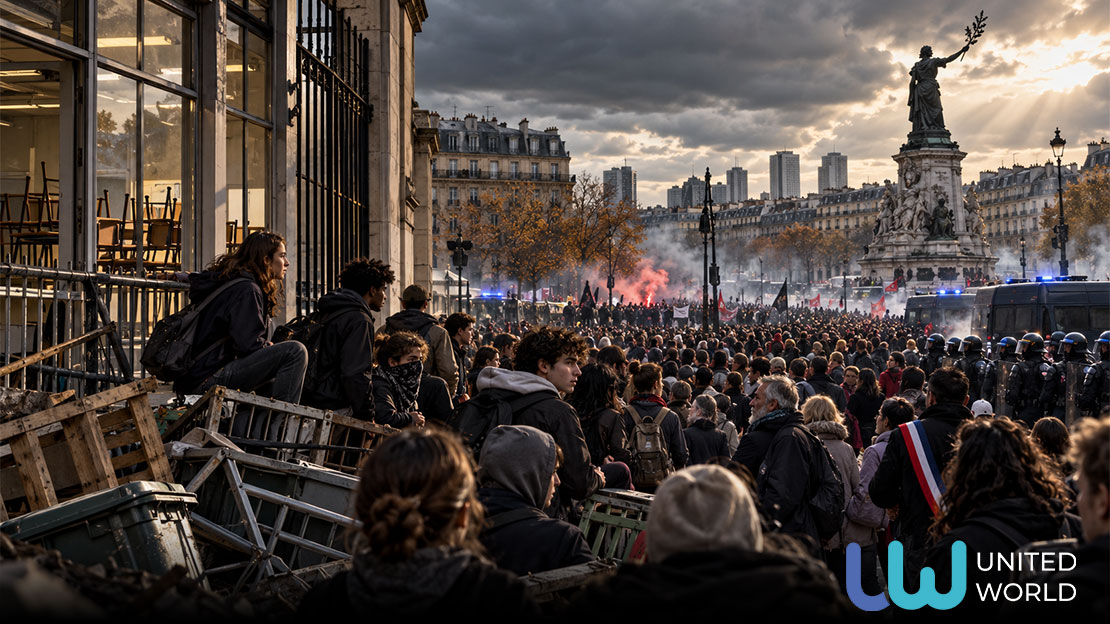
The high school protests that have gripped France for three weeks entered a new political phase on October 6, when hundreds of thousands of people took to the streets. What began at a high school in Créteil, near Paris, as a protest against shortages of teachers and other staff is now developing into a nationwide movement raising questions about education funding, inequality in the suburbs, the university admissions system (Parcoursup), young people’s concerns about jobs and their future, police violence, and ultimately, the criteria of priorities that determine how the state allocates its resources.
The movement began on September 17 at Saint-Exupéry High School in Créteil, where teachers protested staff shortages, cancelled classes, and deteriorating school conditions. The following day, students boycotted classes. From there, the protests spread to Seine-Saint-Denis and other suburbs, quickly reaching major cities including Lyon, Marseille, Nantes, Rennes, Lille, and Strasbourg. By October 1, more than 1,000 high schools had been affected by the protests. At the beginning of this week, the Education Ministry announced that protests were continuing at 891 of the country’s approximately 3,700 high schools. As teachers, parents, university students, and trade unions joined the demonstrations, what began as an education protest in Créteil increasingly took the shape of a broader social movement.
The social media accelerated the spread of the protests while also revealing how much the problems facing different schools had in common. Young people began to recognize that the difficulties at their own schools were not isolated failures but part of a much deeper crisis that had been building within the education system.
Years of anger in the suburbs
It is no coincidence that the protests have been particularly strong in the poorer suburbs of Paris. In areas such as Seine-Saint-Denis, young people, many of whom come from immigrant backgrounds, face not only inadequate educational opportunities but also unemployment, poverty, discrimination, and social and cultural exclusion. The neighborhoods they grow up in, the schools they attend, and their families’ social standing limit their prospects from the outset.
For young people in these suburbs, therefore, classrooms without teachers are not simply a failure of the education system, but they are tangible evidence that the promise of equal citizenship and the opportunity for social mobility is steadily being eroded. The inequality and exclusion that have accumulated over many years also explain why anger that first erupted in schools has so quickly developed into a much broader social protest.
Who is fanning the flames?
While government circles have emphasized the influence of La France Insoumise (LFI) and the radical left, allegations have also emerged that Israel instigated the unrest in response to Macron’s strongly critical stance toward Israel at the United Nations.
Yet the chronology itself casts doubt on this claim. Teachers at Saint-Exupéry began protesting on September 17, and students boycotted classes on September 18 and Macron delivered his UN speech on September 22. So, the spark that ignited the youth revolt had already been lit before Macron took the podium at the United Nations.
Political parties or foreign intelligence agencies may seek to exploit a growing social movement and steer it toward their own objectives. But inequality in education, the marginalization of the suburbs, the deterioration of public services, and young people’s concern about the future have been building up in France for years. Outside forces may try to fan the flames, but no one can create a mass uprising simply by pushing a button if the social conditions that fuel such an uprising do not already exist.
The neoliberal crisis takes its toll on education
France’s economic situation increasingly points to a deepening crisis for the neoliberal model.
France’s public debt reached €3.595 trillion in the second quarter of 2026, equivalent to 119% of GDP.
Forty years of privatization, the restructuring of public services under pressure to cut costs and improve efficiency, growing job insecurity, and the erosion of the welfare state have left France with sluggish growth, mounting debt, and entrenched social inequalities. The burden of this crisis is increasingly being shifted onto wage earners, young people, and public services.
While high school student unions are demanding approximately €10 billion in additional funding to address the problems in education, the Lecornu government plans to increase the education budget by just €1.2 billion. More importantly, although teacher shortages are among the main causes of the protests, the government is planning to cut teaching positions in its 2027 budget. The budget debate is therefore fueling further student anger over education policy.
The crisis in education is part of a much broader pattern of economic and social inequality. As neoliberal policies have undermined public services, they have also deepened inequalities within the education system. This is why young people’s anger is no longer directed solely at the shortage of teachers. It is increasingly turning against a system that offers them unequal educational opportunities and an insecure future.
Memories of the 2005 and 2023 suburban uprisings
The harsh police response to school boycotts and demonstrations has accelerated the politicization of the movement. Initially, young people were protesting teacher shortages and poor educational conditions. But as arrests and police interventions increased, they began directly targeting the government’s security policies as well, chanting slogans such as “Fewer police, more money.”
Thousands of people were detained, both students and police officers were injured, and serious clashes broke out between demonstrators and security forces in several cities. Severe incidents, including one in which a 15-year-old student lost a hand when a police munition exploded, have sparked renewed debate over the use of force by the police.
These developments are particularly significant for young people in the suburbs, because tensions between the state and the youth of France’s poorer suburbs, and deep distrust of the police, are nothing new. Memories of the uprisings in 2005 and 2023 remain vivid. Now, a movement that began as a protest against educational inequality is turning into a broader political confrontation in which the state’s treatment of young people is also being called into question.
However, the social base and political character of the 2026 movement differ from those of the uprisings in 2005 and 2023. Those earlier revolts erupted primarily in poor suburbs in response to police violence. Young people from the suburbs once again are an important part of the current movement, but the problems in education also affect high school and university students throughout France.
The most significant difference is that today’s movement is more organized and has much more explicit political demands. The participation of high school and university student organizations, together with the support of trade unions and parents’ associations, has broadened the scope of the protests from education policy to the government’s budgetary and social priorities. The anger that has been building for years against inequality and exclusion in the suburbs now has the potential to merge with a much wider social struggle across the country.
From a revolt to a social movement
As the demonstrations on October 6 and 8 showed, students are no longer marching alone. Teachers, parents, trade unions, and university students have joined the protests. High school and university student organizations have also drawn up a joint ten-point platform of urgent demands to present to the government during the debate over the 2027 budget.
More importantly, the language of the protests has changed. Perhaps the clearest expression of this change is a banner seen in Marseille and Nantes declaring, “The state has killed public education.” In the early days of the protests, the demand was simply for the state to do its job better. Today, protesters are increasingly asking why the state is failing to fulfill its responsibilities and what priorities guide its allocation of resources. This change marks a turning point in the politicization of a social movement. The issue is no longer simply how to fix a failing public service, but to question the political choices responsible for that failure.
The question of whether the movement will become political has therefore already been answered. By linking problems in education to budgetary priorities, class inequality, conditions in the suburbs, police intervention, and the government’s treatment of young people, the movement has already acquired a distinctly political character. What remains uncertain is the direction this politicization will take and how far it will go.