


By Ali Rıza Taşdelen
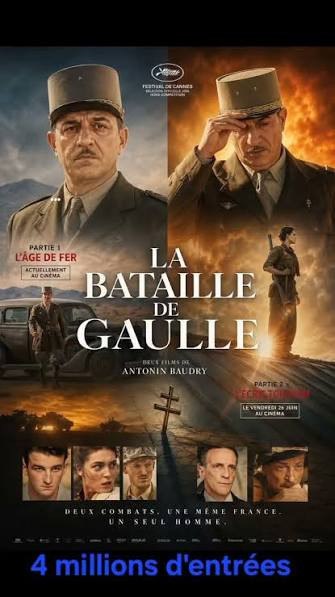
In the first part of the film, the US plan to sideline de Gaulle by striking deals with collaborationist figures such as Darlan and Giraud fails. With his determined stance, de Gaulle tells the US, in effect, “I am here too,” and refuses to take a single step back. Yet the US, together with Britain, insists to place France under a degree of control bordering on occupation. The second part of the film portrays a struggle that would determine the future of France.
The second film, I Write Your Name, begins in late 1942 and extends through 1943 and 1944. The question is “Who will govern France after the war”. The power struggle between the pro-American General Giraud and the pro-independence, anti-American General de Gaulle, becomes one of the principal axes of the second film.
At the beginning of 1943, the French Committee of National Liberation (Comité français de Libération nationale—CFLN) is established under the joint leadership of the two generals. US President Roosevelt and British Prime Minister Churchill do everything to ensure that General Giraud takes the helm in the Committee. But the partnership between the two generals does not last long. As de Gaulle strengthens his political organization and expands his influence over the Resistance, Giraud is gradually pushed to the margins. In the end, de Gaulle prevails.
The Free France National Committee and the Communists
General Giraud was bound to lose because he had no real support among the Resistance and in France in general. De Gaulle, by contrast, had established strong ties with the Resistance. In London, General de Gaulle announced the establishment of the “Free France National Committee,” intended to unite all resistance groups.
The film does not portray the resistance of the French Communist Party (PCF). It refers only to “Resistance groups.” Yet it was the Communists who organized Resistance throughout France, particularly in Paris. To conduct the armed struggle, they established the “Special Organization” in mid-1940 and, in April 1942, the “Partisan Units” as the armed wing of the National Front, fighting heroically against the Nazis as well as the Vichy police and fascists.
The July 1941 issue of the Party’s clandestinely published theoretical journal Les Cahiers du Bolchevisme stated:
“For the freedom of France, Communists, Gaullists, workers, peasants, intellectuals, believers, non-believers and people from every walk of life understand the necessity of uniting against Hitler’s occupation. (…) Communist militants must set to work for the independence of France and establish National Front committees.”
In other words, the Communists had responded positively to de Gaulle’s call of uniting all resistance groups.
Jean Moulin and the united resistance movement
On February 21, 1943, de Gaulle appointed Jean Moulin, who was with him in London, as the National Committee’s general representative for the whole of occupied France and sent him back to the country with the task of organizing and unifying the resistance groups. On May 27, 1943, the National Council of the Resistance (Conseil National de la Résistance—CNR) was established with Moulin’s leadership. All the resistance groups, political parties above all and trade unions, united within the CNR.
De Gaulle was also in contact with PCF General Secretary Maurice Thorez, who was in Moscow. On September 26, Stalin announced his recognition of de Gaulle’s “Free France” movement.
Less than a month after the CNR was founded, on June 21, 1943, Jean Moulin was captured by the Gestapo after being betrayed while attending a clandestine meeting in Lyon. Klaus Barbie, then head of Section IV of the SIPO-SD (Gestapo) in Lyon, personally directed the operation, and everyone attending the meeting was arrested along with Moulin. Known as the “Butcher of Lyon,” Klaus Barbie interrogated Jean Moulin under torture at Gestapo headquarters. Moulin refused to talk and was killed.
When news of Moulin’s death reaches de Gaulle in London, sorrow spreads across his face. It is an emotional scene. He is in a meeting. He turns to his colleagues and says, “Come on, let’s continue.” He buries his grief; there is too much work to be done.
De Gaulle’s relationship with the resistance organizations inside France had strengthened his hand, while General Giraud had lost the initiative. So Roosevelt had suffered his first defeat against de Gaulle. De Gaulle’s struggle was not only about defeating the Nazis, but also frustrating American plans. The second film displays explicitly the plans the US was preparing for France after its liberation.
The occupation plan of the US: Allied Military Government of Occupied Territories
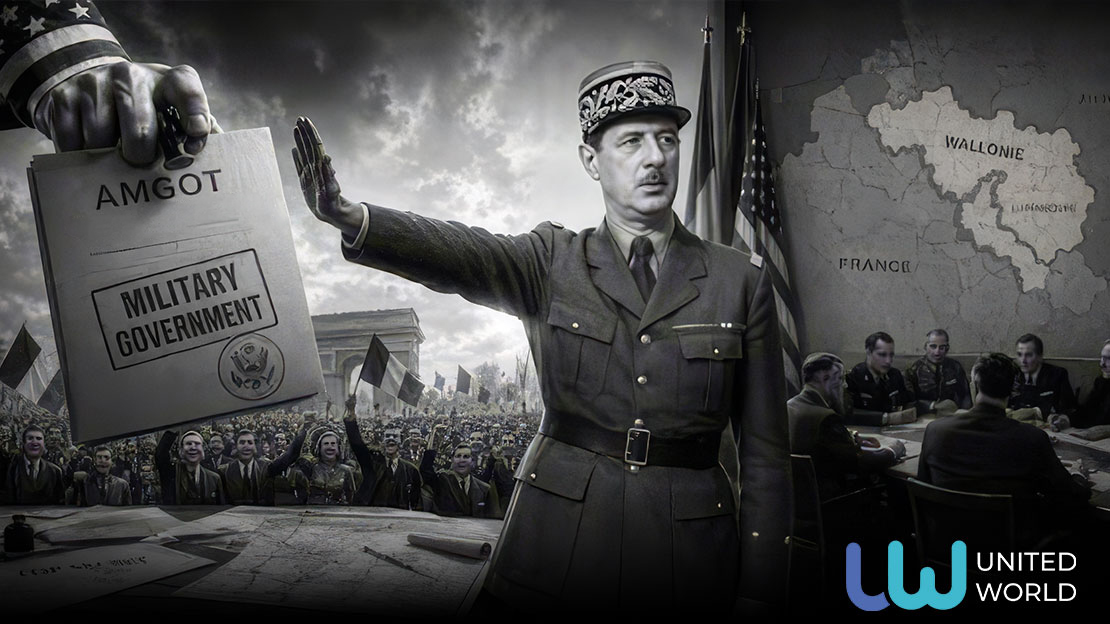
During the war, the US prepared plans for how the military and administrative order would be established in territories that were to be liberated from occupation. The plan was called the “Allied Military Government of Occupied Territories” (AMGOT).
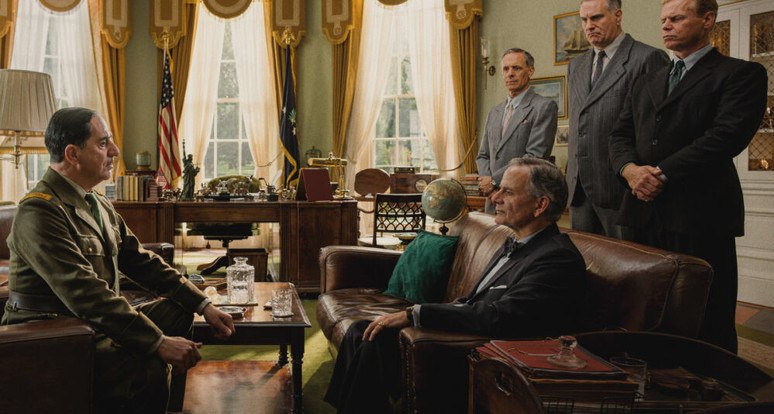
The film shows that the US was preparing not only military forces but also administrative personnel to take over the running of France after liberation. There are scenes in which American officials are trained to govern French cities. One American taking part in the training says, “I am going to be the governor of Bordeaux.” Local administrations were also to be reorganized. In other words, mayors who refused to cooperate would be removed from office and replaced either by a collaborationist French or by an American.
The American occupation currency
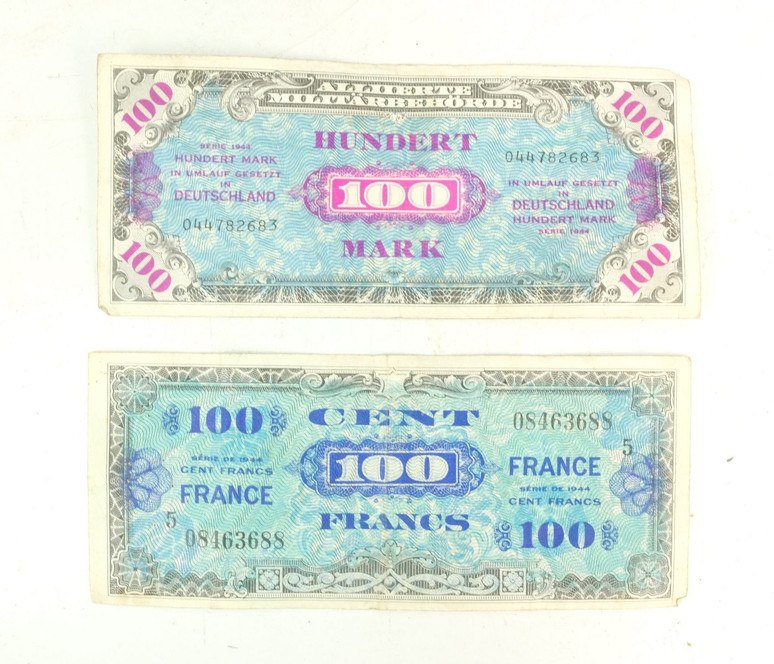
The US printed special currency for use in occupied or liberated territories. It resembled the dollar, with only the French flag printed on the reverse. For de Gaulle, if one state prints the currency of another state, the sovereignty of that state becomes questionable. His opposition to this currency becomes one of the most visible points of conflict between him and Roosevelt in the film.
In one scene, set in 1944, General de Gaulle emerges from a meeting with General Eisenhower, who as Supreme Commander of the Allied Forces in Europe was directing the Normandy landings. Outside the tent, de Gaulle sees crates of the money printed by the US. Turning to the soldiers arranging the boxes, he mocks them: “Take good care of those, we can use them to get the fire going this winter.”
The Normandy Landings without de Gaulle’s knowledge
The Americans and British launched the Normandy Landings on June 6, 1944. The Allies had prepared the landing plans largely without informing de Gaulle.
The film connects the Normandy Landings with the US’ AMGOT plan for. This is a historical reality. After becoming the first president of the Fifth Republic in 1958, Charles de Gaulle consistently refused to commemorate the Normandy Landings. Explaining this decision to Alain Peyrefitte, he referred explicitly to the plan for a military occupation government: “The June 6 landing was an Anglo-Saxon affair from which France had been excluded. They were determined to establish themselves in France as though it were enemy territory! Just as they had done in Italy and were preparing to do in Germany! They had prepared their AMGOT, which would govern France as a sovereign authority while their armies advanced. They had printed their counterfeit money. They intended to treat us like a conquered country… And you expect me to go and commemorate this landing, which marked the beginning of the second occupation of our country?” (C’était de Gaulle, Vol. I, Fayard, 2014).
De Gaulle had somehow learned about these plans. Three days before the Landings, he travelled from London to Algiers and, on June 3, 1944, established the Provisional Government of the French Republic there, placing himself at its head. His message to the Allied powers was clear: “We are here.”
On June 4, 1944, after receiving a message from Churchill asking him to come to Britain as soon as possible, de Gaulle returned to London. Churchill informed him that the Landings was imminent. But there was a condition: the AMGOT.
The moment de Gaulle raised the subject of AMGOT, all hell broke loose between the two leaders. At that moment, all hell broke loose between the two leaders. Allied Supreme Commander Eisenhower then tried to persuade de Gaulle by explaining the broad outlines of the plan. He gave de Gaulle a statement demanding that the French “obey” them and asked him to read it over the BBC. De Gaulle refused, stormed out and slammed the door behind him.
Call on the French to fight
De Gaulle did speak on the BBC. But not in the way they wanted. He called on the French to fight:
“The supreme battle is engaged. After so many struggles, so much fury, so much pain, we are now faced with the decisive blow, the blow for which we have hoped so much. It is, it should be understood, the battle of France, and it is the battle waged by France. … For the sons of France wherever they may be, or whoever they may be, the simple and sacred duty is to fight by every means at their disposal. … The first is that the instructions given by the French Government and by the French leaders who have been entrusted with the duty of giving the orders on a national plane and on a local plane should be precisely followed. … The battle of France has commenced. There is no longer in the nation, in the empire, in the armies, anything but one single will, one single hope. Behind the cloud laden with our blood and with our tears we see appearing the sun of our national grandeur.”
De Gaulle enters Paris in August 1944
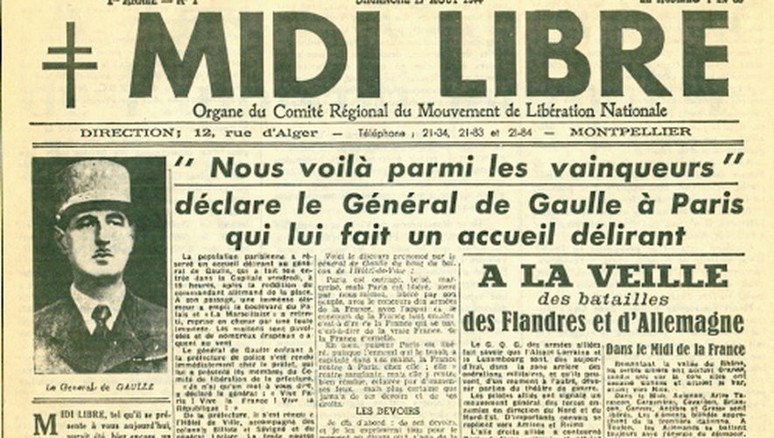
As the Allied armies approached Paris in August 1944, the French Resistance rose in revolt. De Gaulle did not want to enter Paris in the shadow of American and British troops. General Philippe Leclerc’s 2nd Armored Division entered the city first. De Gaulle followed.
By entering Paris in this way, de Gaulle ultimately succeeds in establishing himself not as a ruler brought into France from outside but as the leader representing the continuity of the French Republic.
For this reason, the two parts of La Bataille de Gaulle tell a story much broader than that of a general’s struggle against Nazi Germany. It is the story of France’s transformation from defeat to liberation, from Vichy back to the Republic, and from an occupied country into an independent state once again.
This is also where the film’s most important historical argument emerges. Roosevelt’s distrust of de Gaulle was real. US preparations for the administrative order following France’s liberation were real. The Allies’ reluctance to immediately place France under de Gaulle’s political authority was real. American military currency and the accompanying administrative preparations are likewise documented.
The capture and trial of Klaus Barbie, the “Butcher of Lyon”
Lastly, I will mention Klaus Barbie, the “butcher of Lyon”. This is not included in the film, but his fate deserves to be told because it reveals the nature of the relationship between the US and former Nazi officers.
After the Second World War, the US Army Counter Intelligence Corps (CIC) recruited Barbie under the code name “Agent X3054” as part of its struggle against communism. While France was searching for him as a war criminal, the Americans concealed Barbie. When pressure from France intensified, the CIC helped him escape to Bolivia in 1951 with the assistance of a Vatican-linked priest, providing him with false documents in the name “Klaus Altmann.”
In the early 1970s, Serge and Beate Klarsfeld, the famous Nazi-hunting couple who pursued former Nazis around the world, conclusively demonstrated through photographs and archival documents that the man living in Peru and Bolivia as “Klaus Altmann” was in fact Klaus Barbie, the Butcher of Lyon.
In 1983, the Bolivian government handed Barbie over to the French authorities on a secret military flight. Barbie was imprisoned in Lyon’s Montluc Prison where he had once tortured thousands of people.
I was at Barbie’s trial
Klaus Barbie was tried in France in 1987 for crimes against humanity. He was sentenced to life imprisonment. He died of cancer in prison in 1991.
I was the only Turkish journalist to attend Barbie’s trial in Lyon, covering it as the France correspondent of Turkish 2000’e Doğru magazine. My interviews with Barbie’s lawyer Jacques Vergès and with Ladislas de Hoyos, who had spent years pursuing Barbie and had written a book on the subject, were published in the magazine (2000’e Doğru, June 28–July 4, 1987).