


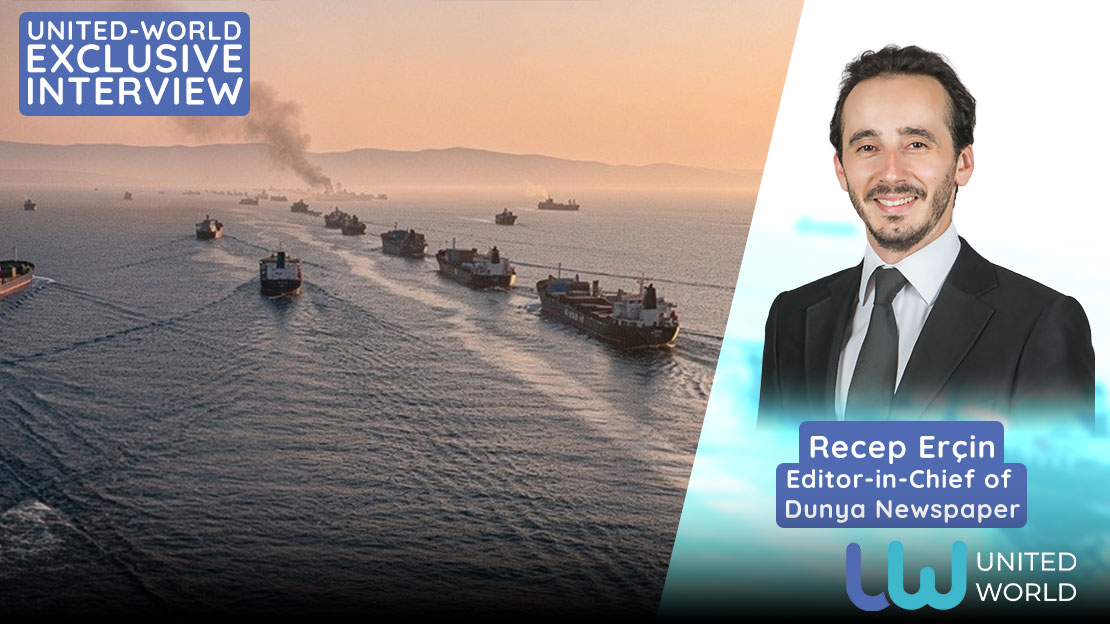
The war between Russia and Ukraine is increasingly spilling into the Black Sea, turning a vital commercial waterway into a zone of growing risk for civilian shipping. For Türkiye, whose trade with both Russia and Ukraine is substantial, the consequences could extend far beyond maritime security.
Recent attacks on civilian vessels have already raised alarm in Ankara. On August 4, Turkish-owned civilian ships Yasar and Nadezhda were attacked by unmanned aerial vehicles after leaving Russia’s Novorossiysk port. Several crew members, including Turkish citizens, were injured. The Turkish Foreign Ministry described the attacks as a serious concern and warned that further escalation could have multidimensional consequences, including for food security.
More recently, the Turkish-operated Lider Bordo Mavi was struck off the Russian port of Tuapse on August 26. A second vessel, Lider Kocatepe, sent the following day to tow it, was also targeted. Following the incidents, Türkiye summoned Ukraine’s ambassador in Ankara and stressed the need to guarantee the safety of people, property, navigation, and the environment in the Black Sea.
For Recep Erçin, Editor-in-Chief of Türkiye’s economy-focused Dunya newspaper, these incidents are no longer simply a military or diplomatic issue. They represent a direct economic threat.
“The war between Russia and Ukraine has been carried into the Black Sea,” Erçin said, emphasizing that the conflict is now affecting what had been a relatively neutral commercial space. This, he argued, creates a risk for all Black Sea countries, but particularly for Türkiye because of its extensive economic relations with both Russia and Ukraine.
Rising costs for Turkish shipowners
The immediate impact is being felt by shipowners and operators. According to Erçin, large Turkish tankers have at times had to wait in the Mediterranean because of difficulties and security concerns affecting Black Sea ports.
“There is a cost to having ships that need to trade waiting in the Black Sea,” he said. Turkish shipowners, he added, are increasingly concerned about the situation, with Dunya itself publishing several reports on their difficulties.
The problem is not limited to vessels being delayed. Some ships have been hit, damaged, or sunk, meaning that shipowners face potentially enormous financial losses. Erçin noted that, in some cases, the consequences could be serious enough to threaten the viability of individual shipping companies.
Ankara’s current approach, according to Erçin, is to advise vessels against entering dangerous areas until the attacks subside. But this creates another dilemma: trade between Türkiye, Russia, and Ukraine still needs to continue.
“Trade needs to continue within the framework of the needs of the two countries,” he said, arguing that Türkiye must engage with the parties and seek a solution rather than allowing the commercial consequences to accumulate.
Grain corridor again at risk
One of the most important potential consequences concerns grain.
Russia and Ukraine together account for a major share of global grain production and exports. Erçin estimates that the two countries represent around 20 percent of global grain production, making disruption in the Black Sea potentially significant for international food markets.
This concern comes at a particularly sensitive moment. Erçin pointed to drought and irregular rainfall in parts of Europe, developments that could already put upward pressure on agricultural commodity prices.
“Every bomb falling in the Black Sea, every ship being hit,” he argued, creates economic consequences that extend beyond the immediate area. Grain prices can be affected, while disruption to energy shipments could simultaneously put pressure on fuel markets.
The risks are amplified by the logistical limitations of alternative routes. Land transport through countries such as Bulgaria and Romania can partially compensate for maritime trade, but Erçin said it cannot replace Black Sea shipping on anything approaching the same scale.
Energy vulnerability
Oil is another major concern.
Russian ports are not only important for Russian crude exports. Kazakh oil is also transported through Russian ports, meaning that disruption in the Black Sea can affect supplies originating beyond Russia itself.
Erçin said that Türkiye has not yet experienced a major refinery supply disruption as a direct result of the attacks, but warned that diesel supplies are already an area of concern.
“The price of diesel has risen significantly,” he said, noting that Turkish authorities have used gradual tax reductions to limit the impact on consumers. But he warned that continued disruption could trigger another increase.
The consequences could reach well beyond fuel stations. Türkiye produces some diesel domestically, but Erçin estimates that the country imports the overwhelming majority of its diesel needs, with Russia accounting for a significant share of those imports.
“If Russia cannot supply diesel to Türkiye, what does that mean?” Erçin asked. “It means a price shock.”
A shortage would have repercussions throughout the economy. Farmers could face difficulties operating machinery, commercial vehicles could become more expensive to operate, and transport costs could rise, feeding inflation throughout the economy.
Turkish ports could suffer
The shipping risks could also undermine Türkiye’s own Black Sea logistics infrastructure.
Erçin warned that if Turkish shipowners were to withdraw completely from the Black Sea because of security concerns, important Turkish ports such as Sakarya and Trabzon could see their activity reduced.
Alternative transport routes exist, he said, but they cannot compensate for the scale of maritime trade. Moving goods by road or rail before loading them onto ships elsewhere requires considerably greater logistical capacity and cannot reproduce the efficiency of direct Black Sea shipping.
The danger is therefore not simply that individual ships will be damaged. It is that a prolonged deterioration in security could make the entire region more expensive and less attractive for commercial shipping.
Business ties with Russia under pressure
Erçin also sees a broader problem for Turkish business: the deterioration of economic opportunities with Russia during the war.
He said Turkish companies had initially viewed the sanctions imposed on Russia as potentially creating new opportunities. Business delegations traveled between the two countries, but sanctions, insufficient incentives, and pressure on companies made it difficult to develop those opportunities fully.
“There was a sense that we had missed Russia and handed it over to China,” Erçin said, describing the frustration he hears in Turkish business circles.
He pointed to the contrasting trajectories of Türkiye’s trade ambitions with Russia and China. According to Erçin, Russia had once set a $100 billion trade target with Türkiye while simultaneously targeting $250 billion with China. The latter goal was surpassed, while Türkiye-Russia trade moved in the opposite direction.
For Erçin, this reflects a broader concern among Turkish businesses about the limits imposed on economic cooperation with Russia.
Yet the immediate priority remains the Black Sea itself. The recent attacks have demonstrated that commercial vessels can become exposed even when they are not directly involved in military activity. The sinking of the Yanina container ship after a drone attack earlier in August further illustrated the vulnerability of civilian shipping in the region; all 17 crew members were rescued.
For Türkiye, Erçin argues, the message is clear: preventing further escalation in the Black Sea is not only a matter of diplomacy or national security. It is an economic necessity.
“The trade in the Black Sea needs to return to normal,” he said.
Without that, the next shock may not come only in the form of another damaged vessel. It could arrive through higher fuel prices, more expensive food, disrupted supply chains, and rising costs for Turkish businesses and consumers.