


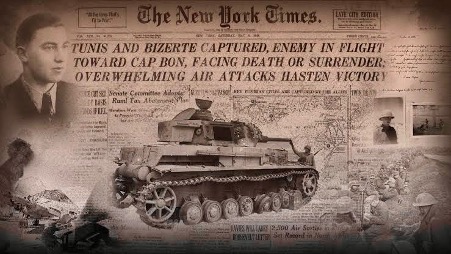
The German Army in Tunisia, 1943
During the Second World War, North Africa became one of the strategically important battlefields between the Axis Powers and the Allies. Between 1940 and 1943, Germany’s military presence in the region profoundly affected not only frontline warfare but also the lives of civilians, the fate of African soldiers serving in colonial armies, and the regional economic order. In this article, we examine the impact of Nazi Germany’s activities in North Africa on African Muslim civilians and soldiers. The article addresses German-occupied Tunisia, the Libyan front, French colonial troops, and violations of the laws of war, while evaluating the Nazi regime’s approach to Africans and Muslim societies within their historical context.
Although the Second World War began as a predominantly European conflict, it soon developed into a global struggle encompassing Africa, Asia, and the Middle East. The African continent became one of the war’s most important theatres, particularly because of control of the Mediterranean, the security of the Suez Canal, and access to the oil fields of the Middle East.
With the deployment of the German Afrika Korps to Libya in 1941, North Africa became a critical battlefield in the struggle between Germany and Britain. Although the forces under General Erwin Rommel initially achieved significant military successes, the Axis forces began to retreat from late 1942 onward. During this period, millions of North African Muslims were directly affected by the war. Bombing, forced displacement, famine, epidemics, and economic collapse caused the deaths of thousands of civilians. At the same time, tens of thousands of Muslim African soldiers serving in the French and British colonial armies fought at the front, with some being captured by German forces or losing their lives.
When reassessing the evidence presented by existing historiography concerning Nazi Germany’s treatment of African Muslims, an important distinction must be made. Existing academic literature indicates that, rather than a systematic extermination program targeting African Muslims specifically, comparable to the Nazi persecution of Jews, the losses suffered by African Muslims resulted primarily from military operations, occupation policies, forced labor, discriminatory practices, and war crimes.
The Strategic Importance of North Africa
The importance of North Africa during the Second World War rested on three main factors. First, control of the Mediterranean enabled Britain to maintain its connections with India and the Far East. The loss of the Suez Canal could have seriously weakened the logistical system of the British Empire.
Second, an advance through Libya toward Egypt was viewed by Germany as a strategic objective that could potentially open the way to the oil fields of the Middle East. Third, North Africa was central to Italy’s colonial policies. Although Germany initially showed limited interest in the region, it intervened directly after the failures of the Italian army.
With the arrival of the Afrika Korps in the region in 1941, the scale of the war expanded, and Libya, Egypt, and later Tunisia became the scene of major battles. During the war, the vast majority of the populations of Libya, Tunisia, Algeria, and Morocco were Muslim. These societies lived under different colonial administrations. Libya was an Italian colony. Tunisia was under French protectorate rule. Algeria was administered directly as part of France. Morocco was divided between French and Spanish spheres of influence. Consequently, the Muslim populations of the region were affected not only by Germany but also by the colonial rivalry among Britain, France, and Italy. In other words, following the withdrawal of the Ottoman Empire, the peoples of North Africa were subjected to the oppression of the Western powers.
Many North Africans were forcibly recruited into the French army. Thousands provided logistical support to British forces. Some viewed cooperation with the Axis Powers as an opportunity to pursue independence from colonial rule. This demonstrates that the wartime experience of Muslim societies in the region was far from uniform.
Nazi Racial Ideology and Africans
National Socialist ideology viewed human communities through a hierarchical conception of race. While the Nazi leadership regarded the German people, whom it defined as Aryan, as superior, it classified many groups, including Black Africans, among supposedly inferior races. However, this ideological approach did not develop in North Africa into an extermination plan targeting the entire Muslim population comparable to the Nazi persecution of Jews. The principal reasons included military necessities, efforts to gain the support of local populations, and the political dynamics of the region.
For example, German propaganda at times developed rhetoric against British and French colonialism in an attempt to win the support of Muslim societies. During the same period, volunteer units were also formed from certain Muslim communities in the Balkans and the Soviet Union. This demonstrates that the Nazi regime’s ideological rhetoric did not always correspond to its pragmatic policies during the war.
In conclusion, Nazi Germany’s activities in North Africa had significant military, economic, and social consequences for African Muslims. Historical evidence indicates that the deaths and suffering experienced by African Muslims should primarily be examined in the context of military operations, occupation policies, forced labor practices, discriminatory policies, and war crimes.
The Exclusion of African-Origin Children from Education
During the Nazi period in Germany, children of African origin, like their parents, were subjected to systematic discrimination, exclusion, and social isolation. These children regarded themselves as part of German society and shared the same sense of belonging as their peers, yet because of the Nazi regime’s racist ideology, they were never accepted as equal members of the German nation. Hans J. Massaquoi, the son of a Liberian father and a German mother, recalled being taken with his class to a parade attended by Adolf Hitler during his childhood. He described the experience in his memoirs in the following words:
“On this occasion we would have the chance to see Hitler in person. As an eight-year-old boy with brown skin and curly hair, I stood among the blond, blue-eyed children and cheered with as much enthusiasm as they did. Yet the man I was applauding was the leader of a regime that sought to destroy people who were not Aryan like me.”
Massaquoi’s memoirs clearly reveal the impact of Nazi propaganda on children and the contradictory experience of identity faced by children of African origin.
Schools, meanwhile, were not merely institutions of education for children of African origin but also among the places where discrimination was felt most intensely. Particularly in biology and so-called racial science classes, they were humiliated by teachers who embraced Nazi ideology, ridiculed in front of their classmates, and made objects of mockery. These practices not only undermined the children’s right to education but also had lasting negative effects on their psychological and social development. At the same time, as part of its policies of persecution against people of African origin, the Nazi regime systematically implemented forced sterilization. The principal purpose of these measures was to prevent the transmission of people of African descent to future generations in accordance with the regime’s supposed concept of racial purity.
Sterilization is a medical intervention that prevents a person from having biological children. Today, forced sterilization is regarded under international law as a crime against humanity. In Nazi Germany, hundreds of thousands of people, including people with disabilities, Roma, and people of African origin, were subjected to this practice. The regime attempted to justify forced sterilization by claiming that these groups threatened the supposed purity of the Aryan race.
The Law for the Prevention of Hereditarily Diseased Offspring, enacted in 1933, allowed people with certain physical and mental conditions to be sterilized by court order. Approximately 400,000 people were forcibly sterilized under this law. Although the number of people of African origin affected was relatively small, some were targeted under the law. Ferdinand Allen, the son of a British-African father and a German mother, was sterilized by court order in 1935 because he had epilepsy and was killed in 1941 at Bernburg as part of the T4 Program.
However, many people of African origin were also sterilized solely because of their ethnic background, without any legal justification. Particularly during the 1930s, multiracial children in the Rhineland region were targeted by a program secretly conducted by the Gestapo. By 1937, at least 385 children and young people had been forcibly sterilized, while their families were subjected to intense pressure to consent to the procedures. Similar practices continued during the war years, with African-origin young people, particularly those reaching adolescence, being systematically targeted.
With the outbreak of the Second World War, the Nazi regime’s persecution of people of African origin became even more severe. As racist laws were expanded and policies of repression intensified, many people of African origin were sent to care institutions, prisons, hospitals, psychiatric institutions, and concentration camps.
Archival documents demonstrate that numerous people of African origin were held in Nazi concentration camps. Among them were Bayume Mohamed Husen, who was imprisoned and killed at Sachsenhausen Concentration Camp; Gert Schramm, who was held at Buchenwald; and Martha Ndumbe and Erika Ngando, who were imprisoned at Ravensbrück Concentration Camp. Some died in the camps, while survivors were able to document the persecution they experienced through their testimonies and memoirs after the war.
In recent years, memorial stones known as Stolpersteine have been placed throughout Germany to commemorate victims of Nazi persecution who were of African origin. By making individual life stories visible, these memorials play an important role in ensuring that the Nazi period is not forgotten and in preserving historical memory.
Today, researchers continue to investigate the African-origin victims of the Nazi regime. Each newly uncovered life story not only documents the discrimination suffered by people of African origin but also contributes to a broader understanding of the devastating consequences of Nazi ideology for individuals and societies.
References
Atkinson, Rick. An Army at Dawn: The War in North Africa, 1942–1943. Henry Holt, 2002.
Boog, Horst (ed.). Germany and the Second World War, Volume III: The Mediterranean, South-East Europe, and North Africa. Oxford University Press, 1995.
Browning, Christopher R. The Origins of the Final Solution. University of Nebraska Press, 2004.
Del Boca, Angelo. Italiani, brava gente? Neri Pozza, 2005.
Gençoğlu, Halim. Batının Afrika Talanı, Kronik. 2024
Overy, Richard. The Dictators: Hitler’s Germany and Stalin’s Russia. W. W. Norton, 2004.
Paxton, Robert O. Vichy France. Columbia University Press, 2001.
Porch, Douglas. The Path to Victory: The Mediterranean Theater in World War II. Farrar, Straus and Giroux, 2004.
Steinberg, Jonathan. All or Nothing: The Axis and the Holocaust 1941–1943. Routledge, 1990.