


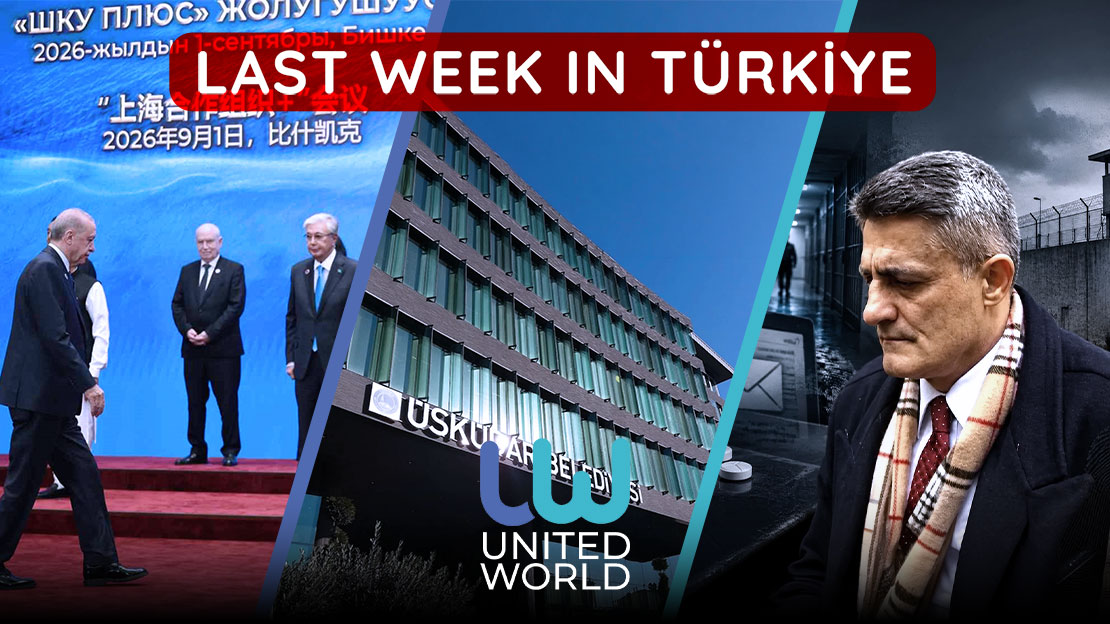
As always, Türkiye had a busy agenda last week.
President Recep Tayyip Erdoğan attended the Shanghai Cooperation Organisation summit held in Bishkek.
Following the detention of the opposition mayor of Üsküdar, a centrally located district of Istanbul, the municipality passed into the hands of the ruling party after a controversial election.
Another important development of the week was the reopening of the case concerning intelligence official Kaşif Kozinoğlu, who died in prison in 2011 while under arrest as part of the Ergenekon case.
Erdoğan attends SCO summit
President Recep Tayyip Erdoğan attended the Shanghai Cooperation Organization (SCO) Summit of Heads of State held in Bishkek, the capital of Kyrgyzstan, on September 1, 2026.
The summit brought together top-level representatives from numerous countries, particularly China, Russia, India and Iran.
The 25th anniversary of the organization’s establishment was also marked during the summit.
On the sidelines of the meeting, Erdoğan held bilateral and delegation-level talks with a number of leaders, including Russian President Vladimir Putin and Azerbaijani President Ilham Aliyev.
Responding to journalists’ questions, Erdoğan signaled that Türkiye could apply for full membership in the SCO, saying:
“It is possible for us to take our relations with the Shanghai Cooperation Organisation to a more advanced level in the coming period. Türkiye’s perspective on membership in the organization would never mean breaking away from one bloc or turning its back on the West. Our aim is to increase our own weight through a 360-degree vision.”
Erdoğan also delivered a speech at the summit. He described the SCO as one of the indispensable components of a multipolar order and underlined the organization’s scale in terms of population and economic strength.
In his remarks, Erdoğan also addressed some projects. Calling for greater coordination between the Middle Corridor initiative, which includes Türkiye, and China’s Belt and Road Initiative, Erdoğan stressed that Türkiye could play an important role in providing access to European markets. Similarly, he emphasized Türkiye’s role in diversifying energy routes and managing geopolitical conflicts. In this context, Erdoğan cited the Mecca Defense Agreement.
At the summit, the Bishkek Declaration was issued and 28 separate documents were adopted.
The joint declaration condemned attacks against Iran and placed particular emphasis on regional security.
It also announced decisions to strengthen cooperation among member states in the fields of security, energy, transport and climate change.
Controversial election in Istanbul
As judicial operations targeting opposition-run municipalities in Türkiye continue, the municipality of Üsküdar, one of Istanbul’s central districts, also changed hands following the arrest of Mayor Sinem Dedetaş.
Now, the government of the municipality has passed to the ruling party after a new election.
Üsküdar Mayor Sinem Dedetaş was arrested by a court on July 31, 2026, on charges including “bribery” and “establishing an organisation for the purpose of committing crimes.”
Following Dedetaş’s arrest, the Ministry of Interior suspended her from office, and the Municipal Council decided to hold a new mayoral election.
The election for the mayoralty had been held on August 5, and won by the opposition candidate Sibel Can Çetinkaya. However, following objections from the ruling party, the election was annulled. In the new election held on September 8, the ruling party’s candidate, Dündar Ziya Gültekin, emerged victorious.
During the election process, several CHP municipal council members, who had a new party leader appointed by court order, joined the AKP. Also, some of the remaining CHP council members did not vote for the joint candidate backed together with the New Parti.
The opposition described the process as a “plot” and an “intervention against the will of the electorate”.
CHP (Republican People’s Party) spokesperson Müslim Sarı said that two municipal council members had been arrested during the rerun process and thereby prevented from voting, describing the election as “a dark stain on Turkish political history.”
Suat Özçağdaş, an Istanbul MP from the New Party, criticized President Recep Tayyip Erdoğan’s approach to the election results, saying, “In Tayyip Erdoğan’s world, the national will exists only when he wins. If he loses, or if his candidates do not win, national will is to be respected.”
New Party’s Istanbul Provincial Chair Özgür Çelik claimed that four council members who had switched from the CHP to the AKP had been taken outside Istanbul before the election and prevented from contacting their families.
Kozinoğlu case reopened
The investigation into the suspicious death of former National Intelligence Organization (MİT) Chief Adviser for the Asia Region Kaşif Kozinoğlu at Silivri Prison in 2011 has been reopened after 15 years.
As part of the renewed investigation, prison personnel who were on duty at the time of Kozinoğlu’s death were taken into custody.
Kozinoğlu’s grave is also expected to be exhumed for further examination.
One of Türkiye’s prominent intelligence officials, Kozinoğlu was arrested in 2011 during the Ergenekon case.
Kozinoğlu died under suspicious circumstances while in prison.
Following his death, many alleged that the US-backed FETÖ (Fethullah Gülen Terrorist Organization) was behind his death, and some media reports suggested that FETÖ wanted to prevent Kozinoğlu from making allegations concerning Gülen in court by killing him.
The case, which had been closed in 2012 with a decision not to prosecute, was brought back onto the agenda following an examination by the Ministry of Justice’s Department for the Investigation of Unsolved Crimes.
On August 26, 2026, the Silivri Criminal Judgeship of Peace formally overturned the previous non-prosecution decision and ordered the investigation to be reopened.
Justice Minister Akın Gürlek said the following regarding the process:
“No matter how many years pass, we are determined not to leave any suspicious death in the dark. We are reopening cases that have raised questions in the public conscience, regardless of how much time has passed.”
As part of the investigation, security camera footage is being examined. It is reported that after Kozinoğlu became unwell in his cell and pressed the emergency button, on-duty prison guard Ferhat Veysi Gül turned up the volume of a radio in order to drown out the alarm, causing other prison officials to notice the incident only after a delay.
Gül was later found to have fled abroad following the failure of the July 15, 2016 coup attempt by FETÖ.
In addition, the claim that the ambulance called for Kozinoğlu was kept waiting unnecessarily is also among the allegations in the case file.
Following Kozinoğlu’s death, his confidential notes were published by Kaynak Publishing. The notes contained important information regarding links between the CIA and FETÖ.