


By Mehmet Enes Beşer
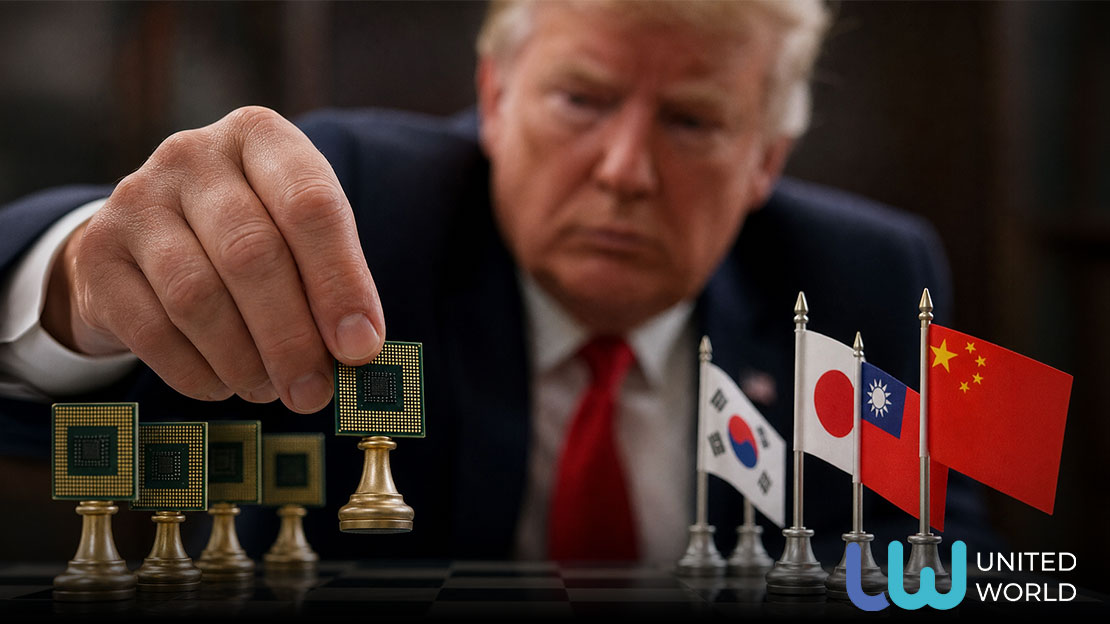
As far as one can see, the US plan regarding semiconductors follows an industrial approach based on national security concerns and techno-nationalism rhetoric. In this regard, supply chains need to be protected, domestic manufacturing promoted, and dependence on Asia reduced. These are the major elements of the policy package consisting of restrictions on the sale of semiconductors to China, prohibitions on specific companies like Huawei, subsidies for semiconductor manufacturing, and allied pressure on South Korea, Japan, and Taiwan.
It appears that we cannot consider semiconductors as some regular commodities used in manufacturing industries. As a matter of fact, producing integrated circuits is the most complex and globally integrated production in human history. The reality is that no country, including the US, can create advanced semiconductors alone. In this regard, there are different stages of supply chain that are characterized by cooperation among countries. In particular, design software comes from American companies, for example, Synopsys or Cadence. At the same time, nano-scale lithography equipment is made by Dutch suppliers. Moreover, Japanese companies dominate in the field of specialty chemicals and materials. Taiwan (TSMC) and South Korea (Samsung) take the first place in high-end fabrication. However, China remains significant despite falling behind in the production of advanced logic chips since it plays an important role in assembly and testing and has demand-side activities.
In this regard, it is necessary to note that the dominance of Asia in semiconductors emerged due to openness of these countries. Specifically, Taiwan offered political stability and a skilled engineering team to make it easy to use American intellectual property and Japanese inputs. South Korea developed the entire semiconductor ecosystem by means of state support and international cooperation. Besides, Singapore, Malaysia, and China also managed to join semiconductor chains due to international relations, market-driven approach, and investments.
First, the suggested US strategy tries to go against this trend at a time when complexities of the supply chain increase. For instance, constructing a high-tech factory in America takes much time and requires many expenditures. Although CHIPS Act is expected to provide a lot of money for it, Intel, TSMC, and Samsung still face problems associated with high expenses and shortage of qualified specialists. Building a single leading edge semiconductor fabrication plant requires at least $20 billions. Furthermore, it can operate several years later. What is more important is that the plant remains a part of the supply chain, and its isolation from the international context can be compared with planting a rainforest inside a dome.
Second, export control that was aimed at limiting China’s growth in semiconductors became counterproductive because it accelerated the development of independent manufacturing. As a result, Chinese companies are investing huge amounts of money in local solutions in this area due to state-led industrial policy and a huge domestic market. Moreover, such measures provoke strategic hedging of allies; for example, South Korea becomes uncomfortable with occupying a central position, and Japanese and Dutch firms begin considering the long-run consequences of restricting entry into their markets. Diplomatic policy of America in this field is seen as coercion.
From this point of view, the question is philosophical. Trump Administration’s strategy towards solving semiconductor problem is zero-sum game where interdependence equals vulnerability, while disengagement equals power. In this case, interdependence becomes underestimated, whereas innovation economics relies on knowledge transfers, global mobility of human capital, and standardized processes. Thus, isolations often become barriers to learning. Moreover, silicon walls do not allow getting not only danger but also opportunities.
Finally, this initiative has its generational aspects. As we mentioned earlier, developing an innovative chip industry requires a lot of time since the success depends on the availability of trained specialists, infrastructure, and industrial culture. It is also necessary to say that Asia succeeded in this sphere because apart from chip manufacturing, it invested in training engineers, protecting intellectual property, building clusters, and attracting global companies that integrate into effective ecosystems. In order to replicate this ecosystem in the US, it is not enough to spend money; patience and modesty are required as well.
Concluding, it appears that by engaging in a race with Asia, America may become a semiconductor island which is subsidized, strategically nervous, and structurally incapable. The traditional strength of America consisted in setting standards in global politics and forming alliances and attracting top talents. In other words, the cooperation was key factor in developing innovations in this sphere. Hence, abandoning the cooperation model is expected to lead to giving away leadership in innovation.