


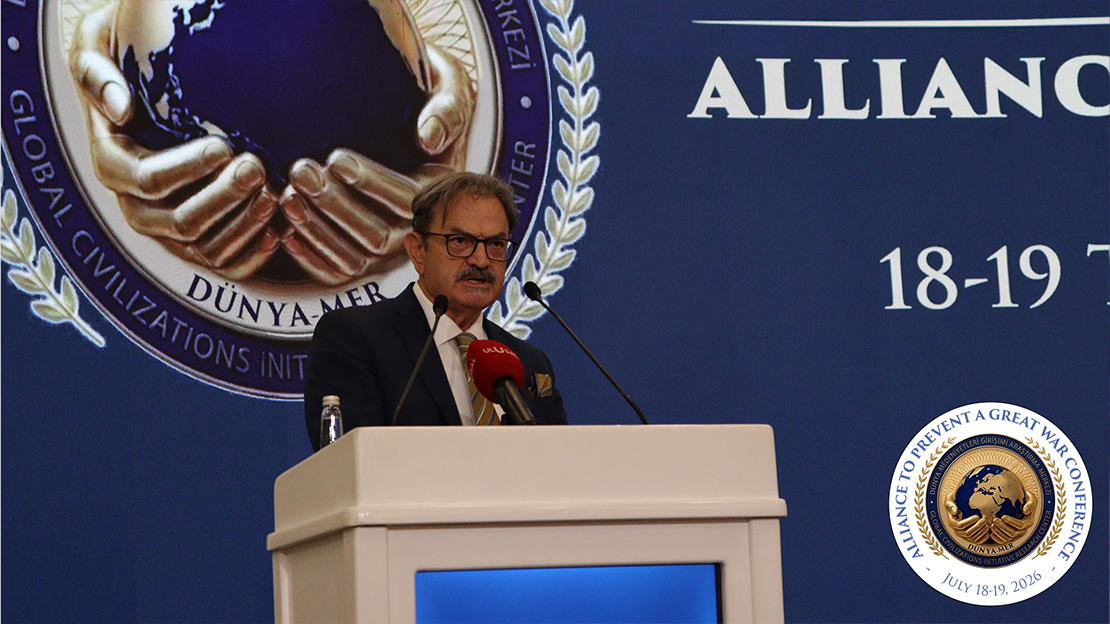
By Dr. Deniz Kutluk, retired Rear Admiral, Turkish Naval Forces
The international conference entitled “The Alliance to Prevent a Great War,” organized by the World Civilizations Initiative Research Center, was held at the Meyra Palace Hotel in Ankara on 18–19 July 2026.
UWI will present the speeches held on the conference during the coming days.
The conference, which featured presentations by speakers from Azerbaijan, Belarus, France, Germany, Greece, Iran, Italy, Japan, Russia, the Sahrawi Arab Democratic Republic, South Africa, Spain, Switzerland, the Turkish Republic of Northern Cyprus (TRNC), Türkiye, the United Kingdom, and the United States, was attended by approximately 200 distinguished invited guests.
Ministers, members of parliament, ambassadors, retired generals, scholars, politicians, diplomats, military officers, and experts examined the question of the “Alliance to Prevent a Great War” from a wide range of perspectives.
Below, we present the speech of Deniz Kutluk. The title was set by UWI.
I am delighted to be a speaker at such an invitation alongside distinguished panelists. I would like to thank the organizers.
I believe our first question should be this: What could be the reasons that might trigger a GREAT WAR? And secondly, what can we say about the mechanisms that will PREVENT it… Instead of presenting definitive conclusions, I aimed to touch upon a few thought-provoking and warning topics regarding the outcomes.
I am of the opinion that there could be 3 Scenarios regarding a Great War:
1st Scenario: The Russia-Ukraine war, which has entered its 5th year, could escalate due to Europeans offering encouragement and support for the continuation of the war despite the US, leading to a world war triggered by the deployment of tactical nuclear weapons against certain European capitals (Berlin and Düsseldorf, London-Warsaw, Baltic Capitals). Although Europe and Russia are actually geopolitical partners, they have tumbled into unstable relations, and it is observed that the EU lacks a fundamental response to this situation.
2nd Scenario: In the Gulf War, which was initiated by the second attack of the US and Israel against Iran, heavy losses occurred. Although a Memorandum of Understanding (MOU) aimed at guiding a lasting peace was signed a month ago, reciprocal attacks that began following the NATO Ankara Summit continue to escalate. Control over the Strait of Hormuz appears to be a zero-sum game. Israel, in order to overcome its deadlock in internal and external dynamics (Netanyahu feeding off aggression yet being stalled, its conventional military power diminishing, and the risk of losing power in the elections coming up within 3 months), might resort to nuclear weapons and subsequently be exposed to counter-nuclear strikes (Prof. Theodore Postol’s analysis, Iran’s declaration of intent regarding a nuclear threshold or deliberate ambiguity, and the existence of its external supporters). This could create drifts that trigger a world war between opposing poles, shaping the destiny of humanity.
3rd Scenario: In this transitional period where “the growing pains of shifting from unipolarity to multipolarity” are felt in every aspect, events and phenomena could lead to confrontational scenarios (Taiwan-China; sovereignty over the Arctic, the Greenland Dispute; Canada-US friction, etc.), and Military-Industrial Complexes could facilitate this. In the liberal economic order, “corporate” profit pursued with great ambition, along with the efforts of corporations to dominate politics for this sake, leaves this domain gray and exploitable.
I hope and estimate that none of these will come to pass. Nevertheless, I would like to explain my thoughts on the continuation of the subject within the scope of this Conference.
At this point, we must first talk about the North Atlantic Alliance, namely NATO, which seems to have provided peace and stability for its members and the world from the end of World War II to the present day.
I observe that every thinker holds different views regarding this organization, which possesses guidelines of encyclopedic proportions regulating its operations. As a retired military officer who was in contact with them across various international tiers for 6 years, a slight commentary is required from me at this point:
During the Cold War, NATO was able to protect the territorial integrity and nuclear defense of its 16 members against the Soviet Union and its supporters—which it perceived as a threat—without firing a single shot. After 1989, despite a non-existent Soviet THREAT and the dissolved Warsaw Pact (both dissolved in 1991), it managed to survive for 33 years. After 2022, the sought-after threat was reinstated in the form of Russia.
During this period, as long as member states reached a consensus, interventions could be executed with NATO’s integrated armed force pursuant to sanction or military intervention decisions taken by the UN Security Council—which was established after World War II and accepted as the guarantee of peace. In summary, by utilizing the global legitimacy umbrella of the UN, NATO projected military power in states and regions such as Yugoslavia (Serbia, Bosnia, Kosovo, North Macedonia), Afghanistan, Libya, Iraq, and Somalia.
Today, alongside 32 NATO members, there are 18 Partnership for Peace (PfP) members, 7 Mediterranean Dialogue members, 4 Istanbul Cooperation Initiative (ICI) members, and 9 Global Partners, bringing the total number of states in the NATO cooperation ecosystem to 70.
Currently, a very clear divergence and differentiation between Europe and the leader of NATO, the US, stands out prominently.
Divergent views on the Ukraine-Russia war; territorial demands from Denmark and Canada contrary to the protection of territorial integrity under NATO Article 5; the US conducting military interventions in the Persian Gulf following Israel without providing NATO with information or seeking its support; and the state claiming leadership behaving recklessly against International Law and treaties are distinct indicators that NATO is fracturing. The abnormal rate of increase (up to 5% of GDP) in members’ defense expenditures planned until 2030, rather than strengthening NATO unity, is of a nature that will deepen fragmentation as a result of competition between European and US arms manufacturers—moreover, Spain has already declared that it will not participate in these rates.
Today, regarding the future of NATO, there are views of “Dissolution,” “Transformation,” and “Europeanization,” with which I also concur.
Corporate States have also reached structures that strain peace. US President Ike Eisenhower was the first to draw attention to the potential impacts of defense companies on global peace and security in his famous farewell address. Today, this danger maintains its position as a risk pulling the world toward a third world war.
As NATO searches for its direction, if it dissolves or becomes marginalized, could a structure emerge to fill its place? For what reasons might it form, or fail to form? I would like to conclude my time by briefly examining this:
NATO was positioned upon an intense perception of an external threat; today, claiming the existence of a similar threat is quite difficult. However, if alliances are to reach a scale and power capable of military integration, the existence of a “common threat” is both a political and social perception requirement. (Otherwise, no country would attempt to allocate billions intended for its own development on behalf of an alliance; its leaders would be punished by voters and lose their political power.)
Today, there appears to be no “common threat”; therefore, the FORMATION OF ONE GREAT ALLIANCE cannot be secured either.
A LOOK INTO THE FUTURE
In an ideal world, an ideal Eurasian Alliance capable of preventing a major global war would go beyond being a mere military pact to become a “Central Eurasian Security and Development Architecture” that fuses geographical continuity, economic interdependence, and collective security into a single pot. Europe-Russia normalization could also be viewed as an integral part of this. But of course, we do not live in an ideal world…
A European-Russian compromise seems distant until elections are renewed in Europe, after which improvements should be expected. Which direction the US will take remains a deeper subject.
If a security umbrella focused on “deterrence” is to be envisioned once again, then organizations dealing with Economic and Logistics Transit Security, the Principle of Collective and Indivisible Security, and Diplomatic Arbitration and Veto Power will also be required. The inadequacy observed in the UNSC regarding the provision of peace following polarizations generates a necessity at this point.
However, existing formations are also deemed inadequate in this domain. The reasons lie within their structural frameworks:
Shanghai Cooperation Organisation (SCO): The SCO was initially established as a loose security forum focused on border security and counter-terrorism (Separatism, Extremism, Terrorism). It lacks a binding common defense commitment (similar to Article 5) like NATO. Its internal contradictions are significant.
BRICS – Why Inadequate?: BRICS is not a geopolitical or military alliance; it is an economic and trade platform. Its primary focus is de-dollarization, creating alternative financial mechanisms, and transforming global economic governance. The threat of a global war is prevented through military deterrence and crisis management rather than financial instruments. BRICS lacks a joint military command structure, an intelligence-sharing network, or a peacekeeping force to be deployed in times of crisis.
Collective Security Treaty Organization (CSTO) – Why Inadequate?: This Russia-centered military alliance possesses a regional and limited structure covering only specific countries in the former Soviet geography (Belarus, Kazakhstan, Kyrgyzstan, Tajikistan). It does not incorporate giant actors that determine the fate of Eurasia, such as China, India, Türkiye, or Iran. It is far from generating global-scale deterrence.
Organization of Turkic States (OTS) – Why Inadequate?: The OTS possesses immense geopolitical potential, identity-based, and cultural ties at the heart of Eurasia (on the Central Asia-Caucasus-Anatolia axis). However, in terms of military and economic scale, it has not yet evolved into a global center of gravity capable of balancing or preventing a direct clash among global superpowers (US-China-Russia) on its own.
Structures such as ASEAN (Association of Southeast Asian Nations) and QUAD (Quadrilateral Security Dialogue) are also important for understanding global geopolitical balances, yet both remain inadequate in preventing an all-out war due to their founding philosophies and structural limitations.
CONCLUSION
In conclusion, today’s global security situation—rather than transforming into a conventional World War III where major powers destroy each other’s mainlands with nuclear weapons—is in a period of evolution toward multipolarity.
In this context, it is poised to remain a hybrid global transition era centered on “War and Stagnation,” spanning over many years, where cold and hot phases are intertwined.
I stop here, thanking you for your attention. We can examine the continuation through questions.