


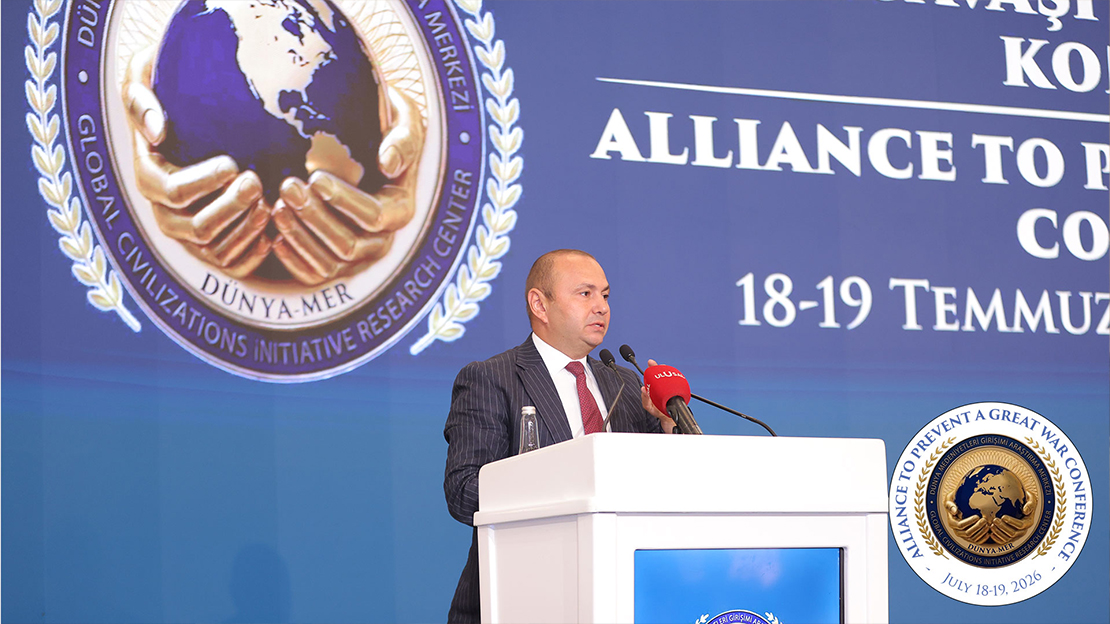
By Elshad Mirbashiroglu, Member of Parliament of Azerbaijan (6th Term)
The international conference entitled “The Alliance to Prevent a Great War,” organized by the World Civilizations Initiative Research Center, was held at the Meyra Palace Hotel in Ankara on 18–19 July 2026.
UWI will present the speeches held on the conference during the coming days.
The conference, which featured presentations by speakers from Azerbaijan, Belarus, France, Germany, Greece, Iran, Italy, Japan, Russia, the Sahrawi Arab Democratic Republic, South Africa, Spain, Switzerland, the Turkish Republic of Northern Cyprus (TRNC), Türkiye, the United Kingdom, and the United States, was attended by approximately 200 distinguished invited guests.
Ministers, members of parliament, ambassadors, retired generals, scholars, politicians, diplomats, military officers, and experts examined the question of the “Alliance to Prevent a Great War” from a wide range of perspectives.
Below, we present the speech of Elshad Mirbashiroglu.
Dear Colleagues!
Today, humanity is experiencing one of the most complex and contradictory stages of development since the end of the Cold War. The world has entered an era of large-scale geopolitical transformation, in which the stability of the previous international relations system is progressively diminishing while the architecture of a new world order is still in its formative phase.
Before our eyes, armed conflicts are intensifying, unilateral sanctions are becoming widespread, economic warfare is escalating, and international politics is becoming increasingly militarized. All of these indicators demonstrate that the contemporary world order is undergoing a profound crisis.
Many researchers believe that a significant portion of these processes stems from the desire of Western states to preserve their global political and economic hegemony. The expansion of military-political blocs, sanction pressure, interference in the internal affairs of sovereign states, the application of double standards in international relations, and the selective interpretation of international law are driving the further fragmentation of global politics.
However, alongside these developments, another equally significant historical phenomenon is taking place: the formation of a new geopolitical space in Eurasia. Today, Eurasia is becoming the primary hub for global economic growth, energy communications, transport corridors, and political initiatives. Here, new models of international cooperation are emerging, grounded in the principles of mutual respect for state sovereignty, non-interference in internal affairs, and consideration for the national interests of all participants.
Under these circumstances, strengthening cooperation among China, Russia, Türkiye, and Iran is of particular importance. Despite differences in their national interests and foreign policy priorities, these states advocate for the creation of a more multipolar international system in which no single power possesses an exclusive right to dictate the destiny of other nations.
As the world’s second-largest economy, China actively promotes the Belt and Road Initiative, establishing new transport and economic links across Asian, European, Middle Eastern, and African countries. Russia remains a key factor in ensuring strategic stability and security in the Eurasian region. Owing to its unique geographical location, Türkiye is becoming a vital transport and energy bridge between East and West. Despite years of sanction pressure, Iran retains its significant geopolitical importance connecting Central Asia, the Caucasus, the Persian Gulf, and the Indian Ocean.
It is essential to emphasize that it would be inaccurate to speak of a full-fledged military-political alliance among these four states. They possess both shared interests and distinct differences on specific regional issues. Nevertheless, expanding their cooperation across economics, energy, transport, security, and diplomacy objectively contributes to the formation of a more complex and less unipolar international system.
The joint development of transport routes—including the International North–South Transport Corridor—the expansion of trade settlements in national currencies, the development of energy projects, and the deepening of cooperation across various international forums serve to strengthen the economic interdependence of Eurasian states and reduce global instability risks.
Of particular importance is the growing role of international associations such as the Shanghai Cooperation Organization and BRICS, which are becoming key platforms for political dialogue, economic interaction, and the collective pursuit of solutions to pressing international issues.
Of course, increasing cooperation among China, Russia, Türkiye, and Iran does not automatically guarantee lasting peace on its own. International security depends on the willingness of all states to adhere to international law, respect one another’s sovereignty, and seek compromise solutions. At the same time, developing a partnership network among major regional powers can contribute to a more balanced system of international relations—one that distributes influence across multiple power centers and potentially reduces the likelihood of any single state or bloc monopolizing global politics.
Thus, modern Eurasia is not merely an arena for geopolitical competition, but also a platform for the formation of a new model of international cooperation. The future of global politics in the 21st century will largely be determined here. The ability of states to renounce confrontation, respect mutual interests, and build equal partnerships will dictate whether the 21st century becomes a new era of conflict, or an era of sustainable peace grounded in dialogue, mutual respect, and a just international order.
Thank you for your attention.