


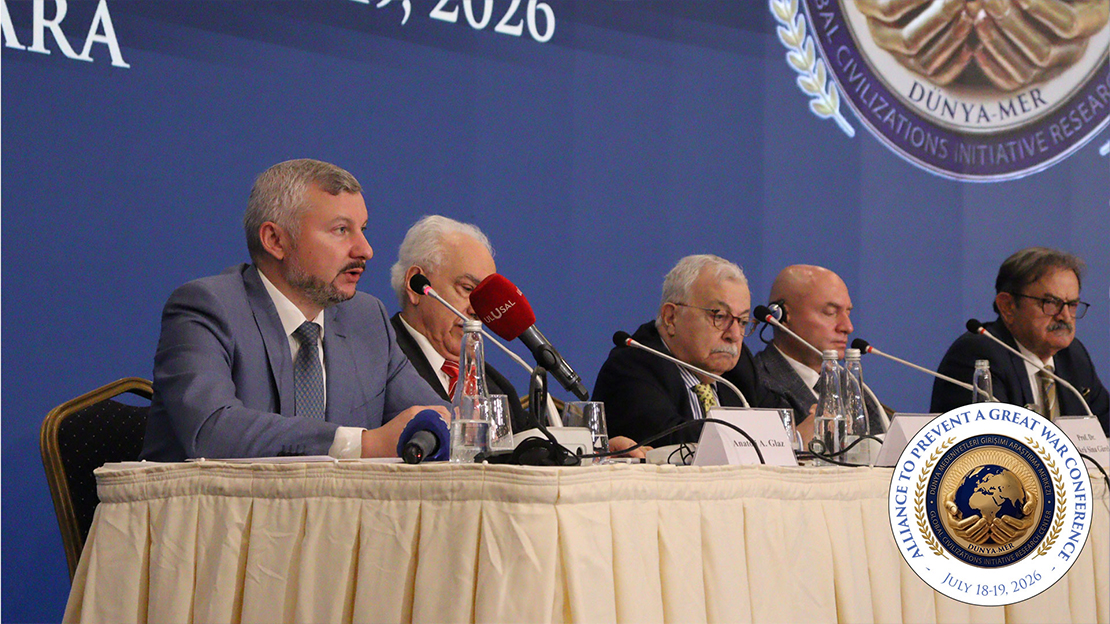
By Anatoli A. Glaz, Ambassador Extraordinary and Plenipotentiary of the Republic of Belarus to the Republic of Türkiye
The international conference entitled “The Alliance to Prevent a Great War,” organized by the World Civilizations Initiative Research Center, was held at the Meyra Palace Hotel in Ankara on 18–19 July 2026.
UWI will present the speeches held on the conference during the coming days.
The conference, which featured presentations by speakers from Azerbaijan, Belarus, France, Germany, Greece, Iran, Italy, Japan, Russia, the Sahrawi Arab Democratic Republic, South Africa, Spain, Switzerland, the Turkish Republic of Northern Cyprus (TRNC), Türkiye, the United Kingdom, and the United States, was attended by approximately 200 distinguished invited guests.
Ministers, members of parliament, ambassadors, retired generals, scholars, politicians, diplomats, military officers, and experts examined the question of the “Alliance to Prevent a Great War” from a wide range of perspectives.
Below, we present the speech of Anatoli A. Glaz. The title was set by UWI.
Distinguished organizers and participants,
I thank the DÜNYA-MER Research Center for the invitation and for raising the important question that has brought us together today.
Only a few days ago, Ankara hosted the NATO Summit, where participants discussed defense spending, arms production, new technologies and military readiness. Today, in the same city, we are discussing how to prevent a major war.
I see no contradiction here. These are two sides of the responsibility of every state. And where these two sides meet, we face the central question of modern diplomacy: how can we make sure that growing military capabilities never have to be used?
For Belarus, this is not a theoretical question. A war is taking place directly near our borders.
I will not repeat the lessons of history. Every Belarusian family knows them. I will say only this: Belarus lost one in every three of its people during the Second World War, around three million lives, and was almost completely destroyed. Our country therefore has a special moral right to speak about the need to prevent another global war.
Because of the conflict in Ukraine, unmanned aerial vehicles are now entering Belarusian airspace. Their routes may change because of electronic warfare systems, technical failures or other factors.
Each such aircraft is a test not only for our air defense. It is also a test of political restraint and, at times, a direct attempt to provoke a harsh response.
Belarus responds professionally. We will continue to repeat our unchanged objective: an isolated incident must not be allowed to develop into escalation between states.
However, on 17 June this year, the war came directly into the lives of Belarusian families.
A civilian bus was attacked in Russia’s Bryansk Region. It was travelling from the Belarusian city of Rechytsa to Gelendzhik in Russia. More than forty Belarusian citizens were on board, including children who were members of a youth football team.
As a result of this tragic and cowardly attack on civilians, a pregnant Belarusian woman was killed. Eight people were injured, including six children.
According to the competent Belarusian authorities, the bus was attacked by a drone of Ukrainian origin. On the same day, a similar aircraft was found in the Lelchytsy District of the Gomel Region of Belarus. According to the information released by our authorities, the position of the aircraft indicated that it had been moving from Ukraine towards Russia through Belarusian territory.
Belarus demanded an immediate and objective investigation and that those responsible be held accountable. We expect the truth to be established.
As you can see, the war reached Belarusian families not through direct combat, but through a civilian bus carrying children on their way to a holiday destination.
At this point, I must stress the responsible position of the Belarusian state.
Belarus will protect its citizens. But we will not allow the suffering of our people to be used as a tool for further escalation of the conflict and tensions in the region.
We will not make decisions under the influence of emotion or on the basis of false or deliberately planted information. We will not give in to provocations.
Restraint is not weakness. A responsible state must be able to stop before taking a step that would make a return to diplomacy impossible.
Let me now turn to regional military developments. I will speak without accusations, as a diplomat working with facts.
Every state has the right to ensure its defence. NATO describes its activities as defensive. The countries of our region explain their military measures by referring to concerns about their own security. We hear these explanations.
But let us look at the facts.
Around 10,000 United States troops are currently stationed in Poland, mainly on a rotational basis. A permanent US garrison and a forward corps headquarters have also been established there.
In Lithuania, Germany is deploying an armoured brigade. Once fully operational, it will include around 5,000 military and civilian personnel.
The members of the North Atlantic Alliance have confirmed their goal of spending 5 per cent of GDP on defence and security-related infrastructure by 2035. Here in Ankara, the NATO Summit announced new procurement worth more than 50 billion US dollars.
This creates a classic security dilemma.
One side describes its steps as defensive. The other sees them as a potential threat and responds with its own military build-up. The first side then sees this response as proof that its original concerns were justified.
The spiral continues. Spending grows, but the sense of security does not.
Let me ask a direct question: if our ability to produce weapons grows faster than our ability to talk to one another, are we really becoming safer?
Weapons are not the only danger. Another danger is becoming used to the very idea of a direct military confrontation.
We hear assessments that, within five years, military force could be used. We hear discussions about long-term confrontation.
I am not suggesting that those making such assessments want a war. Their warnings may be based on defensive concerns.
But when the scenario of direct confrontation moves from being unthinkable to becoming a normal part of political language, it may one day become part of military planning.
We must not allow a hypothetical war first to become established in our words and then to appear in official documents.
The task of diplomacy is not to deny risks. It is to prevent them from becoming a self-fulfilling prediction.
What is Belarus doing in practical terms?
On 26 June, another humanitarian exchange of prisoners of war between Russia and Ukraine took place on Belarusian territory – 160 people on each side.
Belarus provided the Novaya Guta border crossing, transport routes, hot meals, medical assistance and all necessary organizational support.
I would also like to stress that exchanges of prisoners and the return of the bodies of those killed regularly take place with the assistance of Belarus.
There is one kind of security arithmetic that counts percentages of GDP, missiles and troop numbers.
And there is another kind of arithmetic: how many people have been brought home.
I am convinced that the second must be the final purpose of the first. Otherwise, the first loses its meaning.
Let me give one more fact.
During the first six months of this year alone, more than 40,000 Ukrainian citizens entered Belarus. They came to visit relatives, deal with family and personal matters, seek temporary safety or resolve practical issues.
Since the beginning of the conflict, more than 320,000 Ukrainian citizens have entered Belarus.
We have never transferred responsibility for the actions of politicians and military forces to ordinary people. And we never will.
Let me now move from facts to proposals. I would like to identify four practical areas.
First, a mechanism to prevent incidents involving unmanned aerial vehicles.
There should be a rapid exchange of technical information about aircraft that have lost control.
Direct contacts should be established between military and border authorities.
Procedures are needed to provide warning about dangerous objects moving towards national borders.
And there must be a strict rule: no final accusations before the wreckage and flight path have been examined.
International organizations could help develop basic technical protocols.
Second, the restoration of mechanisms to reduce military risks.
These should include direct military communication lines, advance notification of major exercises, reciprocal exchanges of observers, contacts between air defense specialists, and a return to arms control and confidence-building measures.
Let me stress that this cannot be a one-sided gesture. Such mechanisms work only on the basis of reciprocity.
Third, humanitarian diplomacy.
Belarus is ready to continue supporting exchanges of prisoners, the return of the bodies of those killed, searches for missing persons, family reunification, and contacts between human rights commissioners and humanitarian organizations.
Fourth, political dialogue on a common security architecture.
Belarus and Russia have proposed the Eurasian Charter of Diversity and Multipolarity in the Twenty-First Century.
Let me clearly state our official position: the Charter is not an anti-Western project and is not intended as a military counterweight to NATO.
It is an open framework for discussing the indivisibility of security, sovereign equality, collective responsibility and respect for civilizational diversity.
It is an invitation to dialogue, not a completed treaty.
Finally, I would like to say a few words about the friendly country hosting us today.
Türkiye has built its foreign policy on the basis of its own sovereign decisions. It is a member of NATO, while at the same time maintaining working relations with Russia, Ukraine, Belarus, Iran, Western countries, the Middle East and Asia.
We fully respect this choice.
This diplomatic experience is unique. Türkiye’s geography and political capacity allow it to contribute to reducing tensions.
Belarus values its bilateral relations with Türkiye, which are based on mutual respect and trust.
I will end where I began: with the question of how to ensure that accumulated military power is never used.
Belarus will protect its territory and its citizens.
Belarus will not allow itself to be drawn into a war through provocations.
And Belarus will continue its humanitarian and diplomatic work – quiet and routine work, but work that brings people home.
A drone may lose its route. States have no right to lose their political direction.
The most reliable security system is not the one that can send more people to war. It is the one that can bring them home.
Thank you for your attention.